



Greeks are returning in record numbers to the island of Imbros in today’s Turkey 60 years after they were forced to emigrate to Greece and the rest of the world due to a campaign of discrimination and ethnic cleansing.
The Aegean island was primarily inhabited by ethnic Greeks since the Iron Age and had almost five and a half thousand Greek residents in the mid-1960s.
With the decision 35/27.3.1964 of the National Security Council of Turkey, massive expropriations of arable land began, open rural prisons were established, and teaching of the Greek language was prohibited.
The seven minority schools with almost 700 students and 30 teachers were closed. Soon, the island was devoid of young Greeks. Some headed for Istanbul, and the majority for Greece and countries in Europe, the Americas, and Australia.
Since then, the dream of all Imbrians was for the Greek community of the island to flourish again, and this could only be achieved in one way. Just as the closing of schools meant the flight of the island’s Greeks, their opening could mean their return.

The dream becomes reality for the Greeks of Imbros
For many years, the opening of the closed schools was a request and a dream at the same time of Imbrians everywhere. Pioneers in the campaign were the Ecumenical Patriarch Bartholomew, who was born on Imbros, and the Imbrian organizations of the Greek diaspora.
In January 2012, the dream became reality. The Turkish authorities approved the licensing request for a Greek minority school in Imbros.

In September 2013, after 49 years, the Primary School of Agioi Theodoroi, from which the Patriarch had graduated, reopened. Its first students were just four.
In 2015, the abandoned Greek school in Agridia village reopened as a Gymnasium and Lyceum after it had been repaired. Thus, Imbros obtained a complete primary four-year and secondary eight-year Greek education.
“Last year we had 18 students, of whom six graduated. The Gymnasium and Lyceum had thirty students, from which three graduated,” said Stelios Berberis, the director of the Primary Greek School of Agioi Theodoroi, speaking to Athens-Macedonian News Agency (AMNA) recently.”
The schools, which have the character of private schools, are operated by the Educational and Cultural Association of Imvros. They have a Greek expatriate director and a Turkish deputy director.
“Our cooperation is excellent,” said Berberis, who added that the Turkish language is taught by Turkish teachers and the Greek language by Greek expatriates or seconded to schools from Greece.
Couples return to Imbros

New couples decide to return to Imbros for permanent settlement. In 2000, there were only 200 mostly elderly Greeks living on Imbros. Today, their number is estimated to be around 700.
In the deserted village of Schinoudi, a Greek couple named Tryfonas and Garifalia recently opened a restaurant called “Falia Tavern.” Together with their daughters Marika and Kaiti, the family, whose roots are from Imbros, has now settled on the island.
“We will rebuild our village and other villages, and we will make Imbros what it was in the past,” they told AMNA.
“New couples returned to the island, some driven by love for their island and others by the financial crisis. The Greek language is heard again. And we hope that we will do even better,” the Metropolitan of Imbros and Tenedos, Kyrillos, said.
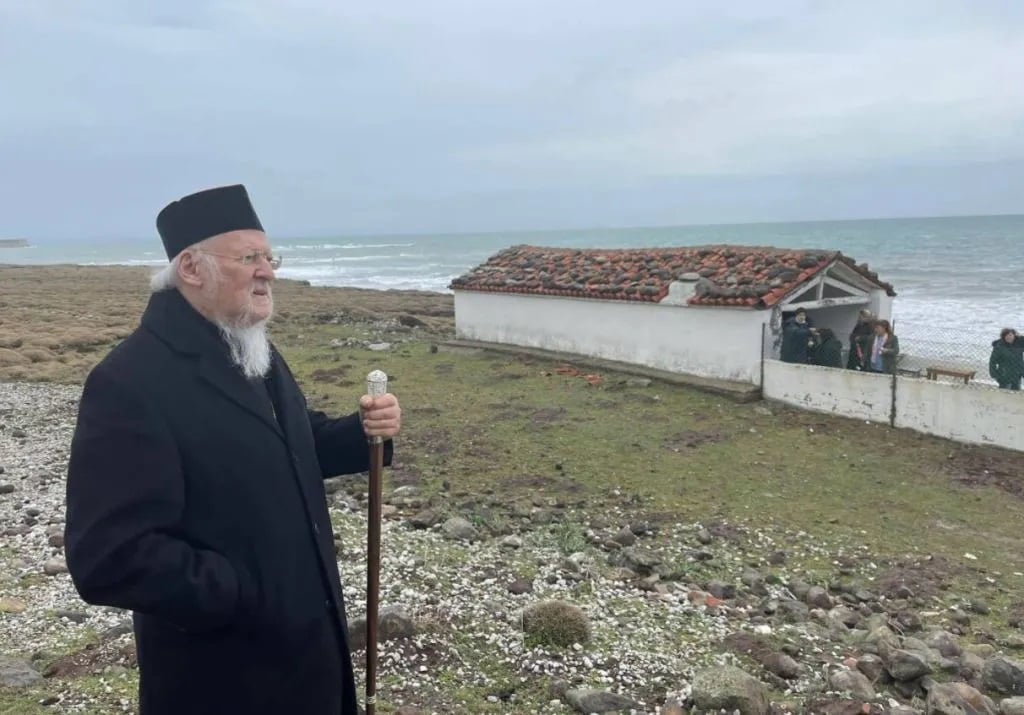
The Greek Orthodox chapels on Imbros that were left demolished and desecrated are gradually being restored.
Ecumenical Patriarch Bartholomew said recently, “For us Imbrians, every renovation of a chapel is a source of gratitude to the God of love.”
He added:
“Our small homeland had about three hundred chapels, located in the mountains, on the slopes, on the plains, and on our beaches. Most were demolished, desecrated, turned into stables, and disappeared from the face of the earth. Few survived, mainly those near or inside the settlements.”
Greeks on Imbros since antiquity
The Aegean island was Greek since ancient times, as Imbros belonged to the Athenian Alliance. According to Greek mythology, the palace of Thetis, the mother of Achilles, was situated between Imbros and Samothrace. The stables of the winged horses of Poseidon were said to lie between Imbros and Tenedos. Homer wrote in The Iliad:
In the depths of the sea on the cliff
Between Tenedos and craggy Imbros
There is a cave, wide gaping
Poseidon who made the earth tremble
stopped the horses there.
Imbros is also mentioned in the Homeric Hymn which was dedicated to Apollo, and Apollonius of Rhodes mentions Imbros in the first book of his work Argonautica.
In classical antiquity, Imbros—like Lemnos—was an Athenian cleruchy, a colony whose settlers retained Athenian citizenship. In 511 or 512 BC, the island was captured by the Persian general Otanes.
Later on, Miltiades conquered the island from Persia after the Battle of Salamis. The colony was established around 450 BC during the first Athenian empire and was retained by Athens for the following six centuries.
Thucydides, in his History of the Peloponnesian War, describes the colonization of Imbros and mentions in his narrative the contribution of Imbrians in support of Athens during various military actions. During the Social War (357-355 BC), the Chians, Rhodians, and Byzantians attacked Imbros, which was an ally to Athens.
Following the fall of the Byzantine Empire, Imbros was claimed by the Ottomans and the Venetians mainly because of its strategic position, as it is very close to the entrance of the Dardanelles Strait leading to the Marmara Sea.
Until 1920, Imbros belonged to the Ottoman Empire with a few thousand Greeks still residing on the island. After Turkey and Germany were defeated in the war, the 1920 Treaty of Sevres saw the island granted to Greece.
However, following the Asia Minor catastrophe, which resulted in the defeat of the Greek army, the Treaty of Lausanne transferred ownership of the island to Turkey. Island inhabitants were exempted from the compulsory exchange of populations called for in the treaty, and Greek minorities—as likewise agreed upon in the Treaty of Lausanne—were provided autonomy and protection. However, this immunity was violated by Turkey on multiple occasions.
Following the catastrophe, Greek buildings and sites were demolished as part of a massive colonization effort by Turkey. In 1955, Turkish fanaticism led to the persecution of Greeks living in Turkish territories along with the expropriation of any and all property owned by them.
On July 1, 1964, the Turks banned the teaching of the Greek language in schools. During that time, the schools of the island were all Greek, with seven operating Greek schools and approximately 693 Greek pupils attending.
Three decades of persecution followed, through a Turkification plan, which was systematically implemented according to a series of laws and decisions. As a result, the Greek population shrank dramatically.
See all the latest news from Greece and the world at Greekreporter.com. Contact our newsroom to report an update or send your story, photos and videos. Follow GR on Google News and subscribe here to our daily email!

