



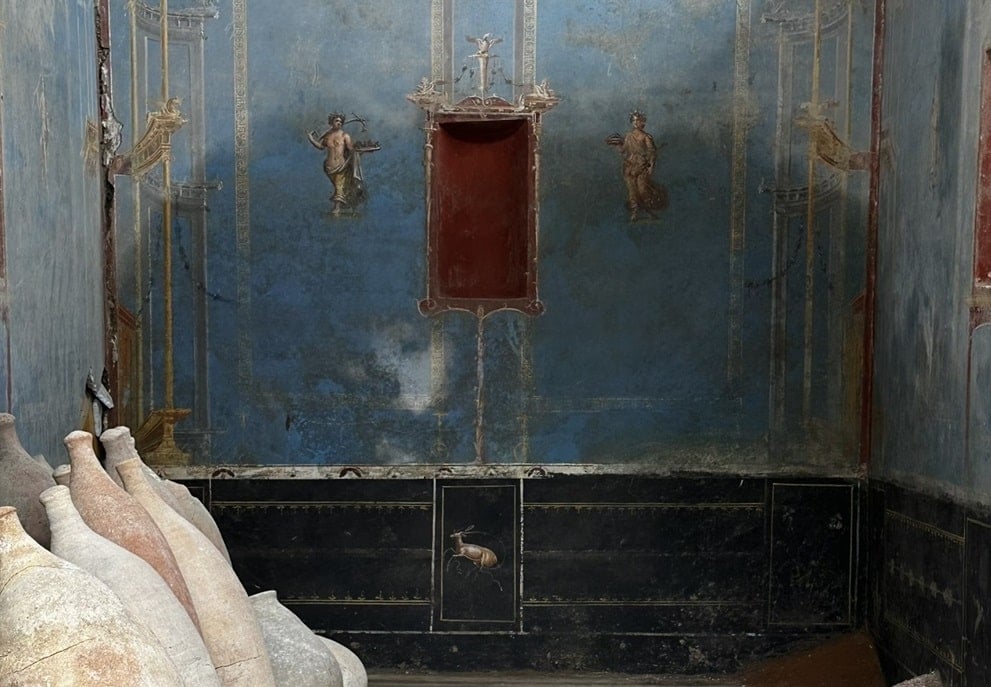
A new room with painted blue walls, a very rare color in Pompeii, has emerged during recent excavations in the central area of the ancient city.
The stunning blue-ground walls are decorated with female figures representing the four seasons and allegorical representations of agriculture and pastoralism, according to experts.
Construction materials, ready to be used in renovations, were also found at the site, as well as a pile of already consumed oyster shells, which according to archaeologists once crushed were probably added to plaster and mortar mixes.

Amphorae were also discovered in Pompeii’s blue room
Additionally, fifteen transport amphorae and a bronze set consisting of two jugs and two oil lamps were found in the room.
The excavation activities that led to the recent discovery are part of a larger project to secure a vast area that includes more than 13,000 rooms in 1,070 housing units.
“Pompeii is truly a treasure chest that never ceases to surprise us and arouses amazement because, every time we dig, we find something beautiful and significant,” says the Minister of Culture, Gennaro Sangiuliano.
Fresco of Trojan War
Just earlier this year, Pompeii archaeologists unearthed frescoes depicting mythological scenes inspired by the Trojan War.
It’s been described as one of the most striking discoveries ever made at the archaeological site in the south of Italy.
Mythical Greek figures such as Helen of Troy are depicted on the high black walls of a large banqueting hall.
In one, the god Apollo is seen trying to seduce the priestess Cassandra. Her rejection of him, according to legend, resulted in her prophecies being ignored.
The tragic consequence is told in the second painting, in which Prince Paris meets the beautiful Helen – a union Cassandra knows will doom them all in the resulting Trojan War.
Fresco of Greek siblings uncovered in Pompeii

Greek influence was strong in Pompeii, the ancient Roman city buried in an eruption from Mount Vesuvius in 79 AD, leaving its mark on the city’s art, architecture, and even religion.
The Romans adopted the Greek pantheon of gods, and Pompeii was no exception. Residents worshipped Zeus, Hera, Athena, and other Greek deities alongside their Roman counterparts.
Also recently a lavish fresco depicting mythological Greek siblings has been unearthed during an excavation in the ruins of Pompeii.
Still colorful after more than 2,000 years, the painting was among several frescoes found during restoration work around the mansion of the House of Leda.
Related: Children’s Graffiti Depicting Gladiators Found in Pompeii
See all the latest news from Greece and the world at Greekreporter.com. Contact our newsroom to report an update or send your story, photos and videos. Follow GR on Google News and subscribe here to our daily email!

