



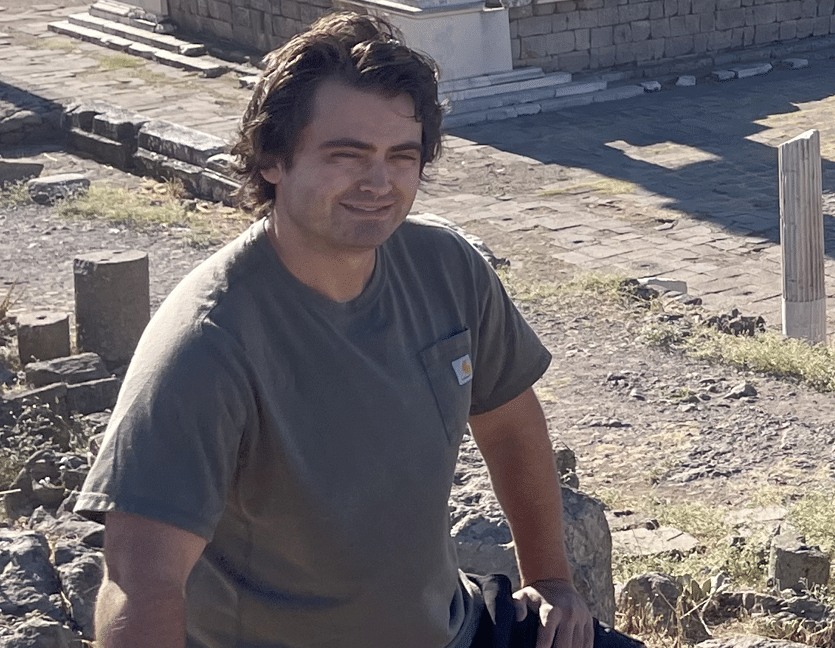
Greek Reporter caught up with The Hellenistic Age Podcast creator and host Derek Latal, who told us why he thinks the Hellenistic Age is such a special period of history, whether Alexander the Great was a good or a bad thing, and how he believes YouTube has transformed engagement with history as a subject.
Derek Latal is an extremely dedicated amateur historian of the Hellenistic Age, and you’ll probably know him from his podcast of the same name. He takes his audience through captivating discussions about the Seleucid Empire, Hellenistic literature, Greco Bactria, and many more topics, enhancing several episodes with the presence of knowledgeable, expert guests.
What’s more impressive is that Latal has a full-time sales job, meaning that all the research, planning, recording, and editing necessary for a successful podcast is performed by him in the evenings and on weekends.
What first struck me during our interview is that Latal really does know what he’s talking about when it comes to Hellenistic era history. He was able—given some fairly general questions about the period—to speak at length about the minutiae of certain events and figures, including a not-very-well-known Indo-Greek king named Menander I Soter, who Latal tells me is probably his favorite person from the time.

“Menander was part of the kingdom known as the Indo-Greeks. These are the Greeks who had moved from Bactria—approximately Central Asia, Tajikistan, and Afghanistan—and crossed the Hindu Kush to invade what is now modern Pakistan,” he explained. “They then established their own kingdoms there and were cut off from Central Asia, and from there they ruled for about another 150 years.”
Menander is perhaps considered the greatest of these kings. We know very little about him. He ruled around the year 155 BC, which is what his coin finds are. These provide the bulk of our information. These kings minted spectacular silver and bronze coinage.”
Latal continued: “Though Menander was very far away from the Mediterranean world, and we only know a little bit about him, it appears that information about him did make it to the Mediterranean territories. The geographer Strabo in the late first century had spoken of Menander as a great conqueror, conquering more peoples than even Alexander.”
“Whether that’s true or not is up for debate,” he admits, “but at the same time, there is evidence in Indian sources pertaining to the invasion of the Yavana, a transliteration for the Greek word “Ionian” referring to the Greeks living along Asia Minor.”
According to Latal, Menander did raid as far as Pataliputra, now the modern capital of Patna, in the lower Ganges. This was pretty much “the furthest extent of Greek military conquest at this time,” he said.
Latal added: “So we have this establishment of him as this kind of militaristic figure. There are coins of him waving a spear, clearly showing that martial prowess. His coins on the surface level appear to be Greek in design, he uses the patron deity Athena Akademos, the defender of the people, which is very much a symbol of the kingdoms of Macedonia.”
This story of an Indo-Greek king is one explanation as to why the Hellenistic Age is such an interesting period of history to study.
Why The Hellenistic Age podcaster thinks the period was so interesting
Latal tells me: “What I think is so interesting about the period is the level of interconnectivity between cultures, which I think is sometimes understated. There probably was more interaction, and conflict, and cooperation than what is believed.”
“I think what also makes it so fascinating is, in modern historiography, there was always a positive outlook towards the democracy of Athens or the republicanism of Rome, and most of the time the Hellenistic period was seen as this weird regression of culture, where everything appears to be based around monarchies,” he added. “But there’s also the other elements of colonialism, where newly-independent nations such as India viewed the Greeks as oppressors.”
Furthermore, the podcaster says:
“There is a bit of rehabilitation that the Hellenistic period needs because it does contain so many fascinating figures that make this period so colorful and I think it’s also important for listeners to understand what the value is of learning about cultures outside of the Mediterranean world to see how it expands beyond. This kind of study allows the perspectives of people to widen, even when studying places like Rome or Athens, because they are players, but they are players on a grand stage which these other parties are taking part on.”
Latal on Alexander the Great
I asked Latal for his thoughts on Alexander the Great and his campaigns. As to these, the podcaster said:
“I can’t help but deny that, in reading sources and biographies on him. I am drawn to Alexander as a figure, and his charisma definitely bleeds through the centuries. Figuring out the positives or benefits of his campaigns, or rule, is almost intrinsically tied to interpreting Alexander himself. There are an infinite number of equally valid interpretations: whether he was a conquering warlord who was only interested in glory and caused massive amounts of death and famine, or whether he was doing some good by linking cultures all the way from Macedonia to India.”

Latal says his thinking is somewhere in the middle. That is, he believes the word Alexander the Great occupied was “brutal, and competitive, and probably didn’t foster much in the way of goodwill.”
“I think a lot of Alexander’s decisions may have been inspired by benevolence: incorporating the local peoples and respecting the customs of certain areas, not forcing conversions,” he said. “But at the same time, this also worked to his detriment with his own Macedonian counterparts who may have seen him as favoring foreign, ‘barbaric’ cultures over them.”
Latal adds:
“But there’s a certain level of pragmatism in regards to a lot of Alexander’s decisions. It makes sense that he would use the institutions established by the Persians because that had worked for 250 years. One famous scholar even argued that Alexander was the last Achaemenid. He seems to have really taken on that role as the great king of Persia, although his Macedonian origins probably did come first and foremost.”
YouTube and podcasting on history
Speaking on the nature of YouTube, and how he thinks it has transformed engagement with history as a subject, Latal said, “It’s a genie in a bottle.”
According to Latal, YouTubing and podcasting has definitely opened up accessibility, not just for people wanting to learn but people wanting to create as well. “It is a double-edged sword,” he said. “On the one hand, you have people who are very passionate who may not come from academic backgrounds, but nevertheless are able to talk about topics they really enjoy.”
Moreover, Latal says audiences are likely attracted to the format because “it offers unique ways of visualizing battles and events, like total war, and shapes on a monochromatic background. Not to mention they can listen on the go.”

Latal then expanded on what he thinks the negative side of history through YouTube and podcasting is. “There’s a proliferation of people who—I wouldn’t say are doing this maliciously—but definitely come at things from a pseudo-historical perspective and talk about conspiracy theories, which has achieved a certain amount of popularity.”
According to the history podcaster, this would of course include things like ancient aliens, which was also on television, or the Nephilim giants, and just generally a lot of talk about how the mainstream are trying to shut the truth down.
Latal concludes that “this leads to a lot of misinformation. In fairness, history is not something that can always be agreed on, but these types come in and produce a sort of echo chamber and gain popularity with people just looking to validate their own opinions.”
If you want to listen to The Hellenistic Age podcast, you can access it through Derek Latal’s website: https://hellenisticagepodcast.wordpress.com/
See all the latest news from Greece and the world at Greekreporter.com. Contact our newsroom to report an update or send your story, photos and videos. Follow GR on Google News and subscribe here to our daily email!

