



From the bronze headgear of ancient Greek warriors to the steel helmets of medieval European knights, the most effective helmets in history combined protection with mobility, visibility and ventilation. Centuries of development produced increasingly sophisticated designs that protected the head, face and neck while maintaining freedom of movement.
In a historical ranking, the armet takes first place, followed by the sallet and bascinet. The selection also includes helmets from ancient Rome, medieval Japan and China, highlighting how different civilizations developed their own approaches to protective military equipment.
10. Roman Coolus and Illyrian helmets
The Roman Coolus helmet provided greater head and neck coverage than the earlier Montefortino design while retaining an open face. Generally made from copper alloys, it offered a balance between protection, visibility, ventilation, and mobility.
Sharing 10th place is the Illyrian helmet, an ancient design dating back to around the eighth century B.C. Later versions provided more extensive coverage of the head and neck. These improvements placed the Illyrian helmet alongside the Roman Coolus in the ranking.
9. Corinthian helmet
The Corinthian helmet was one of the most recognizable pieces of ancient Greek armor. Typically made of bronze, it featured extensive cheek coverage and a prominent nose guard, providing greater facial protection than many contemporary designs.

Its additional facial coverage earned it ninth place, ahead of the Roman Coolus. However, its enclosed construction restricted visibility and ventilation compared with the more open helmets favored by Roman soldiers. The two designs reflected different priorities in ancient military equipment.
8. Roman Imperial Gallic Type H helmet
The Imperial Gallic Type H ranks among the most effective helmets of ancient Rome. Generally manufactured from iron, it represented a significant development in Roman military equipment, offering more extensive coverage than earlier copper-alloy designs.
The helmet featured a pronounced neck guard while retaining an open face. Some Imperial Gallic variants also incorporated additional reinforcement around the forehead and crown. Its improved construction reflected advances in Roman metalworking and the continued development of military armor.
7. Medieval nasal helm with mail coif
The nasal helmet was widely used during the Middle Ages, particularly by Norman soldiers in the 11th century. Examples appear in the Bayeux Tapestry, which depicts the Norman conquest of England and the Battle of Hastings in 1066.
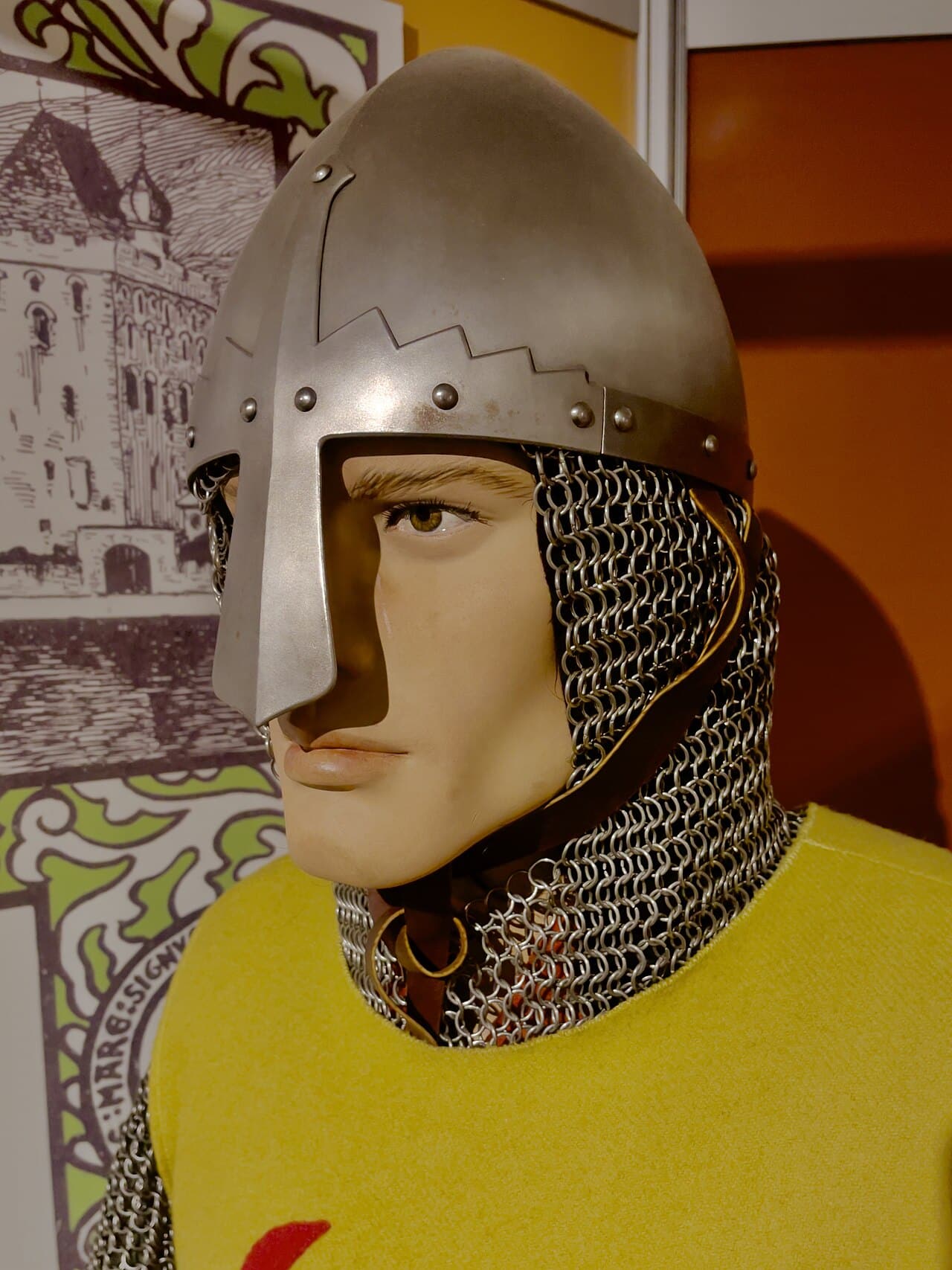
Its conical crown and distinctive nose guard were complemented by a mail coif, a hood made from interconnected metal rings. Together, the two pieces formed what is described as a “multi-layered defense system” that covered the head and neck.
6. Kettle hat: Among the most effective helmets of the Middle Ages
The kettle hat was a distinctive medieval helmet characterized by its broad brim and open face. Commonly associated with European infantry, it appeared in several variations, with differences in the shape and width of its brim.
Its open construction provided good visibility and ventilation without enclosing the face. Similar brimmed helmets appeared in China during the Song and Yuan dynasties, demonstrating that the general design was not exclusive to medieval Europe.
🪖 Western Europe helmets – from the Dark Ages to the Renaissance
🇩🇪🇮🇹 Spangenhelm — 4th–10th century (Germanic / Late Roman)
🇬🇧 Nasal Helmet — 10th–12th century (Norman / Anglo-Saxon)
⚔️ Great Helm — 13th–14th century (Crusader Knights)
🇪🇺 Kettle Hat — 13th–16th century… pic.twitter.com/Q4f8qlTrEt
— Cata Paul 🃏 (@CataPaul2) April 17, 2026
5. Japanese samurai helmet, or kabuto
The kabuto was among the most effective helmets associated with Asian warriors. Traditionally worn by Japanese samurai, it appeared in numerous forms, with iron and steel used in its construction.

Its distinctive features included overlapping sections extending around the sides and rear of the head, allowing flexibility and movement. Samurai could also wear a separate facial mask alongside the helmet. Comparable designs from China’s Jin dynasty received recognition in the same ranking, highlighting similarities between East Asian armor traditions.
4. Medieval great helm
The great helm became closely associated with European knights and men-at-arms during the Middle Ages. Early versions featured a flat crown, while later designs incorporated a rounded or pointed upper section known as the sugarloaf style.
The later sugarloaf version takes fourth place in the ranking. Some great helms were large enough to accommodate a separate iron cap underneath. Although the enclosed construction provided extensive coverage, its narrow openings restricted visibility and ventilation compared with more open helmet designs.
Great helm, Heaume, Topfhelm, 14th century. Iron. Germanisches Nationalmuseum, Nuremberg. pic.twitter.com/EzVV2LOuzw
— Archaeology & Art (@archaeologyart) September 13, 2020
3. Bascinet
The bascinet became a prominent feature of European armor during the 14th and early 15th centuries. One of its best-known variations featured a projecting visor commonly called a “houndskull” because of its resemblance to an animal’s muzzle.

Unlike the traditional great helm, many bascinets featured movable visors that allowed the face to be uncovered without removing the entire helmet. They were also commonly accompanied by mail covering the neck and shoulders. The design marked an important development in medieval armor.
2. Sallet
Although commonly associated with German Gothic armor, the sallet originated in Italy and became widespread across Europe during the 15th century. German versions were particularly recognizable for their elongated rear sections, sometimes constructed from several separate metal plates.
The helmet could be accompanied by a separate piece of armor called a bevor, which covered the lower face and throat. Its distinctive shape, movable components, and adaptability helped establish the sallet as one of the defining helmet designs of late medieval Europe.
Since you asked, here is a cool angle of the late 15th-century sallet belonging to Maximilian I. https://t.co/H0sYCT0RaE pic.twitter.com/HQv2MBJS0o
— Medieval Diesel (@TimothyEveland) January 26, 2026
1. Armet
The armet tops the ranking of the most effective helmets of all time. Closely associated with 15th-century Italian armor, it featured hinged cheekpieces, a movable visor, and an enclosed steel construction.

Some armets incorporated an additional facial defense known as a wrapper. Experts describe the design as having the “best of all worlds.” The armet’s versatility earned it first place.
See all the latest news from Greece and the world at Greekreporter.com. Contact our newsroom to report an update or send your story, photos and videos. Follow GR on Google News and subscribe here to our daily email!

