



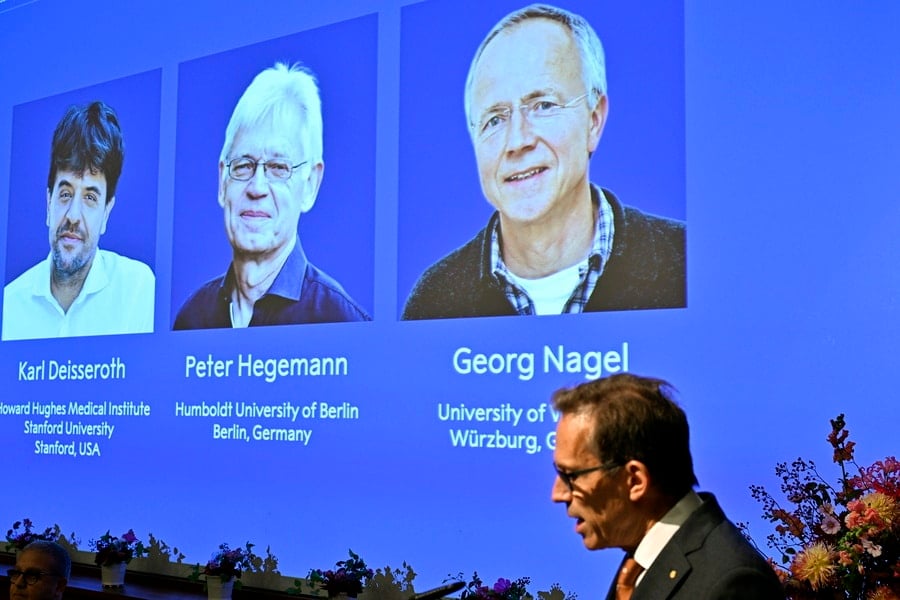
Karl Deisseroth, Peter Hegemann and Georg Nagel have won the 2026 Nobel Prize in Physiology or Medicine for discoveries that led to optogenetics, a revolutionary technique that allows researchers to control individual nerve cells in the brain using light.
The Nobel Assembly at Sweden’s Karolinska Institutet announced the award on Monday, recognizing the three scientists “for their discoveries concerning light-gated ion channels and optogenetics.”
The technique has transformed neuroscience by giving researchers a way to switch specific nerve cells on or off and observe how they affect memories, emotions, behavior and bodily functions.
Their work adds to the long history of discoveries recognized by the Nobel Prize in Medicine, including breakthroughs involving vaccines, genetics and the immune system.
“Optogenetics provides opportunities for mapping the brain in a way that we could once only dream of,” Per Svenningsson, chair of the Nobel Committee for Physiology or Medicine, said.
How optogenetics uses light to control brain cells
The breakthrough began with research on a tiny single-celled green alga called Chlamydomonas.
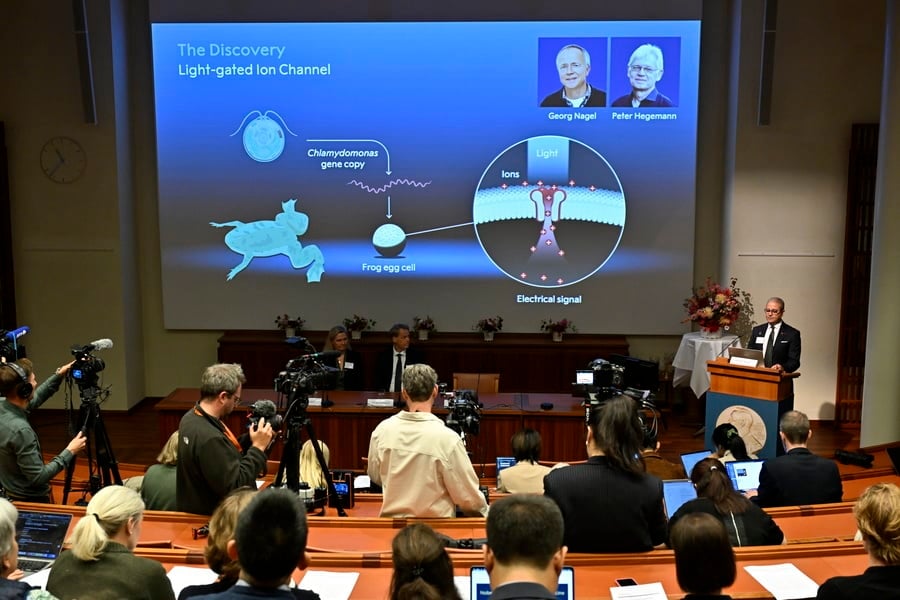
Peter Hegemann and Georg Nagel studied how the microorganism detects and moves toward light. Their work helped uncover channelrhodopsin, a light-sensitive protein located in the cell membrane.
When channelrhodopsin is exposed to blue light, a channel in the protein opens and allows electrically charged ions to move through the cell membrane, generating an electrical signal.
The researchers discovered that introducing the protein into other types of cells could make those cells sensitive to light as well.
Karl Deisseroth then took the discovery into neuroscience.
He introduced the gene for channelrhodopsin into rat nerve cells and demonstrated that flashes of blue light could trigger electrical activity in the neurons. The breakthrough was published in 2005.
Two years later, Deisseroth showed that the technique could work inside the brains of living mice.
The resulting method became known as optogenetics, combining genetic techniques with light to control precisely selected cells.
Unlike older methods of stimulating the brain, optogenetics allows scientists to target particular populations of neurons with extraordinary precision.
Researchers can activate or silence certain nerve cells and then observe the consequences, allowing them to investigate cause-and-effect relationships within neural circuits.
A new tool for understanding the brain
Optogenetics has since become a standard research tool in neuroscience laboratories around the world.
Scientists have used it to identify neural circuits involved in memory, fear, motivation and behavior, while also studying brain mechanisms connected to neurological and psychiatric disorders.
The Nobel committee said the method made it possible to investigate how particular nerve cells contribute to memories, feelings and behaviors in the living brain.
The technology is also being investigated for potential medical applications. Researchers have explored optogenetic approaches aimed at restoring vision in people with certain forms of visual impairment.
The work fundamentally changed how scientists can investigate one of biology’s most difficult questions: how billions of interconnected nerve cells produce thoughts, emotions and behavior.
Understanding the brain has challenged physicians for thousands of years. Ancient Greek thinkers were among the earliest to argue that the brain, rather than the heart, was responsible for thought and sensation, helping establish ideas that would eventually contribute to modern neuroscience and brain surgery.
The three 2026 Nobel laureates
Deisseroth, 54, is an American scientist, physician and professor at Stanford University whose research has focused on developing technologies for understanding the brain and its neural circuits.
Hegemann, 71, is a German biophysicist and professor at Humboldt University of Berlin. His research into microorganisms and their responses to light was crucial to identifying the properties of channelrhodopsins.
Nagel, 73, is a German biophysicist and professor at the University of Würzburg whose work on microbial photoreceptors helped establish the biological tools that ultimately made optogenetics possible.
The three scientists will share the prize of 12 million Swedish kronor, roughly $1.2 million.
The Nobel Prize in Physiology or Medicine traditionally opens the annual week of Nobel announcements. The prizes in physics, chemistry, literature and peace will follow, with the economics prize announced afterward.
Recent medicine prizes have also recognized discoveries with major implications for modern healthcare. In 2023, Katalin Karikó and Drew Weissman received the award for discoveries that enabled the development of effective mRNA vaccines against COVID-19.
The laureates will formally receive their Nobel medals and diplomas in Stockholm on December 10, the anniversary of the death of Alfred Nobel.
The Nobel Prizes have been awarded since 1901 under the terms of the Swedish inventor and industrialist’s will.
See all the latest news from Greece and the world at Greekreporter.com. Contact our newsroom to report an update or send your story, photos and videos. Follow GR on Google News and subscribe here to our daily email!

