



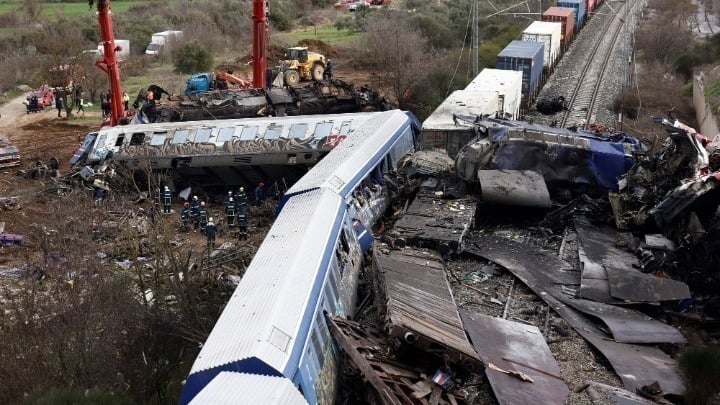
A Greek judicial council has found sufficient evidence to send former deputy minister Christos Triantopoulos and four other officials to trial over interventions at the site of the 2023 Tempi railway disaster that judges say resulted in the loss of important evidence.
The case concerns work carried out in the days after the deadly head-on collision between a passenger train and a freight train at Tempi in central Greece. The February 28, 2023 disaster killed 57 people and became one of the country’s most consequential tragedies in recent decades.
A 204-page judicial ruling details what investigators say happened at the crash site while the criminal investigation was still at an early stage. The Judicial Council points to the removal of about 300 cubic meters of soil and other material, as well as subsequent work that covered parts of the site with gravel and crushed asphalt.
According to the council, the interventions were capable of obstructing investigators and contributed to the loss of evidence from the scene. Five people, including Triantopoulos and former Thessaly regional governor Kostas Agorastos, face accusations of breach of duty.
300 Cubic Meters Removed From Tempi Crash Site
A central part of the ruling concerns work conducted between March 2 and March 7, 2023.
According to the council, workers using trucks removed approximately 300 cubic meters of soil (10,600 cubic feet) from the site, together with material and objects contained within it. The ruling notes that criminal proceedings and a prosecutor’s order for a main investigation had already been issued by then.
The council says the investigation and collection of evidence remained at an early stage and that people were still missing. Passenger Erietta Molho ultimately remained unaccounted for.
The judges say the five defendants acted without obtaining consent from the competent judicial authorities.
According to the ruling, Evangelos Falaras instructed the operator of a company working at the scene to remove at least 300 cubic meters of soil and aggregate, along with wreckage from the two trains. The council says the other four defendants failed to intervene despite knowing that the work was taking place and having a legal obligation to act.
Gravel and Crushed Asphalt Placed Over Parts of Site
The ruling separately examines work carried out between March 4 and March 8.
According to the council, Agorastos instructed the contractor to lay gravel and other material on a road at the crash site and to cover part of the ground with crushed asphalt.
The judges say Triantopoulos did not intervene to stop the work despite having a legal obligation to do so.
The council also notes that cleaning and ground-stabilization work had already taken place, meaning that, in its assessment, the original reason for bringing regional excavation machinery to the site had already been fulfilled.
Judges Say Important Evidence Was Lost
The Judicial Council concluded that the removal and resurfacing work changed the crash scene in ways that could hinder investigators from gathering crucial evidence and preserving traces connected to the disaster.
The ruling specifically identifies passenger belongings, fragments and remains of the trains and their systems, and biological material among what was contained in the soil that was removed.
According to the council, some of that biological material could have been valuable in identifying victims.
The council says the interventions contributed to the loss of significant evidence and later made additional expert examinations necessary. It also found that victims and their families were harmed because they were deprived of evidence that could have been used in exercising their legal rights before criminal and civil courts.
Five Officials Named in Tempi Case
Alongside Triantopoulos and Agorastos, the ruling names former Civil Protection Secretary-General Vasilis Papageorgiou, then-Larissa Police Directorate chief Agapios Charakopoulos and Evangelos Falaras.
The document sets out the responsibilities each held at the time. Triantopoulos had duties involving the coordination of ministries and agencies as well as additional responsibilities for monitoring and coordinating actions at the crash site.
Agorastos, as regional governor, was responsible for coordinating regional operations, while Papageorgiou also had coordination responsibilities as secretary-general for Civil Protection.
Charakopoulos had responsibilities that included protecting the scene so evidence, traces and other findings could be preserved for investigators. The ruling states that Falaras’ responsibilities were limited to freeing passengers from the train and collecting and transporting bodies.
Triantopoulos Request Rejected
The Judicial Council rejected a request by Triantopoulos for further investigation and another examination of witness Ioannis Bratakos.
Triantopoulos had sought clarification over whether the additional responsibilities assigned to him on March 2, 2023, included coordination and direction at the scene. The council found that the evidence already collected was sufficient. In reaching that conclusion, it pointed in particular to Triantopoulos’ own press releases and interviews concerning the additional duties he had been given.
Separate Case Involving Fire Service Personnel
Another part of the ruling concerns three lower-ranking fire service officers and a separate alleged act involving Falaras.
That part of the case will be separated and sent to the Larissa prosecutor because the council determined that those alleged acts fall under the jurisdiction of the regular criminal courts.
The ruling also describes alleged failures during a March 1 inspection of the crash scene.
According to the council, the three firefighters failed to adequately establish the original source of the fire, examine traces, collect other potentially important evidence and promptly request necessary chemical or other tests.
The council says those omissions resulted in an inadequate initial inspection report and subsequently required a supplementary report and numerous additional investigative steps, including expert examinations and sampling.
Triantopoulos Case Heads to Special Court
The Judicial Council ultimately found sufficient indications supporting charges of breach of duty against the five defendants.
In Triantopoulos’ case, the council determined that the alleged conduct occurred while he was carrying out his official duties. That finding places his case within the jurisdiction of Parliament and Greece’s Special Court.
The council said the alleged actions and omissions forming the offense were directly connected to the performance of his ministerial responsibilities.
See all the latest news from Greece and the world at Greekreporter.com. Contact our newsroom to report an update or send your story, photos and videos. Follow GR on Google News and subscribe here to our daily email!

