



When a Greek city-state hit a crisis, such as a period of famine, a plague, or a bad outcome in a war, the solution was almost embarrassingly direct. They picked a person, loaded every bit of the city’s misfortune onto them, and marched them out of town. On the island of Leucas (today’s popular tourist destination of Lefkada), this became even more theatrical: People would tie feathers to their scapegoat and push him off a cliff.
It is tempting to read that and feel a little superior than them. Nobody is feeding unlucky volunteers to the cliffs of Lefkada anymore. But if we look closer, we will see that the instinct never actually went away. We just moved it indoors, gave it a Wi-Fi connection, and let it run all day, every day.
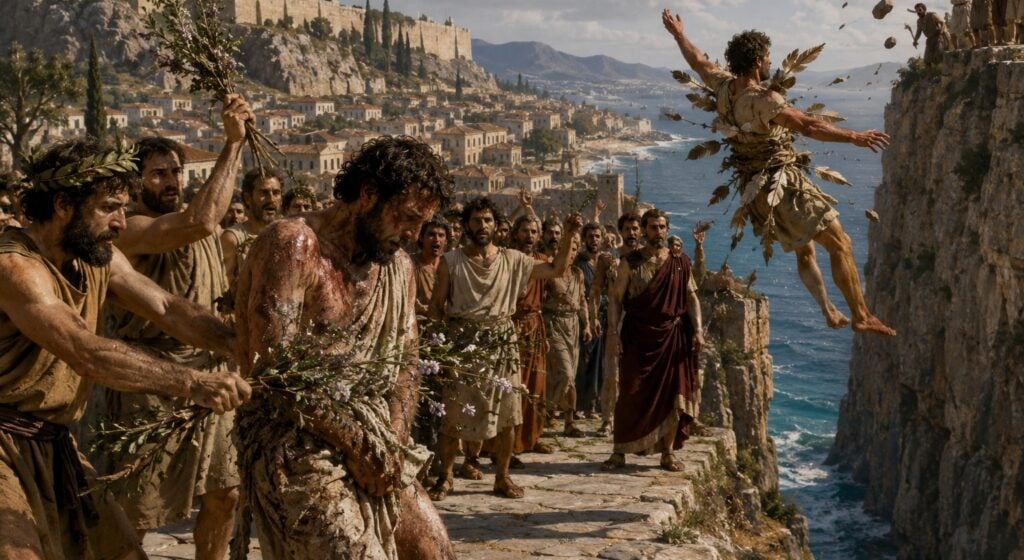
The ancient Greeks had a name for this person: the pharmakos. The word shares a root with pharmakon, which means both “remedy” and “poison” at once—the same root that eventually gives us “pharmacy.” That double meaning reveals everything about how the role worked. The pharmakos was the human equivalent of a sponge, something you press against a mess so it soaks up what you don’t want to deal with yourself.
During the Thargelia festival in Athens, the city would pull people from its margins, parade them through the streets, and strike them with squill branches and wild fig twigs before sending them out beyond the city walls.
Nobody seriously believed the pharmakos caused the drought or summoned the plague. Their only crime was being chosen for quite literally not being successful in their lives. But for a population that was frightened and looking for somewhere to put that fear, watching someone else carry it out of town was apparently enough. The anxiety needed a destination, and the pharmakos was it.
How the ancient Pharmakos became the modern cancel culture
Fast forward 2500 years later and we can see the internet, a digital sphere where we are doing the exact same job the Athenian Agora used to do, just at a scale the Greeks couldn’t have imagined.
X, TikTok, and Reddit have replaced the city square, and like ancient Athens, this square never really settles down. Economic uncertainty, political noise and polarisation, and the sheer exhaustion of being alive right now all generate a kind of background noise of collective anxiety. That tension doesn’t easily dissipate. It has to go somewhere. And when it builds up enough, the algorithm starts looking for a place to put it.
That is where the Cancel Culture comes in, which is just the pharmakos with a fast internet connection. We no longer hunt for the poorest person in the village to drag through the streets. We wait instead for someone to slip up, post something cringeworthy, or phrase an opinion badly enough to go viral for it. The moment a target is identified, the digital gates close around them, and the same old ritual starts again, just with comment sections and scathing TV reports instead of squill branches.
The unsettling part is not so much that this happens. Some people had indeed to be “cancelled” in the last few years. It is how familiar it would have looked to someone standing in the Agora twenty-five centuries ago. They would most probably recognize the fear underneath it immediately. We have swapped feathers and cliffs for screenshots and quote-tweets, but the basic transaction hasn’t changed: find someone to carry the discomfort so the rest of us don’t have to sit with it. The Greeks at least had the decency to admit what they were doing was a ritual. We tend to call ours simply “public opinion.”
Related: Ancient Greeks Used Scapegoats to Purify Cities in Times of Crisis
See all the latest news from Greece and the world at Greekreporter.com. Contact our newsroom to report an update or send your story, photos and videos. Follow GR on Google News and subscribe here to our daily email!

