



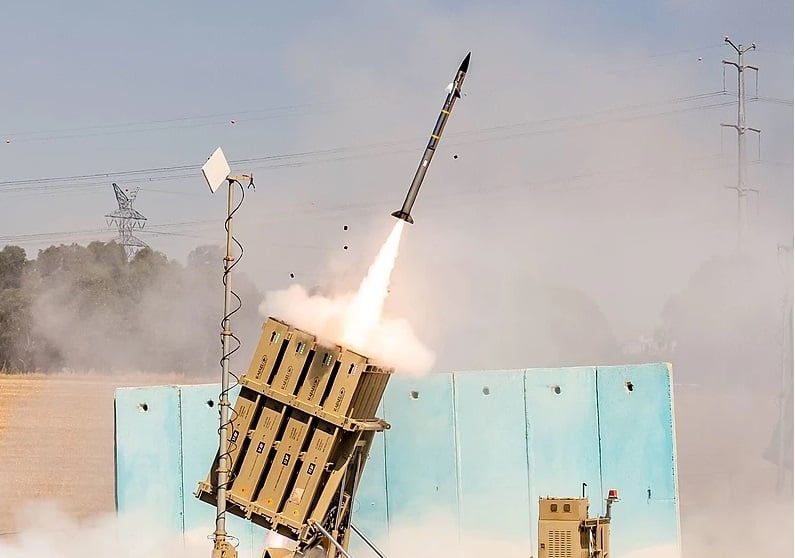
Greece’s €3.035 billion ($3.53) agreement with Israel for the Achilles Shield air-defense network has raised a critical question: Will Athens possess the software source code needed to modify and develop the system independently?
The available public information does not support a simple answer. An Israeli official has said that Greece will not receive the source code associated with the command-and-control capabilities. Greek military sources, however, reportedly insist that full access is explicitly included in the agreement.
Because the contract and its technical annexes remain confidential, neither version can be independently confirmed.
What Greece is buying
Signed in Tel Aviv on August 31, 2026, the agreement covers a multilayered network intended to defend Greece against aircraft, ballistic missiles, rockets and drones.
The planned architecture includes the SPYDER, BARAK MX and David’s Sling air-defense systems, Israeli-made radars and a central command-and-control network. That network will connect the different sensors and weapons, assess incoming threats and help determine the appropriate response.
Achilles Shield is therefore not one weapon with one piece of software. It is a network of different systems, each potentially governed by separate licensing, security and intellectual-property restrictions.
This distinction is central to the dispute. Greece could receive access to some software components or interfaces without obtaining the complete source code for every Israeli system.
Greece presented source-code access as a priority
Before the agreement was signed, Greek Defense Minister Nikos Dendias repeatedly emphasized the importance of technological control over newly acquired defense systems.
On August 30, one day before the signing, Dendias said Greece placed particular importance on access to the source code, alongside technology transfer and Greek industrial participation.
The stated objective was to ensure that Greece would not remain merely a customer and operator of foreign weapons. Athens wanted Greek companies and military specialists to participate in the production, development and future evolution of the systems.
That position created the expectation that source-code access was a condition of the agreement.
The Israeli official’s direct answer
The controversy followed an interview with Moshe Patel, director of the Israel Missile Defense Organization and one of the officials involved in preparing the agreement.
Asked whether Greece would have access to the source code connected to the command-and-control capabilities, Patel answered: “No. Because the source code was not part of the licensing agreement.”
He added that Israel would provide technical support, maintenance and any assistance required in the future.
Taken literally, Patel’s statement means Greece will not receive the source code for at least the command-and-control technology discussed in the interview. It also suggests continued reliance on Israeli suppliers for some upgrades, modifications or technical interventions.
However, it does not necessarily establish that Greece will lack access to every software component across the entire Achilles Shield architecture.
“Joint use of software,” “technology transfer” and “access to source code” are not interchangeable terms. A country may be authorized to operate and configure software, connect approved systems and receive updates without possessing the underlying code or having the right to modify it independently.
What source-code access actually means
Possessing source code can allow specialists to inspect how software works, identify vulnerabilities and develop modifications. But possession alone does not guarantee complete technological sovereignty.
Greece would also require the legal right to modify the code, full technical documentation, development and testing tools, access to encryption and security components, and permission to integrate new weapons and sensors.
There may also be restrictions covering individual systems. David’s Sling was developed with substantial US involvement, and some connections with third-country or NATO systems require American approval. Different conditions may apply to SPYDER, BARAK MX and the national command network.
It is therefore possible that both sides are referring to different parts of the system. Patel may have been discussing protected Israeli command-and-control code, while Greek sources may be referring to access involving the overarching Greek network, selected modules or interfaces specifically developed for Greece.
That possibility remains an interpretation, not a confirmed explanation.
Does Israel retain a “kill switch”?
Claims that Israel will be able to deactivate Achilles Shield remotely go beyond the available evidence.
Not receiving complete source code would create a degree of dependence on Israeli companies for maintenance, updates and major modifications. It would not, by itself, prove that Israel could remotely disable the system.
The existence of such a capability would require separate technical evidence. None has been made public. The legitimate issue is not whether Israel secretly controls a shutdown button, but whether Greece can maintain, secure and develop a strategically vital defense network without requiring continuing foreign authorization or assistance.
What is established and what remains unknown
Several facts are clear.
Greece and Israel have signed a €3.035 billion agreement for a multilayered air-defense architecture. The program includes Israeli interceptors, radars and command-and-control technology. Greece has also secured industrial participation exceeding 25 percent, with 19 Greek companies involved and work valued at approximately €750 million.
Dendias publicly identified source-code access as an important Greek objective. Patel subsequently stated that source code connected to command and control was not included in the licensing agreement. Greek military sources reportedly say the agreement provides the opposite.
The contract itself has not been released, making it impossible to determine publicly whether Greece will receive the complete source code, selected portions of it or only operational and integration rights.
The Israeli update
The Israeli Ministry of Defense issued an official statement on Tuesday September 8th, clarifying the source code agreement.
The ministry specified that while Israel will not transfer the source code supporting its own proprietary operational systems, the contract explicitly mandates the creation of a dedicated Greek source code for the central command-and-control network.
Supported by Israeli technology transfer, participating Greek defense companies will develop this software, ensuring that the resulting source code, along with any future modifications or additions, remains under exclusive Greek control and tailored to national operational requirements.
See all the latest news from Greece and the world at Greekreporter.com. Contact our newsroom to report an update or send your story, photos and videos. Follow GR on Google News and subscribe here to our daily email!

