



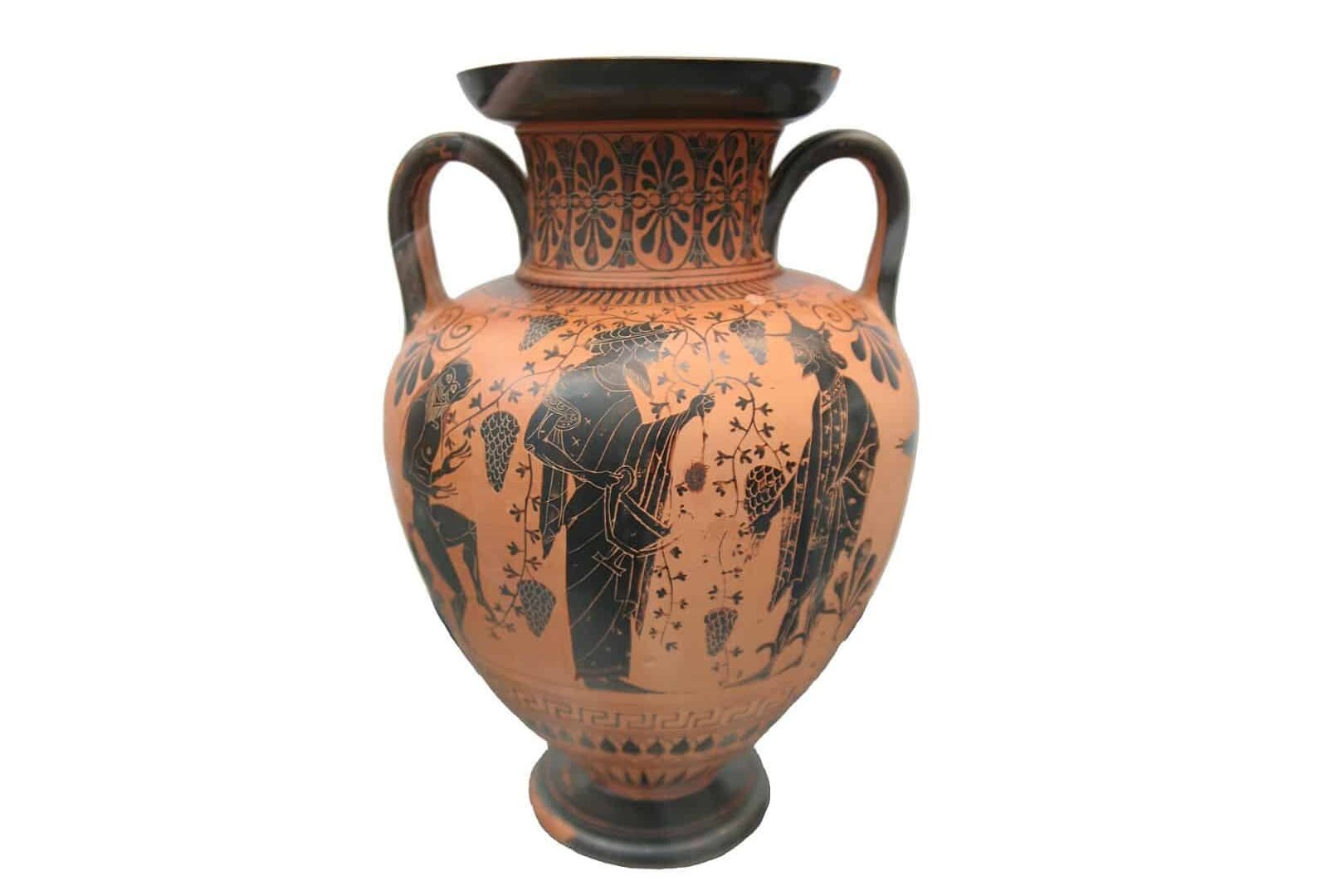
The ancient Greek amphora was used as the main transport container for goods across the Mediterranean and the Black Sea for over two millennia from around 1500 BC to 500 AD.
The great number of ancient Greek amphorae discovered in several parts of southeast Europe, Asia Minor, and North Africa attests to extensive trade activity among cities. This makes them a great source for understanding ancient trade networks and cultural exchange.

In a study entitled Transport Amphorae as Interlinks in the Ancient World, based on Rhodian, Knidian, and Koan amphorae of the Hellenistic period, Dr. Nikoline Sauer argues that amphorae can be used as material evidence of networks in the ancient Greek world.
The etymology of the ancient Greek word “amphora” (αμφορεύς) reflects the purpose of the container: to carry goods. It is a contraction of the word “amphiphoreus” (αμφιφορεύς), with “amphi-” (αμφί) meaning “on both sides” and “phoreus” (φορεύς) meaning “bearer.”
Transport amphorae were the most commonly used containers for the large-scale movement of goods in antiquity. They were widely distributed between trading cities, transporting commodities such as wine, olive products, honey, fish products, fruits, nuts, and cereals.
As a nautical people, the Greeks transported goods far and wide by sea, trading with the entire known ancient world. The transport amphora was used extensively from 1500 BC to 500 AD. During that period, amphorae were mass-produced at levels comparable to those of the industrial age. Their extensive use makes amphorae some of the most common archaeological finds at ancient sites and in shipwrecks.
Mapping the place of origin and destination of ancient Greek amphorae
This frequency, together with the fact that amphorae usually remained at the point of importation—since they were of little value once emptied—makes it possible to conduct a comprehensive mapping of the places where amphorae have been found, the researcher argues. It is also easy to determine the origin of ancient Greek transport amphorae due to their shape and the stamps placed on at least one of their handles. These indicated the names of the makers and were dated, making it possible to establish a clear chronology.
This allows researchers to trace links between senders and recipients, as well as ascertain the timing of amphora arrivals at their destination, thereby outlining the spatial and temporal networks of exchange. With the available data, a formal analysis of the connections between cities or ports can be made. Further analysis can help researchers reconstruct the networks of the ancient world.
Network analysis emerged in the 1980s, but its use has expanded significantly with software capable of handling the large amounts of data required for such studies. These programs are used to create maps and visualize links, highlighting relationships between objects and people and helping researchers better understand human interactions in the ancient world.
The method reveals connections in the ancient world that would otherwise remain invisible. Network analysis has led to an upsurge in studies on ancient Mediterranean networks and connectivity over the last decade.
Hellenistic amphorae from Rhodes, Knidus, and Kos
Sauer’s study focuses on amphorae from Rhodes, Knidus, and Kos, all autonomous city-states of the Hellenistic period located in the southeastern Aegean Sea. These were selected because they were the main Greek centers of amphora production at the time. The purpose of the study is to identify connections with other cities and ports in the Mediterranean and Black Sea.
A survey of data yielded about 200,000 amphorae and stamped handles, including 151,998 from Rhodes, 41,874 from Knidus, and 5,257 from Kos, collected from 361 sites and 18 shipwrecks, dating to the Hellenistic period (323–31 BC).
The large data set made it possible to establish multiple links between the places where amphorae were found and their producers. It also serves as the basis for network analysis, helping to answer key research questions. In the particular study, network analysis demonstrated how Rhodes, Knidus, and Kos could all profit from the same amphora market during the Hellenistic period even though they shared the same geographical position, commodity (likely wine), and overlapping trade links.
The researcher used Rhodian, Knidian, and Koan amphorae to map out how the three city-states were connected through trade and society. She treated the amphorae as stand-ins for people’s interactions and as clues to their role in both the Greek amphora market and the wider Hellenistic economy.
The GIS program MapInfo was used to visualize the interrelation between Rhodes, Knidus, and Kos on the one hand and the various sites in the Mediterranean on the other, with the sizes of symbols indicating the extent of interaction between sites based on the total number of amphorae.
Links to local, regional, and interregional levels
In a closer examination, the connections between the three city-states were analyzed at local, regional, and interregional levels. Locally, a substantial share of amphorae—especially the Rhodian and Koan—circulated within their local area. This likely indicates that the demand for amphorae was high in the domestic market or that there were restrictions, such as the Thasian Wine Law, which hindered foreign amphorae in the local market.
The connections at the regional level show that Rhodes had a monopoly on the amphora market in Egypt, the Black Sea, the Levant, Cyprus, and Anatolia. The 100,000 Rhodian amphorae found in Alexandria alone are evidence of particularly strong trade relations between Rhodes and the Ptolemaic Kingdom, whose capital was Alexandria.
Meanwhile, Knidus dominated the amphora market in Greece and the Cyclades, distributing around 25,000 amphorae to Athens, 2,000 to Argos, and almost 5,000 amphorae to Delos, along with other Cycladic islands such as Tenos, Andros, Amorgos, Antiparos, Kea, Naxos, and Rineia.
Kos never dominated the amphora market of an entire geographic area at the regional level. However, the island still distributed a comparatively large number of amphorae to Greece, Egypt, and the Black Sea, while also serving as the main supplier of amphorae in its local area.
Ancient Greek amphorae in Hellenistic shipwrecks
The predominance of Rhodian amphorae is also evident in Hellenistic-era shipwrecks. As many as seventeen Hellenistic shipwrecks contained Rhodian amphorae, compared to only two shipwrecks with Knidian amphorae and one shipwreck containing Koan amphorae. Based on this evidence, the researcher argues that Rhodes, Knidus, and Kos held separate, geographically distinct shares of the amphora market.
In addition, a broad study of the stamps from the Rhodian, Knidian, and Koan amphorae reveals that the networks of the amphora market were also temporally structured. The distribution of Rhodian amphorae took place primarily in the first part of the Hellenistic period, peaking between 220 and 160 BC.
From that point on, the import of Rhodian amphorae almost ceased, with the exception of Alexandria, which continued to receive a large share of Rhodian amphorae during the second half of the 2nd century BC. Knidus had its main export period from the 2nd century BC to the beginning of the 1st century BC, whereas Kos saw its trade peak in the 2nd century BC until the middle of the 1st century BC. This indicates that Kos was the sole active amphora production center during the last part of the Hellenistic period.
From the data analysis, it becomes clear that ancient Greek amphora transport demonstrates that Rhodes, Knidus, and Kos were able to profit from the Hellenistic market due to a combination of spatial and temporal differences. This suggests that the three city-states profited from the same amphora market as a result of mutual trade relations, likely supported by shared religious beliefs and political ties, a geographically advantageous location, resources, and the production of wine with distinct flavors.
The overall analysis of amphora links indicates the existence of a decentralized network—one with several key sites that interact with each other as well as individually with other sites. Material evidence repeatedly shows that bidirectional exchanges were conducted between sites during ancient times.
Complex methodology
Using amphorae as a way to study ancient trade is an extremely complex task. The main concern when working with Rhodian, Knidian, and Koan amphorae is the difference in stamping customs. Few city-states in the Hellenistic period actually stamped their amphorae, and among those, the stamping practices varied considerably. For instance, the ratio of stamped to unstamped amphorae was nearly 100 percent on Rhodes during its peak trading period but only around 15 percent on Knidus and 1 to 10 percent on Kos.
The various stamping practices have undoubtedly affected the total numbers of amphorae assigned to each city. Additionally, the Koan amphorae were only stamped on one of their two handles, whereas most Rhodian amphorae and some Knidian amphorae had stamps on both. This is a significant difference, since a stamped amphora handle is often taken to represent a complete amphora in inventories.
Another factor to keep in mind is the varying volume of southeastern Aegean amphorae. In the Hellenistic period, the Koan amphora could hold about 44 liters (about 12 gallons), compared with 22 to 29 liters (about 6 to 8 gallons) for the Rhodian amphora and 11 to 38 liters (about 3 to 10 gallons) for the Knidian amphora.
The considerably larger Koan amphora may explain the smaller number of amphorae from Kos, which is praised for its fine wine in literary sources. Thus, the greater capacity of Koan amphorae may have contributed to lower demand—and consequently, reduced production—of these amphorae during the Hellenistic period.
Archaeologist Yvon Garlan noted a third methodological consideration regarding Rhodian amphorae. He states that “certain handles break more easily than others (those of Sinope, for example, in comparison with those of Rhodes); therefore, Rhodian amphorae are likely overrepresented in catalogued findings.”
Challenges in ancient Greek amphora trade studies
The broader challenges in using amphorae as evidence of trade networks overlap with the specific issues associated with Hellenistic amphorae from the southeastern Aegean. The main underlying problem is the reliance on amphora data from large collections of stamped amphora handles. Stamped amphora handles have long attracted the interest of art collectors, some of whom have amassed thousands of them.
These large collections introduce a significant bias in the study of amphorae, as they exclude unstamped examples and often favor a particular type. This focus on stamped amphorae is also evident in many archaeological excavations, which frequently examine only stamped handles or amphora bases.
Finally, the number of amphorae should be interpreted cautiously, as the archaeological record is never complete and the scale and scope of excavations strongly influence the total number of amphorae discovered at sites and subsequently published.
Leading scholars on Greek amphorae and ancient trade highlight five main challenges in amphora studies:
-
the lack of excavation reports, collection, and research on non-stamped amphorae and handles;
-
the direct equation of stamped handles with complete containers;
-
the chronological distribution of amphorae;
-
the differing stamping practices; and
-
the varying volumes.
These five issues have the greatest impact on the estimated number of amphorae attributed to a site and should be given particular consideration when using amphorae in network studies, as well as in amphora research more generally.
Other challenges can further complicate the use of amphorae as data in network studies. For example, the local imitation of foreign amphora types can make identifying amphorae more difficult.
Another aspect is the extent to which an amphora found at a certain site indicates a “direct connection” between the amphora producer and that site. Such connections could easily have been disrupted by the reuse and refilling of amphorae, indirect trade with mixed ship cargoes, or transactions via private merchants.
The distortion of site evidence is apparent in the case of Koan amphorae, which were transported from their original point of importation to Nessana and reused as water containers—a practice noted by the Greek historian Herodotus. Alternatively, amphorae may have been transported with no contents for other purposes at their destination.
Network studies are useful despite the challenges
Some ancient Greek amphora scholars have challenged the empty container theory, arguing that the value of amphorae lay primarily in the contents, and their reuse seems to have been limited to areas near their original point of importation.
Sauer argues that researchers should also examine the motivations and influencing factors behind the connections revealed by amphorae to gain a deeper understanding of the networks involved. Political, economic, religious, social, and environmental factors all appear to have been influential in the establishment and continuation of trade connections.
Amphorae are often studied in the context of ancient trade and economy, but researchers should also consider that their transport may provide evidence of other types of connections, including payments to soldiers, gifts, taxes, or looting.
In summary, the archaeologist’s study offers a systematic assessment of the benefits and limitations of using amphorae in network research. The study’s scope may seem contradictory: it both encourages the use of amphorae in network analysis and highlights the limitations of this approach. However, the findings confirm continuous interchange between city-states across a wide area, regardless of the precise number of amphorae discovered at each site.
To derive meaningful results in studies of connections and exchanges between ancient Greek sites in the Mediterranean and the Black Sea, researchers must apply meticulous methodology when using transport amphorae as evidence.
See all the latest news from Greece and the world at Greekreporter.com. Contact our newsroom to report an update or send your story, photos and videos. Follow GR on Google News and subscribe here to our daily email!

