



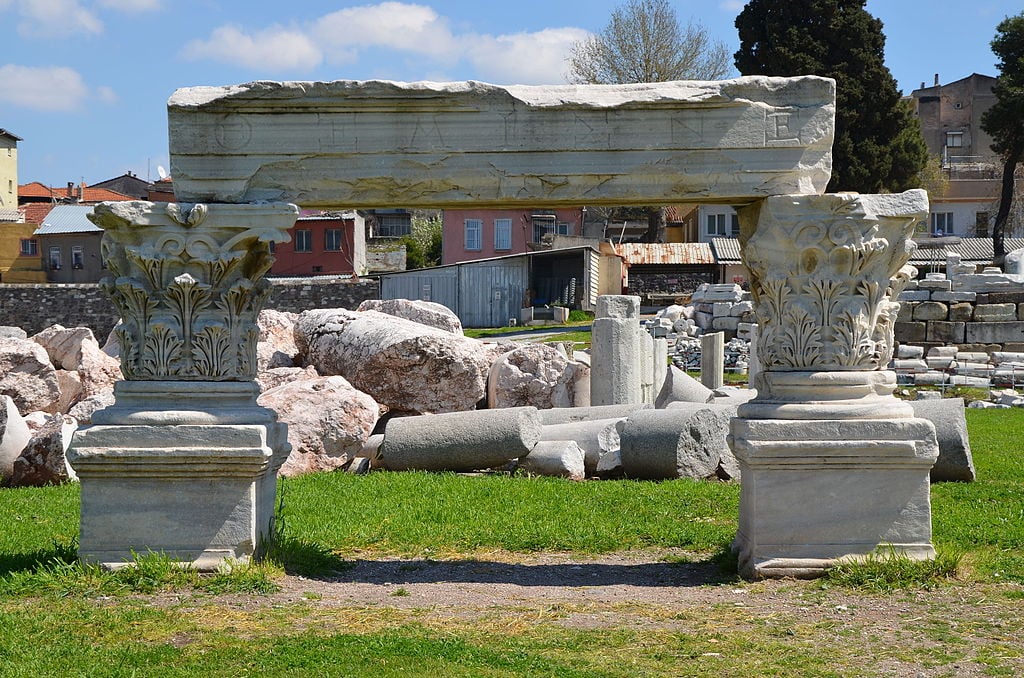
Archaeologists excavating the ancient Greek city of Smyrna (Σμύρνα) in modern-day Turkey have uncovered three previously unknown rooms containing mosaics along with wall frescoes that had never been documented at the site before, the Izmir Metropolitan Municipality announced.
The excavation is being carried out with permission from Turkey’s Ministry of Culture and Tourism, on behalf of Izmir Katip Celebi University.
Crews working in the Smyrna Agora extended a mosaic floor that was first uncovered last year and, in the process, located three additional rooms beside it. Two of the rooms have mosaic flooring, while the third is finished in marble.
Excavation team uncovers mosaic floors and rare wall paintings at the Agora
For the first time, excavators also found wall paintings around the Agora and the nearby Smyrna Theater.
Akin Ersoy, a professor in the Department of Turkish-Islamic Archaeology at Izmir Katip Celebi University and head of the excavation, said the newly uncovered rooms resemble the Terrace Houses at the ancient Greek city of Ephesus and may have served a public purpose rather than a private one.
He said frescoes had never turned up in this part of Smyrna in all the seasons spent digging around the Agora and the theater until now.
Ersoy dated the rooms to the fifth and sixth centuries A.D., placing them within the Late Antique period. He said the Roman Empire’s division into eastern and western halves in the year 395, along with the spread of Christianity, brought major changes to the layout of cities across the region.
The newly found rooms, he said, help explain how Smyrna itself changed during that transition from the classical world to the early Christian era.
Smyrna’s newly found mosaics and frescoes mark a major discovery
Excavators additionally traced part of an ancient water channel built during the Roman era. Ersoy said the channel is believed to have carried water for close to two thousand years. Workers followed roughly 150 meters (492 feet) of the channel, though its original source has not yet been located.
Archaeologists uncover new mosaics and frescoes at the ancient Greek city of Smyrna, revealing rare Late Antique rooms and a Roman-era water channel in Turkey. pic.twitter.com/lOR6uZwaWP
— Tom Marvolo Riddle (@tom_riddle2025) August 31, 2026
He added that a spring may once have stood near the Namazgah Bath and the Kursunlu Mosque, south of the Agora, and that water traveled along a route of about 150 meters (492 feet) before reaching the Agora at Smyrna.
The mosaics and frescoes uncovered this season stand among the most notable additions yet to Smyrna’s known Late Antique remains, and researchers say continued excavation could reveal further details about the ancient city’s history in the centuries that followed Rome’s division.
See all the latest news from Greece and the world at Greekreporter.com. Contact our newsroom to report an update or send your story, photos and videos. Follow GR on Google News and subscribe here to our daily email!

