



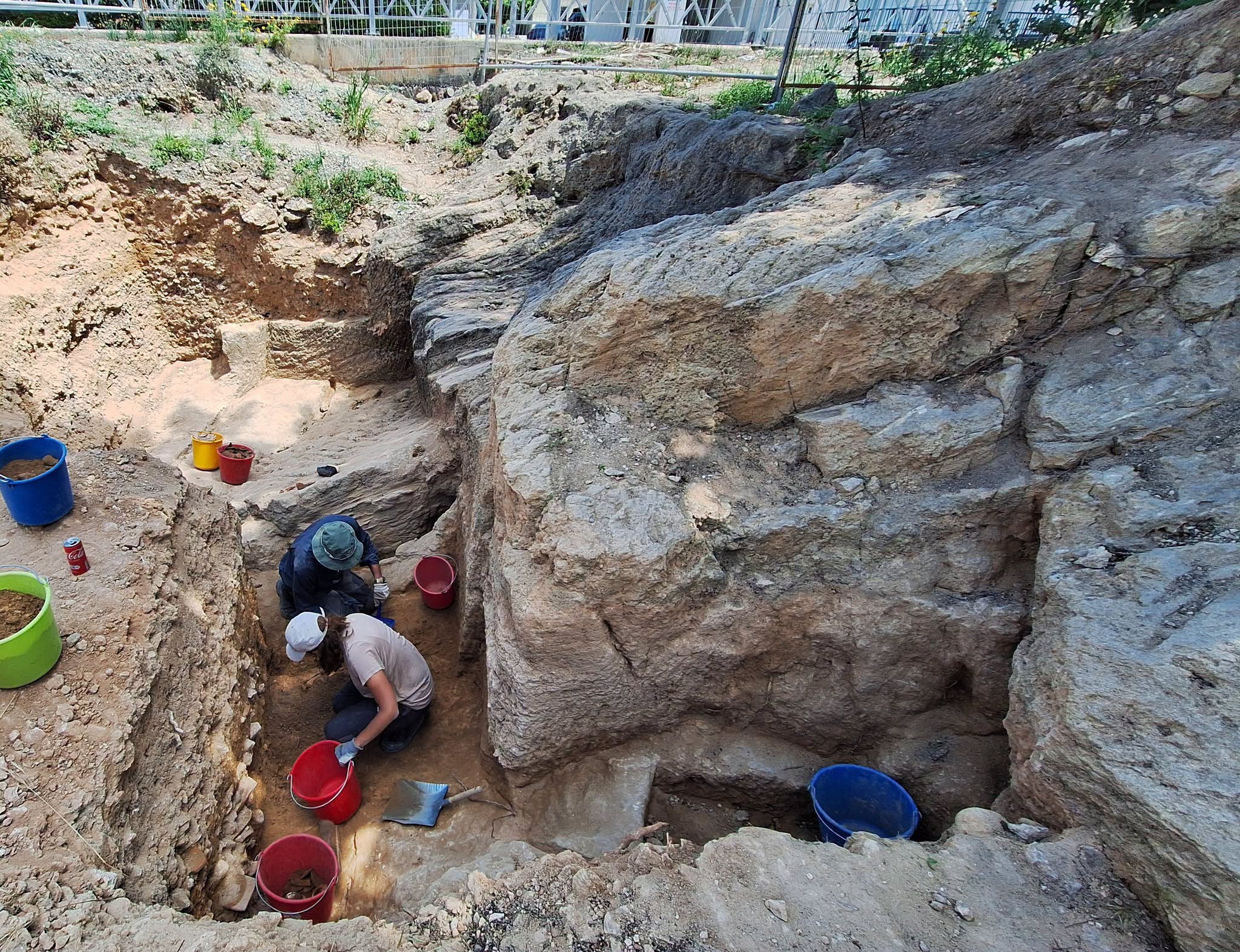
Archaeologists have uncovered a Hellenistic defensive tower, revealed new sections of an ancient water management system, and completed the excavation of a rock-cut chamber during the 2026 excavation season at the ancient city of Nea Paphos in Cyprus.
The discoveries were made on Fabrika Hill in Kato Paphos, where researchers continued investigating the city’s northeastern acropolis and sections of its Hellenistic fortification walls. The findings are helping archaeologists better understand how the city developed from a fortified Hellenistic settlement into a Roman and later Byzantine urban center.
Excavations reveal new evidence of the city walls
One of the season’s most significant discoveries was the identification of the northeastern tower of the Hellenistic city wall beneath the rock-cut Church of Agios Agapitikos. Archaeologists found that many of the tower’s dressed stones had either been removed during the Roman period or reused in the church’s foundations after it was built within the remains of the ancient structure.
At the city’s northwestern gate, researchers cleaned the foundations of defensive towers and identified part of the southern tower’s final floor level, preserving evidence of the site’s last phase of use.
They also examined Hellenistic and Roman pottery recovered from Paphos Harbour during excavations carried out in the 1980s, while a new topographic survey documented another section of the city’s fortification wall.
Ancient water system offers new clues
Excavations also continued at an ancient well and underground gallery north of the theater. Researchers found that a rock-cut water channel discovered in 2025 extends farther southeast than previously known.
The study showed that the original Hellenistic system stored water in the underground gallery before a later well redirected it to a Roman cistern. Fragments of a large ceramic pipeline recovered from the gallery floor provide further evidence of the site’s changing water management system.
A new trench outside the gallery uncovered a large crack in the rock-cut wall that researchers believe was caused by an earthquake. The damage may explain why the gallery was abandoned after water began leaking from the fractured structure.
Nearby, archaeologists also discovered a second wall about 3 meters (10 feet) high, confirming that the ancient ground level once lay significantly lower than today’s surface.
Roman house and chamber reveal a later occupation
Elsewhere on Fabrika Hill, excavations continued inside a large Roman house, where researchers uncovered a well-preserved southern wall built with reused stone blocks, offering new insight into the building’s later construction phases.
Archaeologists also completed the excavation of Chamber 5, one of 15 underground chambers documented by the French Archaeological Mission. The chamber first served as a quarry during the Early Hellenistic period before being prepared as a tomb that was never used.
Researchers believe construction of the city wall in the second half of the second century B.C. transformed the area into a residential district, ending its funerary role. The chamber was later partially filled during the Roman period before being converted into a church in the Early Byzantine era.
Long-term study of Nea Paphos
The excavation was led by Professor Claire Balandier of the University of Avignon and carried out by the French Archaeological Mission in collaboration with the French School at Athens and the Cyprus Department of Antiquities.
The long-term project aims to produce the most comprehensive study of Nea Paphos’ Hellenistic fortifications. Researchers are combining evidence from new excavations with findings from investigations carried out by the Department of Antiquities during the 1980s.
The project is supported by the French Ministry for Europe and Foreign Affairs, the French National Centre for Scientific Research (CNRS), the University of Avignon, the French School at Athens, and the Municipality of Paphos.
Together, the discoveries provide a clearer picture of how Nea Paphos evolved over centuries, tracing the city’s transformation from a fortified Hellenistic stronghold to a thriving Roman city and later Byzantine community.
See all the latest news from Greece and the world at Greekreporter.com. Contact our newsroom to report an update or send your story, photos and videos. Follow GR on Google News and subscribe here to our daily email!

