



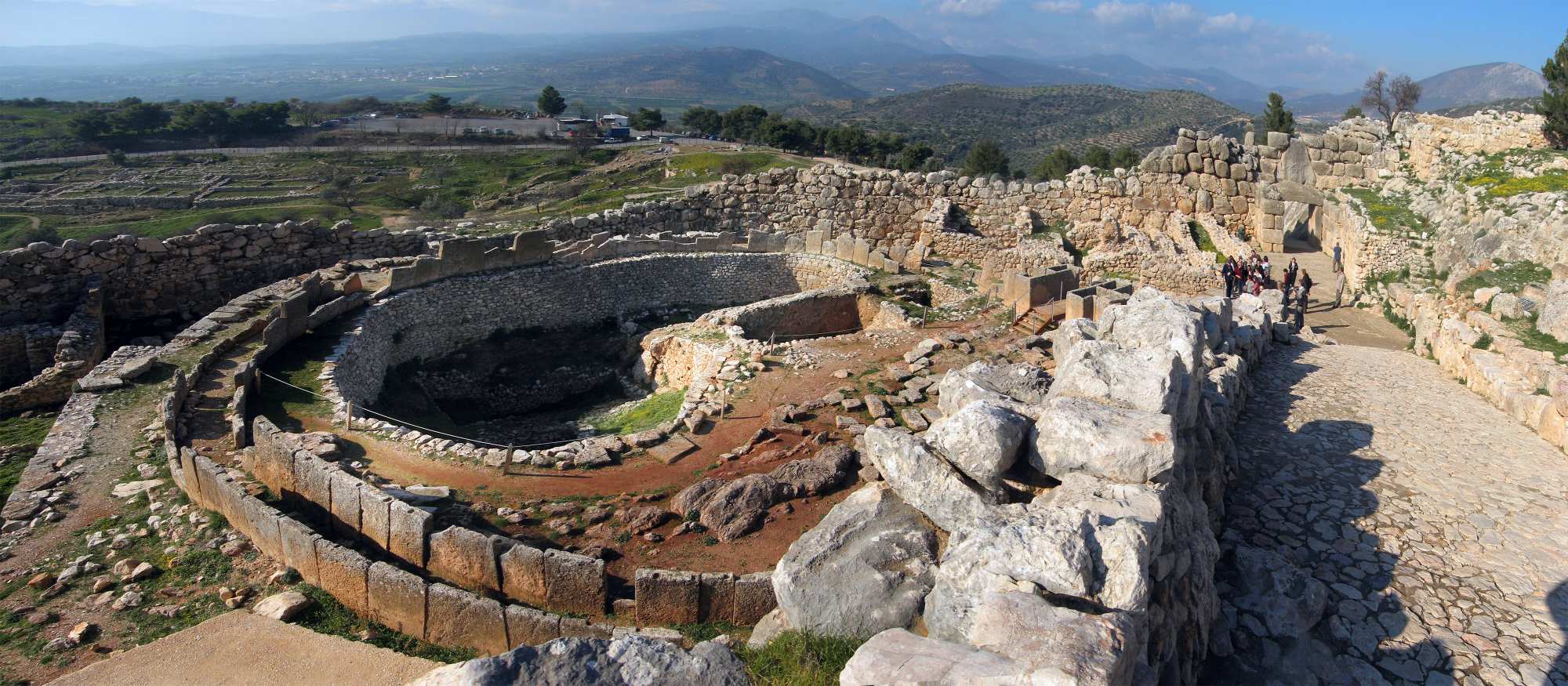
The Bronze Age Collapse is shrouded in mystery. Scholars continue to debate what exactly caused this major event in history. However, modern scientific research has revealed evidence for a so-called earthquake storm that may have contributed to the end of the Bronze Age. What exactly is an earthquake storm, and how were Bronze Age cultures likely affected by it?
What is an earthquake storm?
We normally think of storms as extreme weather phenomena accompanied by heavy winds, intense rain, and potentially thunder and lightning, and while it may not immediately be clear how this is all related to earthquakes, the concept of a storm in meteorology is not limited to a single, isolated gust of wind or sudden but brief downpour. As a matter of fact, it is a prolonged state of strong winds and heavy rain.
Similarly, an earthquake storm refers to an occurrence (or occurrences) that play out over a period of time. Simply put, it is a series of major earthquakes that take place within a relatively short span of time (perhaps years or decades) within one particular region. This differs from a major earthquake followed by multiple smaller aftershocks. As for the cause of earthquake storms, it may be that the initial earthquake actually triggers subsequent ones due to the shifting of pressure within the earth.
The destruction of cities in the Bronze Age Collapse
Archaeologists have found evidence of extensive destruction at numerous cities during the Bronze Age Collapse. This cluster of devastation dates from roughly 1225 to 1175 BC. Such events come just before the fall of certain civilizations, as was the case with the Hittite Empire and Mycenaean Greece. Based on this, it is fair to say that whatever caused the ruin of those cities was at least partially responsible for the Bronze Age Collapse as well.

The problem is that it is not always easy for archaeologists to identify the precise cause of a disastrous event. In many cases, an attacking army could be responsible, though this is not the only possible explanation. Occasionally, archaeologists do not uncover any weapons or other direct evidence of an attack, leaving open the possibility that something else, such as an earthquake, could have been responsible.
In the case of cities destroyed during the Bronze Age Collapse, French archaeologist Claude Schaeffer suggested as early as 1948 that an earthquake could have been responsible, but much of the contemporary academic community rejected his postulation. The key issue is that the collapse of these Bronze Age cities was not a single event. Rather, it occurred over a roughly fifty-year period. This chronological evidence thus seemed to disprove the earthquake hypothesis.
How an earthquake storm could explain the Bronze Age Collapse
The most straightforward way to reconcile Schaeffer’s earthquake hypothesis with the chronology of the cities that fell to ruin is to attribute their destruction to an earthquake storm rather than a single major event. But is there any actual evidence to support this interpretation?
In a paper published in 2000, geologist Amos Nur and archaeologist Eric H. Cline made the case that there is indeed evidence for an earthquake storm at the end of the Bronze Age. One piece of evidence is the fact that a similar earthquake storm occurred during much of the 20th century in the Eastern Mediterranean. This sequence of earthquakes affected much of Greece, Turkey, and the Levant. Researchers compared the locations of these earthquakes with the cities that were demolished in the Late Bronze Age Collapse. The result was fascinating. There was a remarkably close correspondence between the two sets of locations. Furthermore, for many such cities, there was no archaeological evidence that pointed to human attackers as the cause of the destruction.
Since the publication of the paper, many scholars have accepted the plausibility of this theory. There is now much wider acceptance that an earthquake storm could have contributed to the Bronze Age Collapse. Of course, this differs significantly from positing that earthquakes were single-handedly responsible. Undoubtedly, other factors were involved as well.
See all the latest news from Greece and the world at Greekreporter.com. Contact our newsroom to report an update or send your story, photos and videos. Follow GR on Google News and subscribe here to our daily email!

