



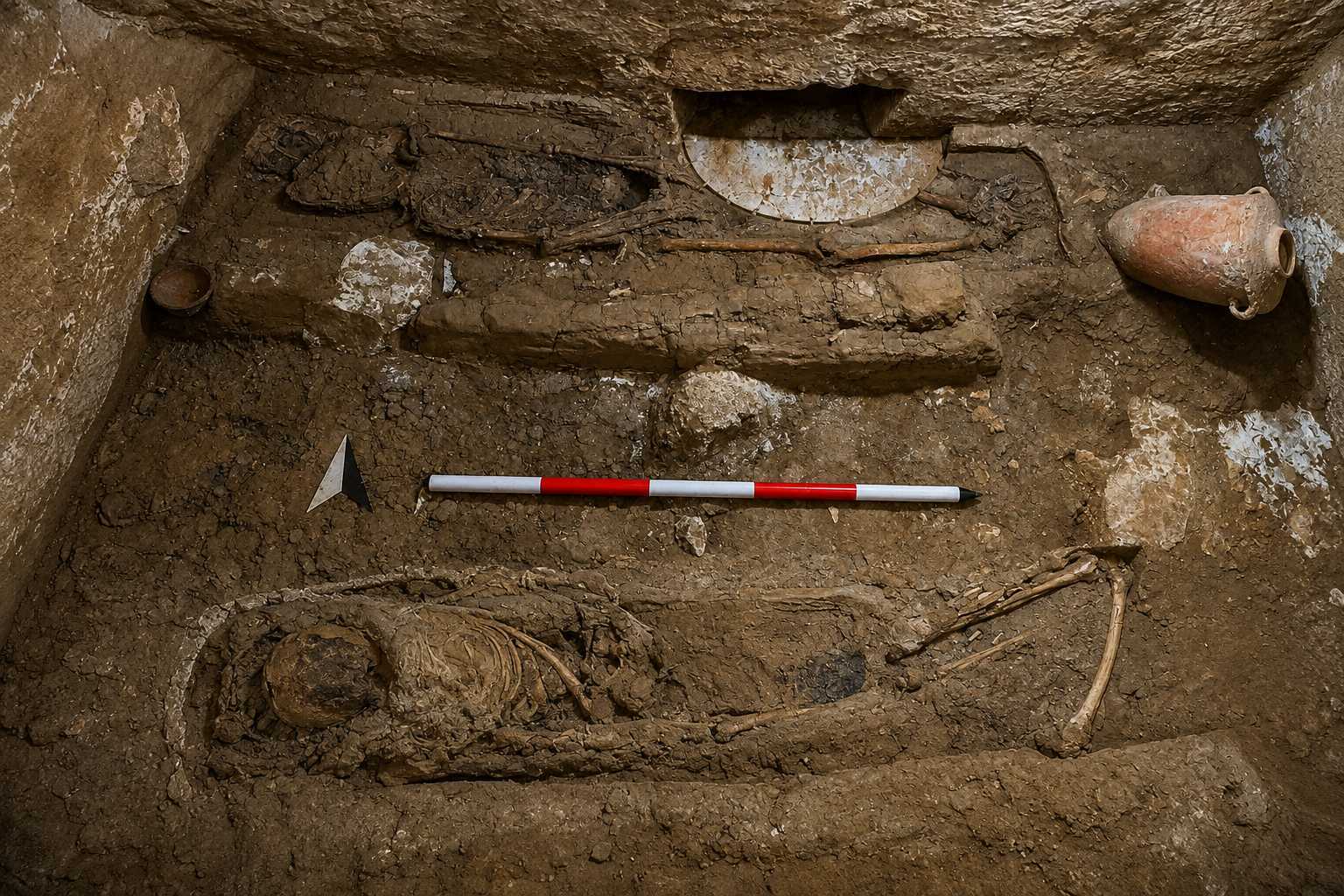
Sixteen mummified people and a mummified dog found in an ancient Egyptian tomb are revealing how burial chambers were reorganized and reused for centuries without losing their ritual importance.
The remains were studied in chamber three of tomb TT 209 in the Theban Necropolis, a vast burial ground across the Nile from Luxor. The necropolis contains more than 400 tombs spanning different periods of ancient Egyptian history.
Archaeological work continues across Luxor’s west bank, where researchers recently discovered another decorated tomb in the Theban Necropolis and uncovered a priest’s tomb and coffins from several eras.
In a study published in Frontiers in Environmental Archaeology, researchers in Spain reconstructed how the chamber changed from the Twenty-fifth Dynasty, around 754 to 656 B.C., through the Ptolemaic period, 305 to 30 B.C.
Researchers documented nine funerary deposits containing individual and multiple burials. They photographed the mummies and recorded their positions, orientation, and relationship to other remains and structures.
Early burials reflected wealth and status
The earliest burials were relatively separate. Bodies were placed in coffins and accompanied by funerary nets, amulets, and costly goods. Dr. Miguel Ángel Molinero Polo, an Egyptologist at the University of La Laguna and senior author of the study, said the evidence suggests these people held high social status.
Numerous Phoenician amphorae were also found nearby. Such objects formed an important part of Egyptian burial traditions, with amulets and other grave goods intended to protect or assist the dead in the afterlife.
Archaeologists studying an ancient Egyptian tomb near Luxor found 16 mummified people and a mummified dog, revealing how the burial chamber was carefully reused for centuries.
The dog may even have served as a symbolic guide to the afterlife. pic.twitter.com/0nQMGt7Fur
— Tom Marvolo Riddle (@tom_riddle2025) August 18, 2026
Burial practices changed toward the end of the Twenty-fifth Dynasty and during the Persian period. As space became limited, bodies were fitted into available areas. Some limbs were repositioned, including arms folded inward instead of stretched out as in earlier burials. Researchers also found bodies placed on top of one another in about two-thirds of the chamber’s burials.
Mummified dog points to changing rituals
In the southeastern section, four mummies dating to the Ptolemaic period were stacked together, with a mummified dog above them. The people had no coffins but were carefully mummified. Upright jars associated with the bodies suggest a ritual not seen in the tomb’s earlier phases.
The dog lay directly above the mummies of a man and a woman. Study first author Dr. Jared Carballo-Pérez said its placement could point to a close relationship between the animal and the people. Molinero Polo said another possibility is that the dog served as a psychopomp, a symbolic helper guiding the dead to the afterlife.
Later burials also included people with both arms folded across their chests in the Osirian position, named for Osiris, the Egyptian god associated with death and the afterlife. Osiris played a central role in ancient Egyptian beliefs about judgment and eternal life, making the change another sign of evolving funerary practice.
Crowded chamber retained its funerary order
Researchers say the increasingly crowded chamber should not be interpreted as evidence that burial customs collapsed.
Carballo-Pérez said each new deposition appears to have been adapted to remains already inside. The researchers describe this as a form of “funerary memory,” in which earlier burials continued to shape how the chamber was used.
The team argues that TT 209 was repeatedly reactivated. New burials transformed the space without erasing its past.
Reconstructing every burial sequence remains difficult. The chamber was used for centuries and flooded several times. Fires, later human entry, and displaced debris also disturbed the archaeological record.
Still, Carballo-Pérez said the findings could change how archaeologists interpret deposits previously described as “disordered.” Arrangements that appear chaotic may instead preserve evidence of deliberate funerary choices and the social behavior behind them.
See all the latest news from Greece and the world at Greekreporter.com. Contact our newsroom to report an update or send your story, photos and videos. Follow GR on Google News and subscribe here to our daily email!

