


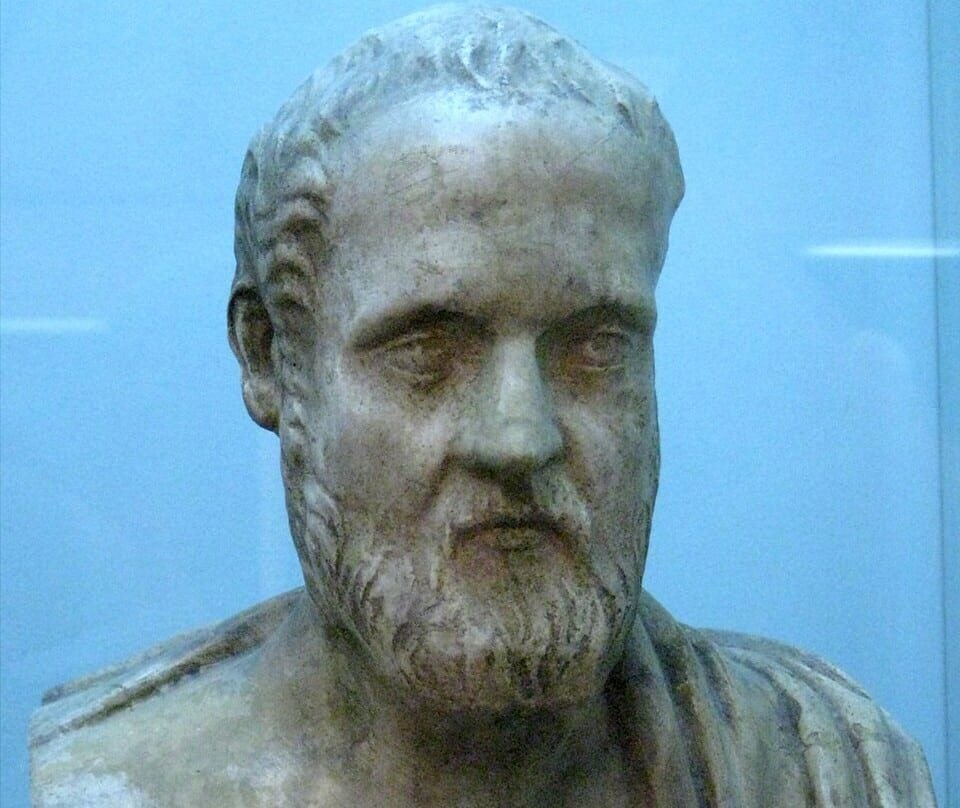
The Greek orator Isocrates of Athens developed an educational system that would later influence Roman education, Renaissance humanism, and modern liberal education. Unlike his contemporaries, who focused on philosophical speculation or technical rhetoric, Isocrates (436–338 BC) established an educational model designed to cultivate moral character, civic responsibility, and practical wisdom through the study of rhetoric.
Rather than viewing education as the simple transmission of knowledge, he believed in shaping virtuous citizens capable of leading their communities through persuasive speech, sound judgment, and ethical action.
Athens after the Peloponnesian War
The 4th century BC was a period of political instability and intellectual transformation in Greece. Following the Peloponnesian War, Athens faced military defeat, political upheaval, and a decline in its influence across the Greek world. During this era, education took on renewed importance as citizens searched for new ways to restore civic excellence and collective pride. Sophists, philosophers, and rhetoricians competed for students by presenting different visions of what education should achieve.
Around 390 BC, Isocrates established his own school in Athens. Unlike the Sophists, who were often criticized for teaching persuasion without ethical principles, Isocrates believed rhetoric should serve justice and the common good. His school quickly became one of the most respected institutions in Greece, attracting future politicians, diplomats, and intellectuals from throughout the Greek world.
As historian Werner Jaeger observed, “Isocrates was the founder of the educational ideal that dominated the Hellenistic and Roman world.” Jaeger’s assessment highlights the enduring significance of the Greek orator’s ideas and their influence on the development of Western educational thought.
Isocrates and the Ancient Greek ideal of paideia
Central to Isocrates’ educational philosophy was the Ancient Greek ideal of paideia (παιδεία), the comprehensive cultivation of the individual. Education, in his view, was not limited to acquiring technical skills or memorizing facts. Instead, it aimed to develop intellectual ability, moral integrity, eloquence, and civic commitment.
For Isocrates, education rested on the three essential elements of natural ability (physis, φύσις), instruction (didaskalia, διδασκαλία), and practice (askesis, ἄσκησις). The Greek orator argued that excellence could only emerge through the harmonious interaction of the three factors. Even naturally talented individuals required disciplined study and continuous practice to achieve true excellence.
Although Isocrates regarded himself as a sophist, he distinguished himself from what he called the “common herd” of sophists. In Against the Sophists, he wrote, “Natural ability, education, and practice must all contribute if excellence is to be attained.” This statement reflects his rejection of simplistic educational theories that emphasized either innate talent or formal instruction alone.
Isocrates, the Greek orator, and rhetoric as moral education
Unlike many Sophists, Isocrates did not view rhetoric merely as a tool for winning arguments. Instead, he regarded persuasive speech as inseparable from ethical character. A good speaker required not only technical skill but also wisdom, self-control, and a commitment to the public good.
According to classicist George A. Kennedy, “For Isocrates, rhetoric was not simply verbal technique but the highest expression of practical intelligence.” Kennedy emphasizes that Isocrates viewed rhetoric as an intellectual discipline that required thoughtful judgment rather than manipulation.
Students at the Greek orator’s school studied literature, history, politics, ethics, and composition. Through the careful imitation of exemplary speeches and repeated writing practice, they gradually learned to think critically and communicate effectively.
This educational approach contrasted sharply with the abstract philosophical investigations associated with Plato. While Plato sought universal truth through dialectic, Isocrates focused on preparing students to make wise decisions in practical political situations where certainty was impossible.
Isocrates’ philosophy of education for citizenship
One of Isocrates’ greatest contributions was his belief that education should prepare individuals for responsible citizenship. Democracy required educated citizens who were capable of deliberation, persuasion, and leadership. He argued that political success depended less on theoretical knowledge than on practical wisdom (phronesis, φρόνησις). Citizens needed to evaluate changing circumstances, balance competing interests, and persuade others toward collective action.
As historian Thomas Cole notes, “Isocrates transformed rhetoric into an instrument for civic education rather than merely forensic success.” Cole’s observation captures the political dimension of Isocrates’ educational philosophy.
The Greek orator’s famous work Antidosis (Ἀντίδοσις, or “treatise”) serves partly as a defense of his educational program. Isocrates argues therein that his students became better citizens because rhetorical training encouraged responsibility, moderation, and public service rather than selfish ambition.
The importance of character formation according to the Greek orator Isocrates
Modern educational theory often distinguishes between knowledge and character education. Isocrates made no such distinction. In accordance with his thinking, intellectual development and moral development are inseparable. The Greek orator taught his students virtues such as prudence, justice, moderation, self-discipline, respect for law, and public responsibility.
Educators themselves were expected to embody these virtues, serving as moral examples for their students. Professor of rhetoric Takis Poulakos explains, “Isocrates envisioned rhetoric as an ethical art whose purpose was to improve both speaker and community.” This interpretation underscores the fundamentally ethical purpose of Isocratean education.
Isocrates’ rhetorical-based educational ideal contrasted with that of Plato. The intellectual rivalry between Isocrates and Plato represents one of the most significant debates in ancient Greek thought. Plato criticized rhetoric because persuasive speech could manipulate audiences without producing genuine knowledge. In dialogues such as Gorgias, he portrayed rhetoric as potentially dangerous when separated from philosophy.
Isocrates, on the other hand, recognized that absolute certainty was impossible in political affairs. Therefore, he believed education should cultivate reasoned judgment rather than the pursuit of perfect knowledge. Effective leaders needed experience, wisdom, and persuasive ability more than abstract philosophical certainty.
According to classicist Werner Jaeger, “Plato sought truth through philosophy; Isocrates sought wisdom through culture.” This comparison highlights the fundamentally different educational goals of the Greek orator Isocrates and Plato, the philosopher.
Isocrates’ influence on later educational models
The influence of the Greek orator extended far beyond Classical Greece. During the Hellenistic period, Isocrates’ educational model dominated throughout the Eastern Mediterranean. Roman educators such as Marcus Fabius Quintilianus drew on many of his principles, especially the belief that the ideal orator should also be a morally virtuous person.
During the Renaissance, humanist scholars rediscovered Isocrates and embraced his emphasis on classical literature, eloquence, and civic engagement. His educational philosophy helped shape liberal arts education throughout Europe. Today, many aspects of university education reflect Isocratean principles, including critical thinking, communication skills, ethical leadership, civic responsibility, and interdisciplinary learning.
Educational theorists continue to recognize the importance of combining intellectual excellence with moral development, and modern scholars increasingly appreciate Isocrates as an original educational philosopher rather than merely a rhetorician. Classical rhetoric George Kennedy, for instance, states that “(Isocrates’) educational system became one of the foundations upon which Western rhetorical education was built.” Similarly, Werner Jaeger argues that Isocrates deserves recognition as one of antiquity’s greatest educators because he united intellectual training with civic virtue.
Contemporary scholars likewise note that Isocrates anticipated many principles associated with modern liberal education, including lifelong learning, interdisciplinary study, ethical reasoning, and public engagement.
See all the latest news from Greece and the world at Greekreporter.com. Contact our newsroom to report an update or send your story, photos and videos. Follow GR on Google News and subscribe here to our daily email!

