



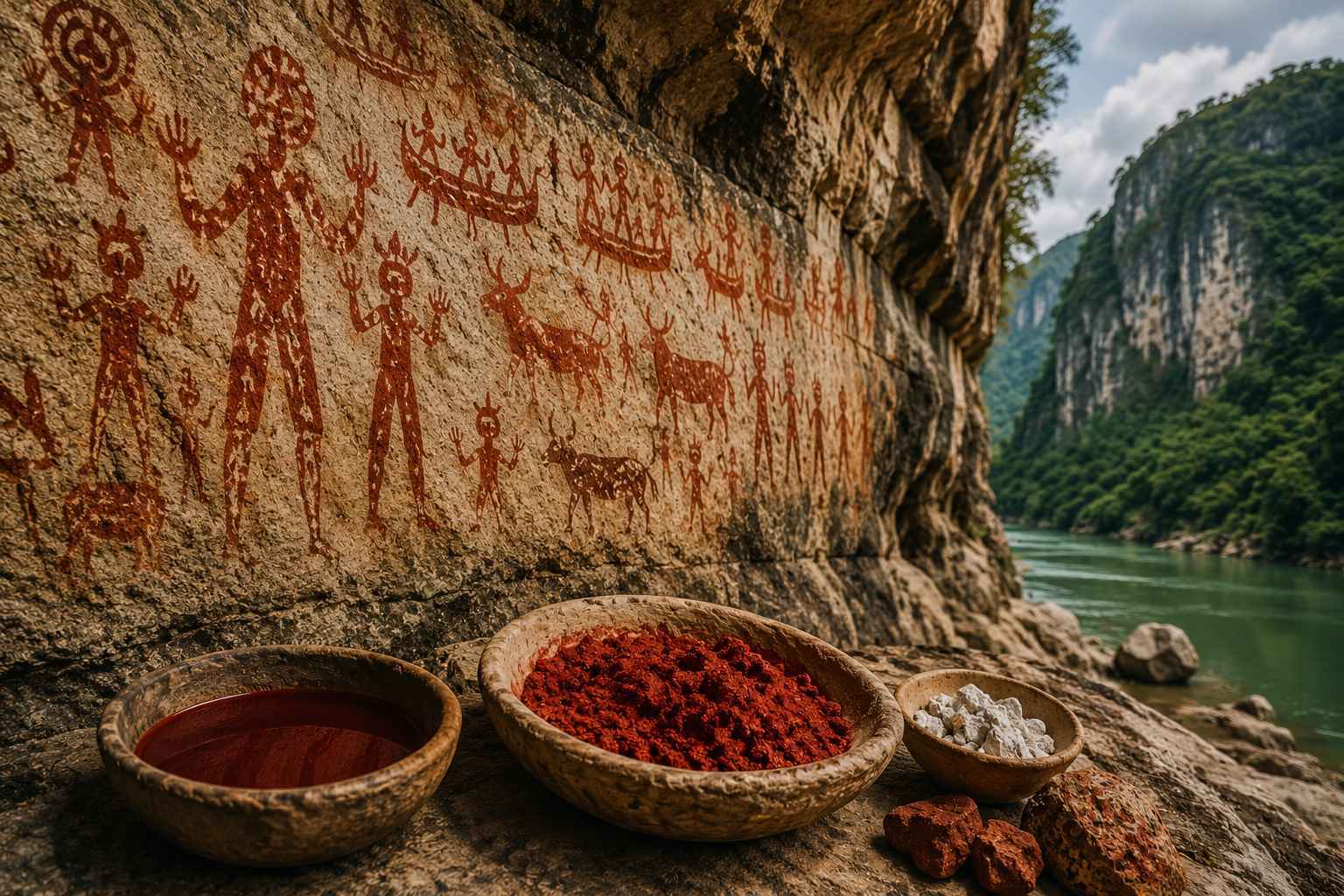
China’s famous Huashan rock art may have survived more than 2,000 years because ancient artists mixed lime, red clay and blood into the paint, according to a new study. Researchers found that the blood likely came from women during childbirth and helped create a mineral-rich binder that kept the paintings attached to limestone cliffs despite centuries of heat, heavy rain and humidity.
The study was led by Meng Wu of Shandong University in collaboration with the Guangxi Museum of Anthropology. It was published in the Journal of Archaeological Science.
The Huashan rock paintings stretch for more than 260 kilometers (161.5 miles) along the Zuojiang River in China’s Guangxi Zhuang Autonomous Region. The UNESCO World Heritage Site includes more than 80 cliff sites decorated with human figures, animals, and bronze objects. Most of the paintings were created between the fifth century BC and the second century AD.
For decades, archaeologists debated how the bright red pigments remained firmly attached to exposed limestone cliffs without restoration. The new research suggests the artists developed a sophisticated technique that created a long-lasting bond between the paint and the rock.
Researchers uncovered an ancient binding technology
To investigate the paintings, researchers examined fragments that had naturally fallen from three Huashan sites: Gaoshan, Daningshan and Tupingshan. They compared the painted layers with nearby limestone and natural sediments.
The analysis showed that the pigment was not painted directly onto the cliff. Instead, the artists first created an artificial mortar that bonded the paint to the rock.
Natural sediments collected near the sites crumbled easily. The preserved paint layers, however, were so firmly attached that researchers needed an electric drill to remove some samples from the limestone.
Microscopic analysis revealed a thin but highly uniform bonding layer. Chemical tests identified calcium carbonate, calcium phosphate, silicates, sulfates and proteins. Those materials were absent from the surrounding rock, showing that the layer had been deliberately made rather than naturally formed.
Researchers concluded that the artists mixed lime, red clay and blood to produce a biomineralized mortar. As the lime reacted with air, calcium carbonate crystals formed and permanently locked the pigment into the limestone.
Protein analysis points to blood from childbirth
The study’s most unexpected discovery came from the proteins preserved inside the bonding layer.
Researchers identified blood proteins including albumin, fibrinogen and immunoglobulins in every sample. They ruled out modern contamination by thoroughly cleaning the fragments before analysis and confirming that the proteins had naturally aged over thousands of years.
Most of the proteins found in the Gaoshan samples belonged to humans, while smaller amounts came from snakes and other animals. Samples from Daningshan contained both human and cattle blood.
China's 2,000-year-old Huashan rock art may owe its remarkable survival to an unexpected ingredient. A new study found ancient artists mixed lime, red clay and blood likely from childbirth to create a durable binder that withstood centuries of heat, rain and humidity. pic.twitter.com/8GfVKbVLrl
— Tom Marvolo Riddle (@tom_riddle2025) July 27, 2026
Researchers believe the human blood most likely came from women during childbirth rather than from violence or sacrifice.
The team detected two proteins commonly found in the blood of pregnant or breastfeeding women. At the same time, they found no evidence that milk had been used because the samples lacked casein, the main protein found in milk. The findings suggest the blood was likely collected during childbirth or shortly afterward.
The researchers estimate that only about eight milliliters of blood would have been needed to produce one square meter of painted surface.
Fertility beliefs may explain the practice
Researchers say the findings fit with historical descriptions of the Luoyue people, who are believed to have created the paintings.
Ancient Chinese records describe the Luoyue as a matrilineal society. The paintings themselves also contain images linked to fertility, including pregnant women, scenes of sexual activity and male figures with prominent reproductive features.
The researchers believe these themes may explain why blood associated with childbirth was chosen as part of the painting process.
A mineral shield protected the paintings
According to the study, the paintings survived because the lime-based mortar gradually formed calcium carbonate rather than because of the blood alone.
Organic binders such as plant sap or proteins normally deteriorate in hot, humid climates. The mineral layer created by the lime mixture instead behaved much like natural limestone and tightly bonded the pigment to the cliff surface.
Researchers also found that microorganisms later converted some of the calcium carbonate into calcium oxalate. Although calcium oxalate forms a stable surface coating, it does not hold pigment as effectively.
That became clear at the Tupingshan site, where much of the original calcium carbonate had disappeared. The pigment at that site separated from the rock much more easily, reinforcing the conclusion that calcium carbonate was responsible for the paintings’ remarkable durability.
Ancient artists possessed advanced technical knowledge
The study suggests the Huashan paintings were not simply artistic works but carefully engineered creations.
The necessary materials, including limestone, shells, clay, bones and blood, were all available in the surrounding valley. Researchers believe the artists produced lime by heating limestone and obtained phosphates from bones or bird droppings before combining the materials into a stable mortar.
According to the researchers, the paintings demonstrate an advanced understanding of material science long before modern chemistry existed. Their technique produced a durable bonding system that allowed the artwork to withstand the harsh subtropical climate for more than two millennia.
The team plans to examine additional Huashan sites to determine whether the same method was used throughout the region and whether similar techniques appear in ancient rock art elsewhere.
See all the latest news from Greece and the world at Greekreporter.com. Contact our newsroom to report an update or send your story, photos and videos. Follow GR on Google News and subscribe here to our daily email!

