



Archaeologists studying a Greek vase held in a museum in northern Greece have found proof of an ancient repair and identified rare pigments used to paint it, adding new details to the story of the pottery trade in the ancient Mediterranean.
The vase, known as a pelike, comes from the Archaeological Museum of Thessaloniki. Its exact origin remains unclear. Museum records show it arrived from an illegal digging activity.
A middleman later said the piece likely came from the Nea Moudania area near Kassandra, in the Chalkidice region of Greece. The vase dates to around 350 to 340 BC and stands nearly 30 centimeters (11.8 inches) tall. It shows a wedding scene on one side and three young men wrapped in cloaks on the other.
Ancient repair and rare pigments uncovered on the Greek vase
Researchers used several scientific methods to study the vase, including microscopy, X-ray analysis, and Raman spectroscopy. The tests uncovered signs that the vase had been damaged and then mended in ancient times.
Two holes drilled near the base, along with a piece of lead found among the fragments, point to a repair technique rarely seen in ancient pottery.
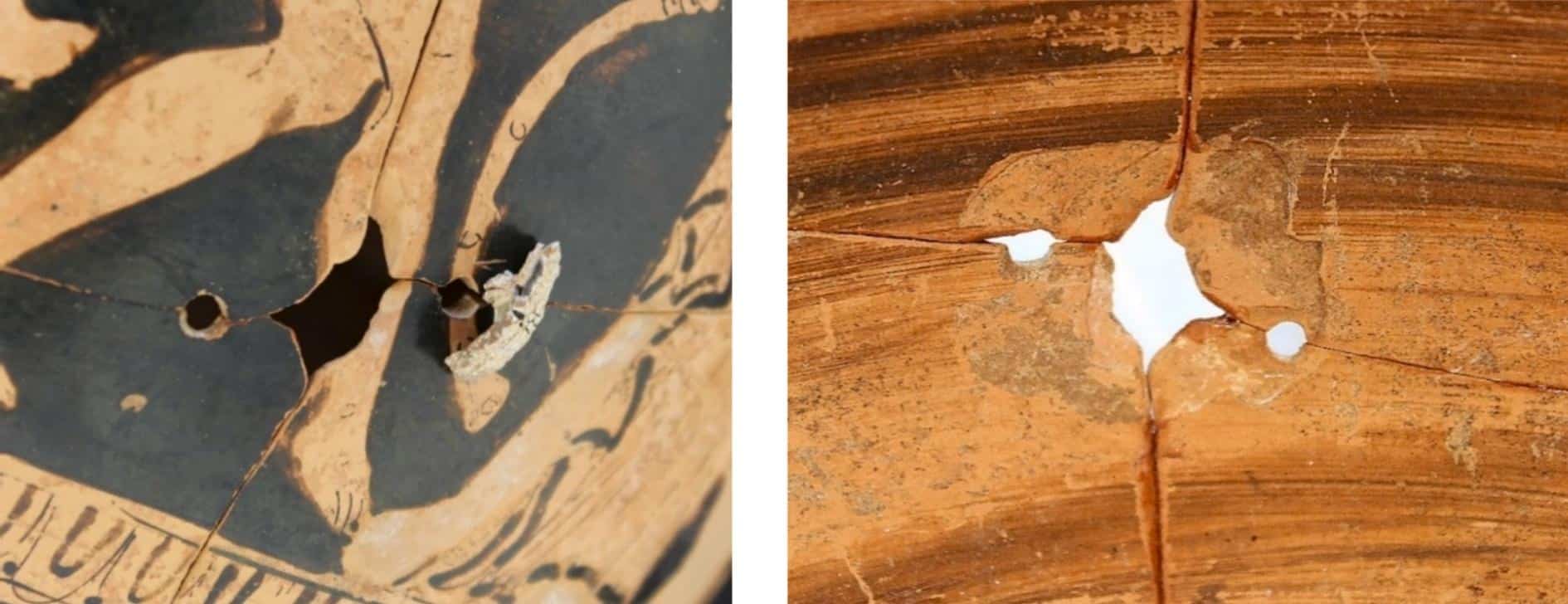
Instead of gluing broken pieces back together, someone filled a hole in the vase with molten lead to make it usable again. A similar method has been documented once before, on a large storage jar found in Greece.
The study also identified the materials behind the vase’s colors. Kaolinite, a soft white clay mineral, created the white paint. Magnetite gave the black areas their glossy finish.
Red ochre, rich in iron, produced the reddish tone on the surface. These findings match techniques long associated with Attic red-figure pottery, a style once common across ancient Athens.
Clay analysis links vase to Kassandra Peninsula sites
Chemical testing also compared the vase’s clay with forty samples from ceramic pieces found at excavation sites across Chalkidice.
Two samples, from the sites of Afytos and N. Skione, showed close chemical and mineral similarities to the pelike. Both locations sit on the Kassandra peninsula, supporting the idea that the vase may have come from that area.
P. Veleni, the study’s lead author and Emeritus Director General of Antiquities and Cultural Heritage at Greece’s Hellenic Ministry of Culture, said that the repair work and the quality of the decoration suggest the vase held real value to its ancient owners.
Veleni added that the findings help explain how Athenian pottery styles spread into Macedonia during the 4th century BC, even as local workshops began producing their own versions.
The research appears in the Journal of Archaeological Science: Reports. The team said further study of pottery from the region could help confirm exactly where the vase was made.
See all the latest news from Greece and the world at Greekreporter.com. Contact our newsroom to report an update or send your story, photos and videos. Follow GR on Google News and subscribe here to our daily email!

