



Every year on July 23, the Cycladic island of Tinos honors Saint Pelagia, commemorating the humble nun whose reported visions led to the discovery of the island’s sacred icon. More than two centuries later, her story continues to intertwine faith, history, and Greek tradition.
Each July, thousands of pilgrims cross the Aegean Sea to visit the Church of Panagia Evangelistria on Tinos, Greece’s most important Orthodox pilgrimage site. Although the island is best known for its grand August 15th celebration, the feast day of Saint Pelagia, whose reported visions led to the discovery of the icon of the Annunciation of the Virgin Mary, on July 23rd also holds profound significance for Tinians.
Preserved through Orthodox tradition and closely intertwined with modern Greek history, her story remains one of the most remarkable chapters in Tinos‘ spiritual heritage.
A humble nun on the hills of Tinos
Perched high above the island’s capital, the Monastery of Kechrovouni is a historic women’s monastery overlooking the Aegean Sea. According to long-standing monastic tradition, the monastery dates back to the 10th century and has served as a center of Orthodox spirituality for centuries. It was here that Loukia Negreponti, later known as Saint Pelagia, dedicated her life to prayer and service.
Born in 1752 in the village of Kambos on Tinos, she was the daughter of an Orthodox priest. As a teenager, she entered the monastery and eventually became a nun, taking the name Pelagia. Accounts of her life describe her as humble, obedient, and deeply devoted to prayer. She lived quietly within the monastery walls, never seeking public attention. Yet her name would become forever linked with one of Greece’s most remarkable religious discoveries.
The visions of Saint Pelagia

According to Orthodox tradition, in the summer of 1822, in the early years of the Greek War of Independence, Saint Pelagia experienced a series of visions of a radiant woman who instructed her to inform the leaders of Tinos that a sacred icon of the Virgin Mary was buried in an area known as Doxaras. The figure also revealed that an ancient church dedicated to the Virgin had once stood there.
Pelagia initially remained silent, questioning whether the experience was genuine and fearing that she might be mistaken. The figure reportedly appeared to her twice more, repeating the same message, and during the third vision, she identified herself as the Mother of Christ, prompting Pelagia to inform Bishop Gabriel of Tinos and the island’s local authorities. The bishop then authorized excavations at the aforementioned site.
The discovery of the sacred icon of Tinos brought to light by Saint Pelagia

The first attempts to find the icon were unsuccessful, leading some island residents to question the search. The excavation was also interrupted by an epidemic that affected Tinos. When work resumed, however, the discovery that followed would change the island forever.
On January 30, 1823, excavators uncovered the remains of an ancient Christian church, a well, and a Byzantine icon depicting the Annunciation of the Virgin Mary. Although the icon was split into two pieces, the sacred image remained recognizable. For Orthodox Christians, the discovery affirmed Saint Pelagia’s visions. Historically, it marked the beginning of Tinos’ transformation into one of Greece’s most important pilgrimage destinations.
A symbol of the Greek Revolution
The discovery came during one of the darkest periods of the Greek War of Independence, and many Greeks viewed the icon’s discovery as a sign of hope and divine protection amid the struggle for freedom. Donations soon poured in from across Greece and Greek communities abroad, helping finance the construction of the Church of Panagia Evangelistria.
The church became not only one of Greece’s most vital religious shrines but also a powerful symbol closely tied to the nation’s modern identity.
Tinos honors Saint Pelagia on July 23
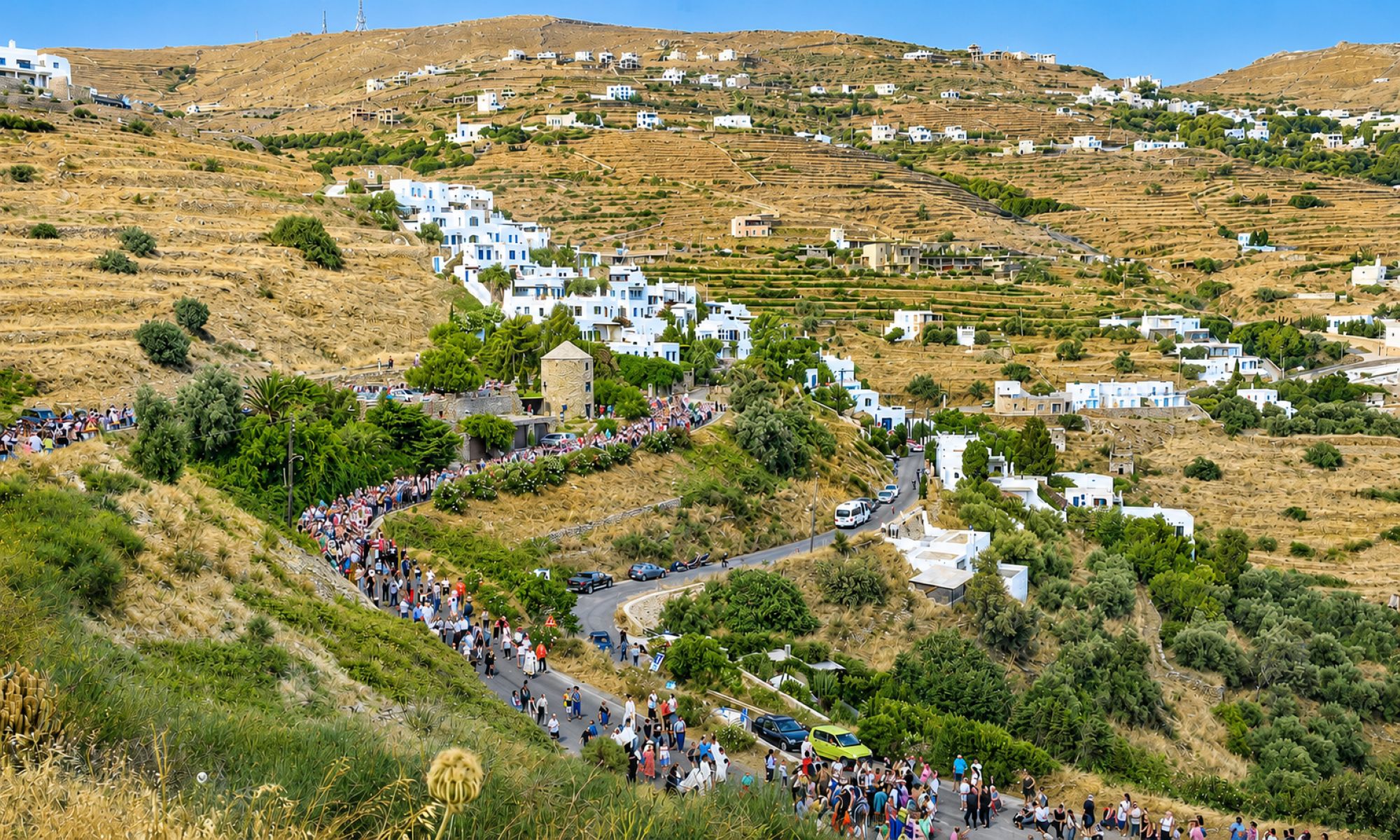
Each year on July 23, Tinos celebrates the feast day of Saint Pelagia, bringing together clergy, island residents, and pilgrims from across Greece and abroad. The celebration begins the day before with a solemn Vespers service. Then, on the morning of the feast, the sacred icon of Panagia Evangelistria is carried out of the church in Chora for the traditional procession to the Monastery of Kechrovouni, where Saint Pelagia lived. Thousands of pilgrims accompany the icon on foot along the roughly five-mile route. As the procession winds through the villages, church bells ring, and residents welcome the icon with flowers, incense, and prayers.
At the monastery, a Hierarchical Divine Liturgy is held, and pilgrims have the opportunity to venerate the relics of Saint Pelagia. The nuns continue the monastery’s long-standing tradition of hospitality by welcoming visitors with refreshments and traditional treats. For travelers visiting Greece, the feast offers a unique opportunity to experience Tinos not only as a beautiful Cycladic island but also as a living center of faith, history, and tradition.
An ongoing legacy
Saint Pelagia died in 1834, returning to the quiet monastic life she had always embraced. According to Orthodox tradition, she never sought recognition, attributing the events surrounding the discovery of the icon to the Virgin Mary. Her relics remain at the Monastery of Kechrovouni, where pilgrims continue to honor her.
Today, many visitors arriving on Tinos first catch sight of the impressive marble Church of Panagia Evangelistria overlooking the harbor. Yet the island‘s most enduring story begins high above the sea within the humble walls of a monastery where a simple nun became forever linked with one of Greece’s most cherished religious traditions.
As Tinos once again celebrates Saint Pelagia, her legacy lives on in every procession, each prayer, and every pilgrim who makes the journey to Kechrovouni in July. More than two centuries after her reported visions, the story of Saint Pelagia continues to unite faith, history, and the enduring spirit of Greece.
See all the latest news from Greece and the world at Greekreporter.com. Contact our newsroom to report an update or send your story, photos and videos. Follow GR on Google News and subscribe here to our daily email!

