



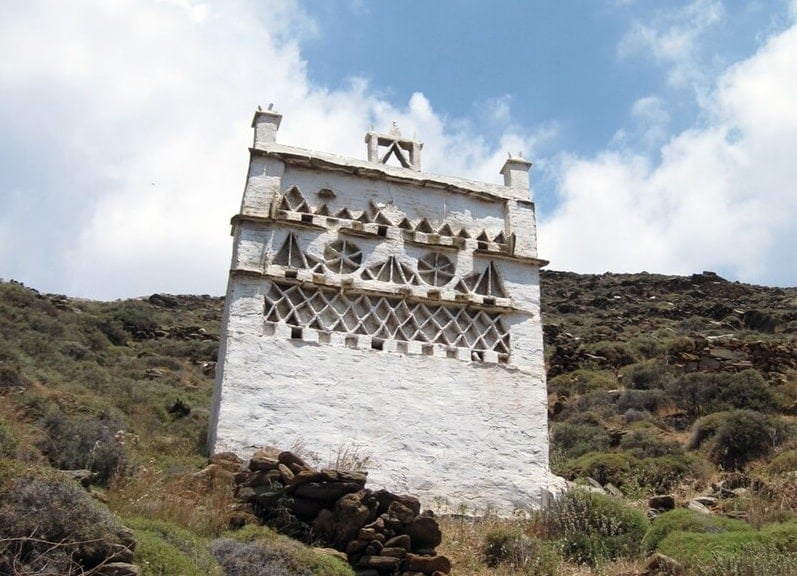
Greece’s Tinos is famous, among other things, for its dovecotes or peristeriones, which are dotted throughout the island. They are not just simple birdhouses, but masterpieces of folk art and historical monuments that tell the story of the island’s economic and social past.
There are over 1,000 of these structures on Tinos, making the island home to the most significant concentration of dovecotes in the Cyclades. They are a defining feature of the rugged, verdant valleys, particularly noticeable in areas like the valley of Tarabados.
Giannis Psaltis, the president of the Tinos Environmental Protection and Reforestation Association “Friends of the Green”, spearheads efforts to keep the dovecotes standing.
“In Tinos, we grew up with the dovecotes. When we founded the Association in 1975, one of our first priorities was to take action to save them. Fifty years later, we have managed to restore 148 buildings out of the slightly more than a thousand, which are scattered across the island. Our dream is to see the dovecotes come back to life,” he told Greek daily Kathimerini recently.
Dovecotes on Tinos were a Venetian status symbol
The tradition of pigeon breeding was introduced by the Venetians, who controlled Tinos from the 13th to the 18th century. Initially, the right to own and maintain these structures was reserved exclusively for the wealthy nobility. Consequently, the size and elaborate nature of a dovecote became a potent symbol of its owner’s status and financial power.
When the Venetians departed, the privilege was extended to local landowners. This spurred a construction boom in the 18th and 19th centuries, transforming the structures into the decorative monuments we see today.
While stunning to look at, the dovecotes were essential to the island’s agricultural economy. Pigeons provided a valuable and reliable source of meat for the local diet.
“Our ancestors smoked pigeons, put them in large clay pots with oil or fat, and sent them to Izmir and Constantinople. The dovecotes were a key part of the economic and social life of the place, ” Psaltis said. He added that pigeons were one of the best foods that the feudal lords of that time sought to have at their Sunday meal.
Perhaps more importantly, the birds’ droppings were prized as the finest natural fertilizer. This nutrient-rich manure was vital for enriching the island’s cultivated fields and even became an important export product, contributing significantly to Tinos’ prosperity.
To ensure the birds thrived, the dovecotes were strategically built on slopes and in ravines to shelter them from the strong Aegean winds and were always placed near a reliable water source.
Masterpieces of folk architecture
What makes the Tinian dovecotes truly unique is their dazzling architecture and ornamentation. They are typically two-story structures built with local stone, often whitewashed, with the pigeons nesting on the upper level and the ground floor used for storage.
The exterior facades showcase an incredible artistry, frequently described as “stone embroidery.” Local marble, slate, and schist rock are meticulously arranged into geometric patterns—circles, squares, triangles, and rhomboids—that form decorative friezes.
These patterns are not just for show; they create small, protective niches and entry points where the pigeons could rest and find shelter from the elements.
No two dovecotes are exactly alike; each is a unique expression of the local craftsman’s skill and the owner’s creativity, leaving a fascinating, beautiful, and lasting legacy imprinted across the Tinian countryside.
Related: Tinos: This Unique Greek Island Will Enchant You
See all the latest news from Greece and the world at Greekreporter.com. Contact our newsroom to report an update or send your story, photos and videos. Follow GR on Google News and subscribe here to our daily email!

