



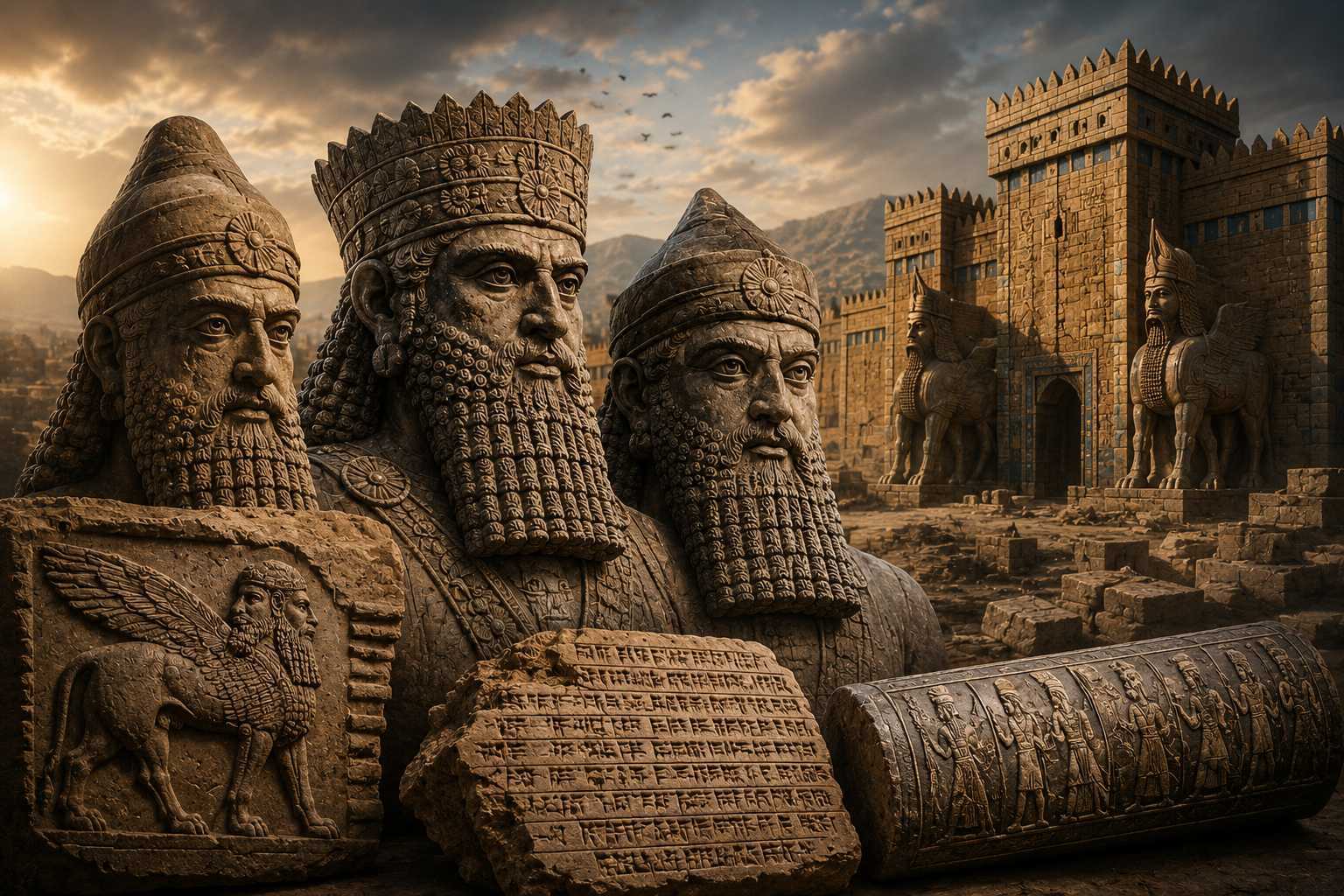
For more than a century, historians believed the Assyrian King List recorded every ruler who governed the Neo-Assyrian Empire. A new study on the forgotten kings of Assyria challenges that view. Researchers argue that at least three short-lived kings ruled parts of Assyria but were later removed from the official historical record.
The study was led by Alexander Johannes Edmonds and co-authored by Eckart Frahm. It concludes that Assyria’s royal succession was far more unstable than previously thought.
Rather than recording every king, the famous Assyrian King List appears to have preserved only rulers whose reigns lasted long enough or proved successful enough to be considered legitimate by later scribes.
Official king list may have hidden political turmoil
The Assyrian King List has long served as one of the foundations for reconstructing Assyrian history. Historians generally treated it as a complete record of kings who ruled between roughly 1000 and 609 BCE.
The new research disputes that assumption. Researchers examined royal inscriptions, administrative records, eponym chronicles, and damaged cuneiform tablets. They argue that the official list was not simply a historical document. Instead, it also served as a political tool that promoted an ideal picture of uninterrupted royal succession.
According to the study, scribes updated the list over time while quietly removing rulers whose reigns ended in defeat or whose claims to the throne later became politically inconvenient.
Evidence points to three forgotten kings
The strongest case involves a previously unknown king named Tiglath-pileser, who appears to have seized power during a rebellion in 763 BCE.
Researchers reexamined a damaged royal land grant that had puzzled scholars for more than a century. Earlier interpretations created impossible dates because they identified the issuing king incorrectly. The new reading suggests the document was issued by another ruler named Tiglath-pileser rather than the well-known King Adad-nārārī III.
A study argues that the famous Assyrian King List deliberately omitted three short-lived rulers who briefly claimed the throne before being erased from history. Researchers say the findings reveal that Assyria's royal succession was far more contested than historians believed. pic.twitter.com/iyDSWXybe7
— Tom Marvolo Riddle (@tom_riddle2025) July 10, 2026
The study argues this rebel king ruled from the religious capital of Aššur after taking advantage of political unrest that followed a dramatic solar eclipse in 763 BCE. His reign probably lasted less than two years before loyal forces removed him from power. Evidence for the rebellion also survives in Assyrian chronicles that mention unrest in the city during the same period.
Researchers also identify a previously unknown King Shalmaneser, who may have briefly ruled after Aššur-nārārī V around 747 BCE before losing the throne to Tiglath-pileser III in 745 BCE.
Their conclusion comes from a famous Assyrian monument where the name “Shalmaneser” had later been carved over and replaced with “Tiglath-pileser.” The researchers argue this alteration reflects political change rather than a simple correction or mistake. They say the overwritten inscription preserves evidence of a king later excluded from official history.
Earlier ruler may also have been erased
The third forgotten king lived nearly two centuries earlier. Researchers reexamined an inscription describing repairs to a ceremonial silver vessel dedicated to the god Aššur. The text credits a ruler named Aššur-uballiṭ, even though no king by that name appears in the accepted sequence for the period.
Instead of dismissing the inscription as an error, the researchers argue it preserves the memory of another short-lived king whose reign was later suppressed after he was overthrown by Adad-nārārī II. Additional archaeological evidence, including a damaged royal statue that appears to have been deliberately altered, supports the idea of a contested succession during this period.
A more complicated picture of Assyrian rule
The study concludes that Assyria experienced repeated succession struggles throughout the Neo-Assyrian period rather than only during its final centuries.
According to the researchers, each of the three forgotten rulers briefly gained support from members of Assyria’s political, military and religious elite. All were eventually defeated, and later officials attempted to erase their memory by removing references from royal records and rewriting inscriptions.
The authors stress that these discoveries do not significantly alter Assyrian chronology after 911 BCE. However, they do change how historians should interpret the Assyrian King List. Rather than treating it as a complete record of every ruler, researchers argue it should be viewed as a carefully edited list of kings considered legitimate by later generations.
If accepted by other historians, the findings could reshape understanding of Assyria’s political history and even lead scholars to reconsider how several famous Assyrian kings are numbered in the future.
See all the latest news from Greece and the world at Greekreporter.com. Contact our newsroom to report an update or send your story, photos and videos. Follow GR on Google News and subscribe here to our daily email!

