



The Lavrio silver mine in Greece became central to the first instance of stock market fraud and early financial speculation in the modern history of the country before there was even a stock market in the newly established Greek state.
In Ancient Greece, the Lavrio silver mine was a major source of wealth for Athens, helping finance the powerful Athenian fleet that ultimately defeated the Persians at the historic naval Battle of Salamis. More than two millennia later, control over the Lavrio silver mine once again took center stage, as questions of ownership helped destabilize governments, triggered a diplomatic episode involving France and Italy, and ultimately became entangled in what is considered the first stock market fraud in a country that had not yet formally established a stock exchange.
Mining at Lavrio dates back to around 3000 BC, and during the Classical period, the mines served as a major source of wealth for Athens. After antiquity, however, mining and metallurgical activity gradually came to a halt.
In 1864, however, Italian businessman Giovanni Battista Serpieri, who owned mines in Cagliari, Sardinia, was introduced to the work of mineralogist Andreas Cordellas, whose studies had been submitted to the Greek Ministry of Finance. Cordellas strongly advocated for the reopening of the Lavrio silver mines, and Serpieri, who had arrived in Greece in 1863 as a representative of a European company, quickly recognized the opportunity.
Serpieri acquired extensive tracts of land from the Monastery of Penteli and the community of Keratea, totaling 10,791 acres, rich with ancient mining slag. In April 1864, he established the Italian-French metallurgical company Roux-Serpieri-Fressynet C.E. in Lavrio, which soon developed into one of Greece’s most significant industrial hubs of the era, featuring blast furnaces, metalworks, chemical laboratories, and storage facilities. By 1867, the metallurgical plant employed approximately 1,200 workers.
The point of friction between the company and the Greek State
However, the area also contained large piles of metal-bearing waste, or slag pits, which the company had no legal right to exploit despite its insistence that it did. The Italian-French metallurgical company soon found itself in direct conflict with the Greek government over control of these valuable residues.
At the same time, segments of the Greek press dramatically inflated the estimated value of the slag deposits, claiming they were so extensive they could resolve Greece’s economic problems. In response, the government of Alexandros Koumoundouros passed legislation nationalizing the slag pits, which provoked strong opposition from the company as well as diplomatic pressure from France and Italy, whose intervention the firm sought. The company even demanded compensation from the Greek state amounting to 15 million drachmas, an enormous sum for the period.
This dispute over slag exploitation and the political tensions that followed became known as the “Lavriotika.” In March 1871, a bill was introduced in Parliament proposing the taxation of surplus materials. Although the government of Epaminondas Deligiorgis rejected the proposal, it simultaneously prohibited any further use of metallurgical residues and deployed military forces to secure the Lavrio mines. In April of the same year, another bill was introduced calling for the nationalization of the surpluses.
France and Italy clash with Greece over Lavrio silver mine
The governments of France and Italy soon responded, demanding that the dispute between the company and the Greek state be submitted to international arbitration. France went even further, openly threatening Greece that if it refused, its navy would blockade Greek ports.
Shortly afterward, the French government introduced new legislation affecting maritime trade. Additional taxes were imposed on goods transported by foreign-flagged vessels traveling from third countries into France. These measures disproportionately affected Greek shipping, particularly ships carrying grain from Russia, Romania, and Egypt to French ports. At the same time, France left its ambassadorial post in Greece vacant, further heightening tensions.
The reaction placed significant strain on the Greek government and contributed to a broader political crisis marked by repeated resignations and rapid changes of leadership. The government of Alexandros Koumoundouros collapsed, followed by those of Thrasyvoulos Zaimis and Dimitrios Voulgaris. A new administration was eventually formed under Epaminondas Deligiorgis, who had initially raised the issue of the slag pits. Deligiorgis insisted that the company be brought before Greek courts to settle the dispute.
King George I of Greece ultimately intervened, and at his request, Andreas Syggros, acting as a representative of the Bank of Constantinople, reached an agreement with Serpieri in February 1873. The negotiations concluded with a settlement in which the company was renamed the Lavrio Metallurgical Company, the Greek state secured 44 percent of net profits, and the firm was granted exploitation rights for 99 years. Serpieri, meanwhile, established another joint French-Hellenic company, the “Mines of Kamariza.”
The escalating tensions between France, Italy, and Greece over the Lavrio silver mine, combined with economic speculation and state financial instability, became part of the broader historical context surrounding Greece’s early experience with stock market activity and fraud.
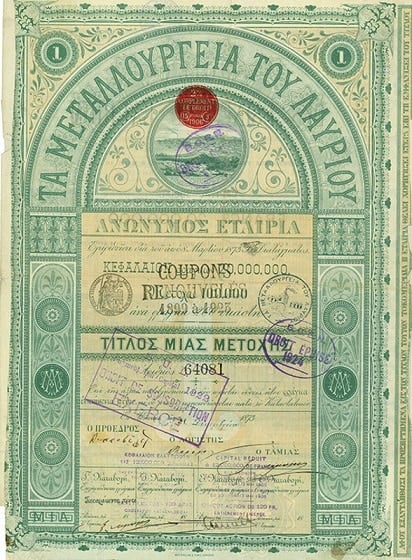
Greek capitalist Andreas Syggros and the first case of stock market fraud in modern Greece
Syggros, together with other members of the Greek diaspora communities in Constantinople and Odessa, led by Evangelos Baltatzis, founded the National Credit Bank (Ethniki Pistotiki Trapeza). The banker had previously accumulated significant wealth as a merchant and later became the majority shareholder in the Bank of Constantinople.
Amid the intense public controversy, driven by prolonged parliamentary debate and the involvement of prominent businessmen and foreign governments, an impression emerged that gold could be found within the metallurgical waste at Lavrio. The support of the newly established bank for the silver mine project further reinforced public confidence in the venture. Syggros understood that gold might never actually be extracted from the pits, but he recognized the opportunity created by the widespread speculation. He proceeded to privatize the Lavrio Metallurgical Company and immediately issued shares.
At the time, the Greek public had little to no knowledge of modern financial markets. Syggros increased the price of the shares by 50 to 100 drachmas, taking advantage of inexperienced yet ambitious investors who rushed to purchase securities, often paying up to three times their actual value. Many believed the waste from the silver mines contained gold as well, leading people to sell their land or exchange their fortunes for shares that ultimately proved to be worthless.
In February 1874, Deligiannis was forced to resign as prime minister after being blamed for the silver mine fiasco. The sharp rise in stock prices was followed by a steep decline, resulting in the first stock market fraud scandal in modern Greece and leading thousands of Athenians into financial collapse. Between 1873 and 1875, bankruptcies in Greece doubled. The press accused Syggros of causing the financial ruin of thousands of citizens, portraying him as a reckless speculator. Numerous cartoons and defamatory articles targeting him flooded newspapers for months, and amid the growing backlash, Syggros eventually left Greece.
Greece’s first stock market fraud: Syggros’ fall, return, and controversial legacy
In 1881, following the annexation of Thessaly into the Greek state, Syggros founded the Privileged Bank of Epirothessaly in Volos and dedicated substantial funds to public works. Among his many contributions, he helped establish museums in Delphi and Olympia and supported the completion of the Corinth Canal. In Athens, he founded the Evangelismos Sanatorium, the Syggros Dermatological Hospital, the Syggros Prison, the Municipal Theater of Athens, and numerous other smaller public projects. Some believed that he became a major benefactor of Athens in an effort to rebuild his reputation after being labeled “Lavriophagos” (“Lavrion Eater”) by Athenians following the silver mine scandal.
In his memoirs, Syggros wrote that he returned to Greece to take advantage of “the infantile state of the financial sector.” Regardless of his motives, he became one of the most influential bankers of his era and the greatest Greek stock market speculator of his time despite the fact that Greece did not yet have an official stock market. In fact, discussions surrounding the silver mine transaction, the creation of the National Credit Bank, and the sale of Lavrion mine shares took place at an Athens coffeehouse called “Beautiful Greece.”
In spite of the public works he funded for the benefit of society, Syggros continued to face accusations that his financial ambitions had contributed to Greece’s economic struggles. He entered politics and was elected as a representative for Syros, yet the press and political opponents continued to accuse him of speculation at the country’s expense. In January 1894, dynamite charges exploded in the garden of his mansion, resulting in minor property damage. In the 1899 elections, he was elected as a member of Parliament for Attica with 15,139 votes, but he died later that same year.
Despite his reputation among many Greeks as a con man linked to the first stock market fraud in modern Greece, Syggros was honored at his funeral by the royal couple, the prime minister, and numerous prominent politicians and businessmen of the time.
See all the latest news from Greece and the world at Greekreporter.com. Contact our newsroom to report an update or send your story, photos and videos. Follow GR on Google News and subscribe here to our daily email!

