



A student aerospace team from Aristotle University of Thessaloniki has successfully tested Greece’s first publicly documented liquid-propellant rocket engine, marking a major milestone for the country’s emerging aerospace sector.
ASAT, the Aristotle Space and Aeronautics Team, designed and developed the engine entirely in-house. The team operates within the Department of Mechanical Engineering at the university’s Polytechnic School and is considered the largest student aerospace team in Greece.
A major Step for Greek aerospace engineering
The static test campaign began in April 2026 and took place at a closed, controlled testing site in northern Greece. During the most demanding phase, the team carried out a series of consecutive ignition and combustion cycles to assess the engine’s performance under real operating conditions.
Throughout the procedure, the rocket engine remained fixed to the ground while ASAT members collected key engineering data. The team monitored pressure and temperature, recorded the engine’s generated thrust, and controlled the flow of propellants with precision.
As a result, the successful completion of the campaign confirmed both the technical integrity and the potential of a project considered unprecedented for Greece.
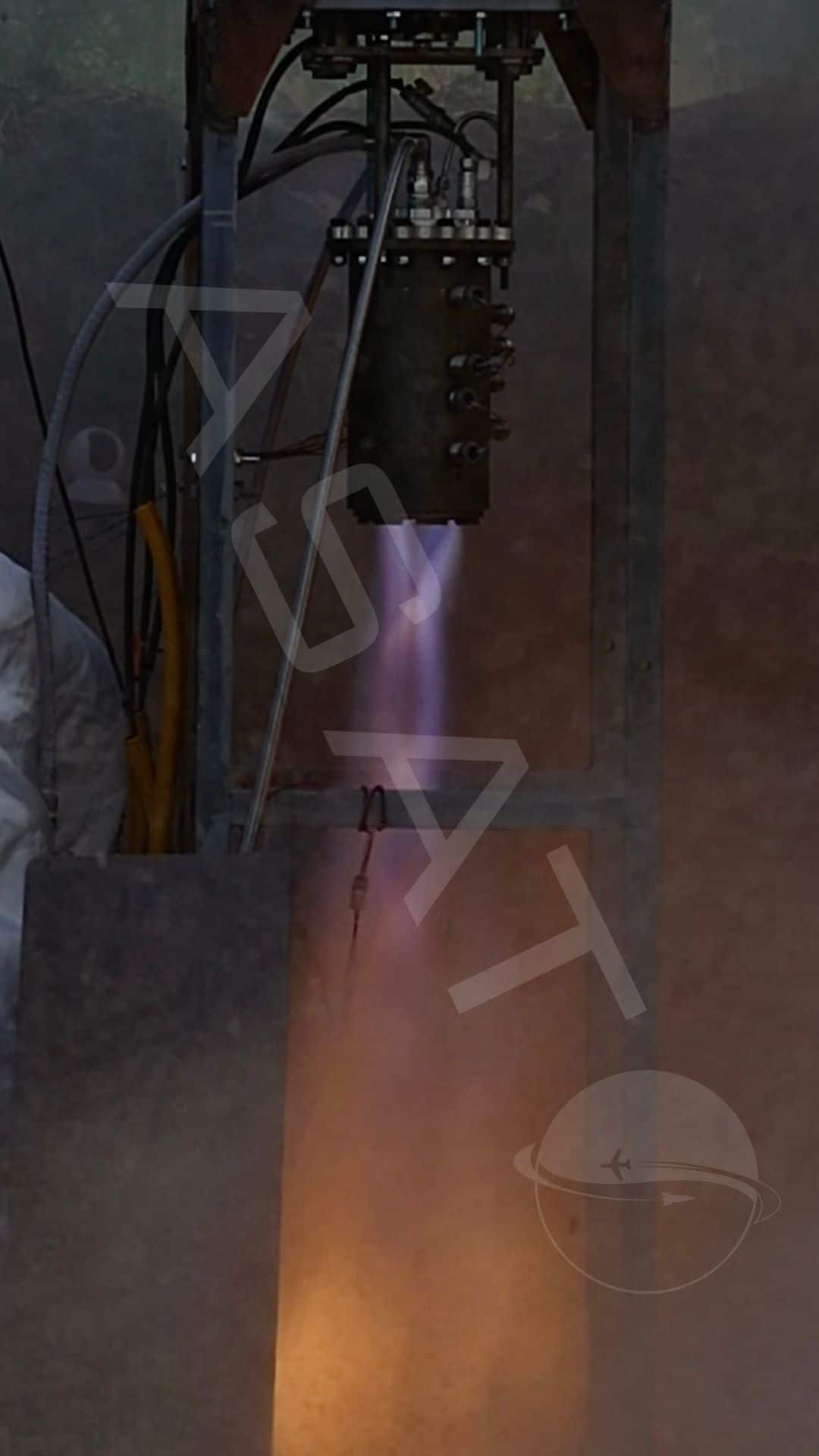
Greece’s ASAT student team powers rocket engine with liquid oxygen and ethanol
The engine uses liquid oxygen, known as LOX, and ethanol as propellants. According to the technical specifications released by ASAT, it produces 5,500 newtons of thrust and operates with a combustion chamber pressure of 40 bar.
In addition, its feed system relies on an advanced pressure-fed network, with operating pressures reaching up to 300 bar. ASAT designed and built the entire engine from scratch.
The main technical characteristics are:
- Propellants: Liquid Oxygen, LOX, and Ethanol
- Generated thrust: 5,500 N
- Combustion chamber pressure: 40 bar, or 4,000,000 pascals
- Feed system: Advanced pressure-fed network with operating pressures up to 300 bar, or 30,000,000 pascals
- Development: 100 percent in-house design and implementation from scratch
In-House platform managed real-time data
The Main Operations Platform, or MOP, played a central role in the testing process. The system’s main computer collected, processed, and managed data in real time throughout the test campaign.
ASAT developed MOP as a 100 percent in-house, high-performance electronics board. The platform uses an advanced Xilinx FPGA SoC architecture, allowing the team to handle demanding test conditions and monitor the engine’s behavior with accuracy.
At the same time, the platform highlights the broader technical scope of the project, which extended beyond propulsion and included electronics, control systems, data handling, and operational safety.
Sponsors and University funding supported the project
The project required significant resources, specialized components, and controlled testing infrastructure. Company sponsorships covered around 70 percent of the funding, while the Special Account for Research Funds of Aristotle University of Thessaloniki provided additional support.
Together, private-sector backing, university support, and student-led engineering helped the team complete the tests safely and successfully.
ASAT student team in Greece prepares for next flight after rocket engine test
Following the successful static tests and the safe operation of the system, ASAT is now preparing for its next major milestone: the first flight of a new, more powerful rocket.
The planned rocket is expected to reach an apogee of more than 5 kilometers and a speed of Mach 1.5.
See all the latest news from Greece and the world at Greekreporter.com. Contact our newsroom to report an update or send your story, photos and videos. Follow GR on Google News and subscribe here to our daily email!

