



A growing body of evidence points to contact between Mycenaeans and Scandinavians during the Bronze Age, suggesting elite networks may have connected southern and northern Europe more closely than previously thought. Researchers say shared symbols, rare materials, and burial evidence point to cultural connections between Mycenaean Greece and early Scandinavian societies.
A study led by I.B. Gubanov and published in Archaeology, Ethnology and Anthropology of Eurasia, focuses on royal graves at Mycenae. These burials, especially those in Grave Circle B (Greek: Ταφικός περίβολος Β), offer clues about long-distance links during the mid- to late second millennium B.C.

Evidence from royal burials
Artifacts from two graves, known as Gamma and Omicron, indicate contact between elites in the Eastern Mediterranean and those of the Scandinavian Bronze Age. Researchers highlight decorative patterns and imported materials that suggest ideas and goods traveled far beyond their place of origin.
One key detail is the appearance of the “running spiral” motif in Scandinavia. This design emerged roughly at the same time as the rise of the Mycenaean civilization. Researchers say the timing is important, as such motifs often carried symbolic or social meaning rather than serving as simple decoration.
Shared symbols across regions
Images of ships with rams also appear in Scandinavian contexts during this period. These ship forms resemble those linked to Mediterranean cultures. Because ships were central to trade and power in the Bronze Age, similar designs across regions may reflect shared influence rather than coincidence.
Amber offers another strong piece of evidence. Baltic amber was highly valued and widely traded across Europe. The study notes that amber appears in royal Mycenaean burials but is absent from sites in (Minoan) Crete. This pattern suggests that Mycenaean elites may have had direct or indirect access to northern trade routes.
Researchers do not argue that Mycenaeans sailed directly to Scandinavia. Instead, they propose that Mycenaean elites played a major role in spreading cultural elements northward through connected exchange networks. These links likely developed through a chain of interactions across Europe.
Gold ornaments reveal wider connections
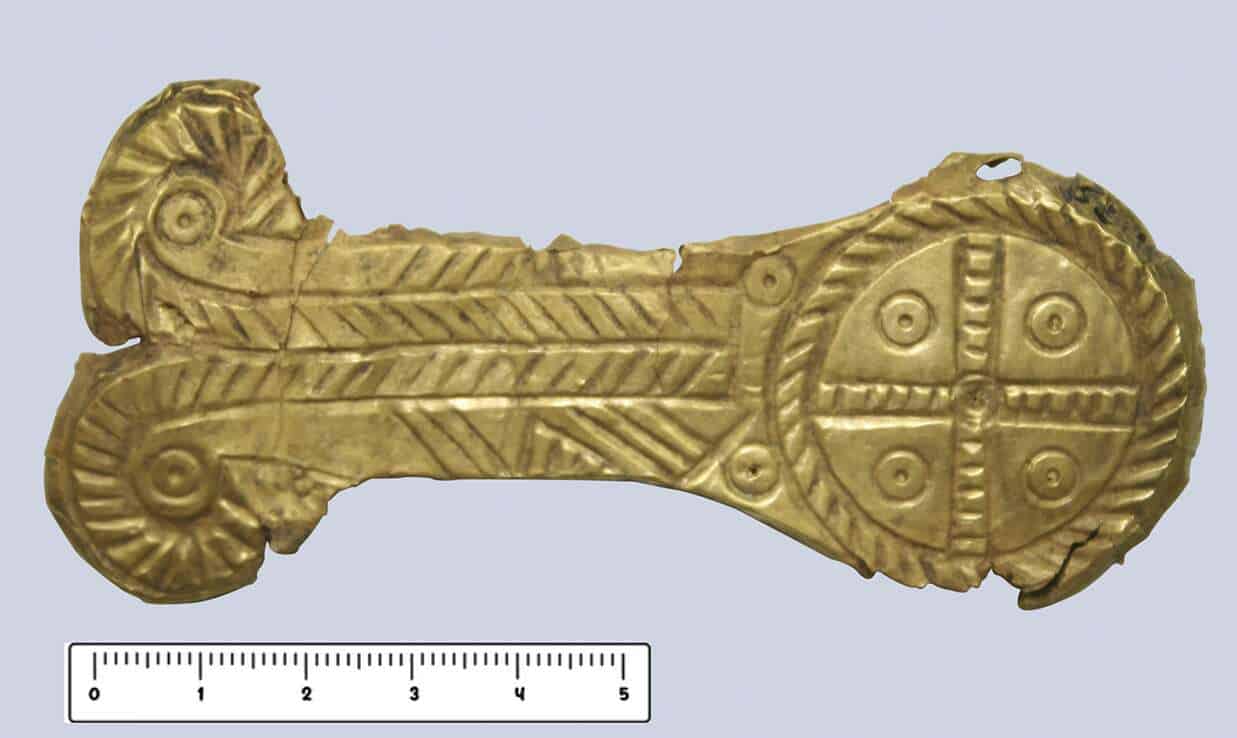
Additional findings from the Greek island of Kefalonia support the idea of long-distance cultural exchange. A separate study led by Christina Souyoudzoglou-Haywood, published in the European Journal of Archaeology, examines two delicate gold ornaments that carry symbols linked to northern Europe.
The objects were found in cemeteries at Mazarakata and Lakkithra. Both are made from thin sheets of gold and decorated with geometric designs. One shows concentric rings, while the other features a four-spoked wheel inside a circle.
Researchers say these patterns closely match solar symbols known from central and northern Europe. Such symbols were often tied to beliefs about the sun and the cosmos. Their presence in the Aegean suggests that ideas moved alongside goods during the Bronze Age.
Cultural exchange after collapse
Kefalonia’s location along key sea routes made it an important link between the Aegean and the wider Mediterranean. After the collapse of Mycenaean palace systems around 1200 B.C., trade became less controlled. This shift may have allowed cultural ideas to spread more freely.
The study also shows that these symbols were not simply copied. One ornament may have been imported, while the other appears to have been made locally using Aegean techniques. Researchers describe this as an adaptation rather than direct borrowing.
Both ornaments were placed in graves, suggesting they signaled status and identity. Their use in burial contexts also points to evolving beliefs about death and the afterlife.
A connected Bronze Age world
Together, the findings suggest that Bronze Age Europe was more connected than previously believed. From Mycenaean graves to Scandinavian symbols and Kefalonian goldwork, the evidence points to a network of exchange that carried ideas, materials, and cultural meaning across long distances.
See all the latest news from Greece and the world at Greekreporter.com. Contact our newsroom to report an update or send your story, photos and videos. Follow GR on Google News and subscribe here to our daily email!

