



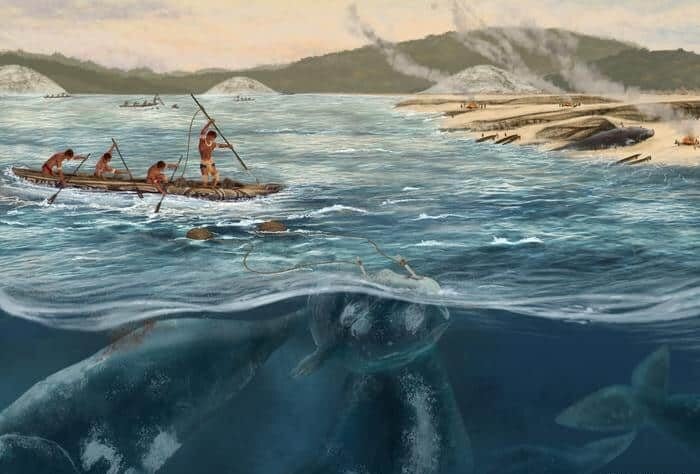
The hunting of large whales began thousands of years earlier than scientists once believed, according to new research from South America that is reshaping long-held views of early maritime societies.
Researchers report that Indigenous coastal communities were hunting large cetaceans about 5,000 years ago—roughly 1,000 years earlier than the earliest documented evidence from Arctic and North Pacific regions. Until now, large whale hunting was thought to have emerged mainly among postglacial societies in the Northern Hemisphere between about 3,500 and 2,500 years ago.
The study, published in Nature Communications, was led by researchers from the Institute of Environmental Science and Technology at the Universitat Autònoma de Barcelona and the university’s Department of Prehistory. It focuses on archaeological evidence from Babitonga Bay in the southern Brazilian state of Santa Catarina.
Shell mounds reveal complex coastal societies
The research centers on sambaquis—monumental shell mounds built by Holocene-era societies along Brazil’s coast. Long interpreted mainly as refuse piles or burial sites, the structures are now seen as signs of complex and well-organized coastal cultures with advanced maritime knowledge.
Researchers examined hundreds of cetacean bone remains and bone tools recovered from sambaquis in the region. Many of the original sites no longer exist due to urban development, making museum collections critical to the study.
The materials are preserved at the Museu Arqueológico de Sambaqui de Joinville, which now serves as a rare archive of this ancient coastal history.
Scientific analysis confirms active whale hunting
To analyze the remains, the research team combined zooarchaeology, typological analysis, and advanced molecular methods known as ZooMS. This approach allowed scientists to identify multiple whale species, including southern right whales, humpback whales, blue whales, sei whales, sperm whales, and dolphins.
Many of the bones showed clear-cut marks. Researchers say these marks are consistent with butchering and provide strong evidence that the animals were actively hunted rather than scavenged after stranding.
The team also documented large harpoons made from whale bone, among the largest ever found in South America. The tools were discovered alongside abundant whale remains and, in some cases, within burial contexts. The presence of inshore species further supports the conclusion that whale hunting was deliberate and organized.
Ancient shell mounds along Brazil’s coast reveal that Indigenous societies were skilled whalers 5,000 years ago, challenging long-held ideas about early maritime cultures and whale hunting origins. pic.twitter.com/ZCyKqEulOW
— Tom Marvolo Riddle (@tom_riddle2025) January 9, 2026
Krista McGrath, the study’s lead author, said the evidence shows these communities had detailed knowledge of whale behavior and possessed the tools and cooperative strategies needed to hunt massive marine animals far earlier than researchers had assumed.
Findings reshape whale ecology and conservation history
The study also carries important ecological implications. The high number of humpback whale remains suggests the species once ranged much farther south than its main breeding areas today along Brazil’s coast.
Marta Cremer, a co-author of the study, said the recent rise in humpback sightings in southern Brazil may reflect a long-term return to historical habitats. She noted that reconstructing whale distributions before industrial whaling is essential for understanding modern recovery patterns and guiding conservation efforts.
A new view of Sambaqui social organization
Beyond rewriting the history of whale hunting, the research offers new insight into the economies and social organization of South America’s postglacial coastal societies.
André Colonese, the study’s senior author, said the findings challenge earlier views of the Sambaqui peoples as primarily shellfish collectors and fishers. Instead, the evidence shows they were also skilled whalers with a sophisticated maritime culture.
Brazilian archaeologist Dione Bandeira, who has studied sambaquis for more than 20 years, said whale hunting likely played a major role in sustaining dense and long-lasting coastal settlements. Marine resources, she said, were deeply woven into cultural practices, technology, and ritual life.
Preserving an unwritten Indigenous history
Ana Paula, director of the Museu Arqueológico de Sambaqui de Joinville, said the museum’s collections—especially the Guilherme Tibúrtius Collection—continue to reveal the richness of ancestral coastal societies.
She noted that much of this Indigenous history survives only through preserved artifacts and the work of those protecting sambaqui sites that escaped centuries of urban expansion. Researchers say these collections now serve as a crucial link to understanding the lives, knowledge, and traditions of Brazil’s early coastal peoples.
The study adds to growing evidence that advanced maritime traditions developed earlier and in more regions than once believed, placing South America firmly within the global history of early whale hunting.
See all the latest news from Greece and the world at Greekreporter.com. Contact our newsroom to report an update or send your story, photos and videos. Follow GR on Google News and subscribe here to our daily email!

