



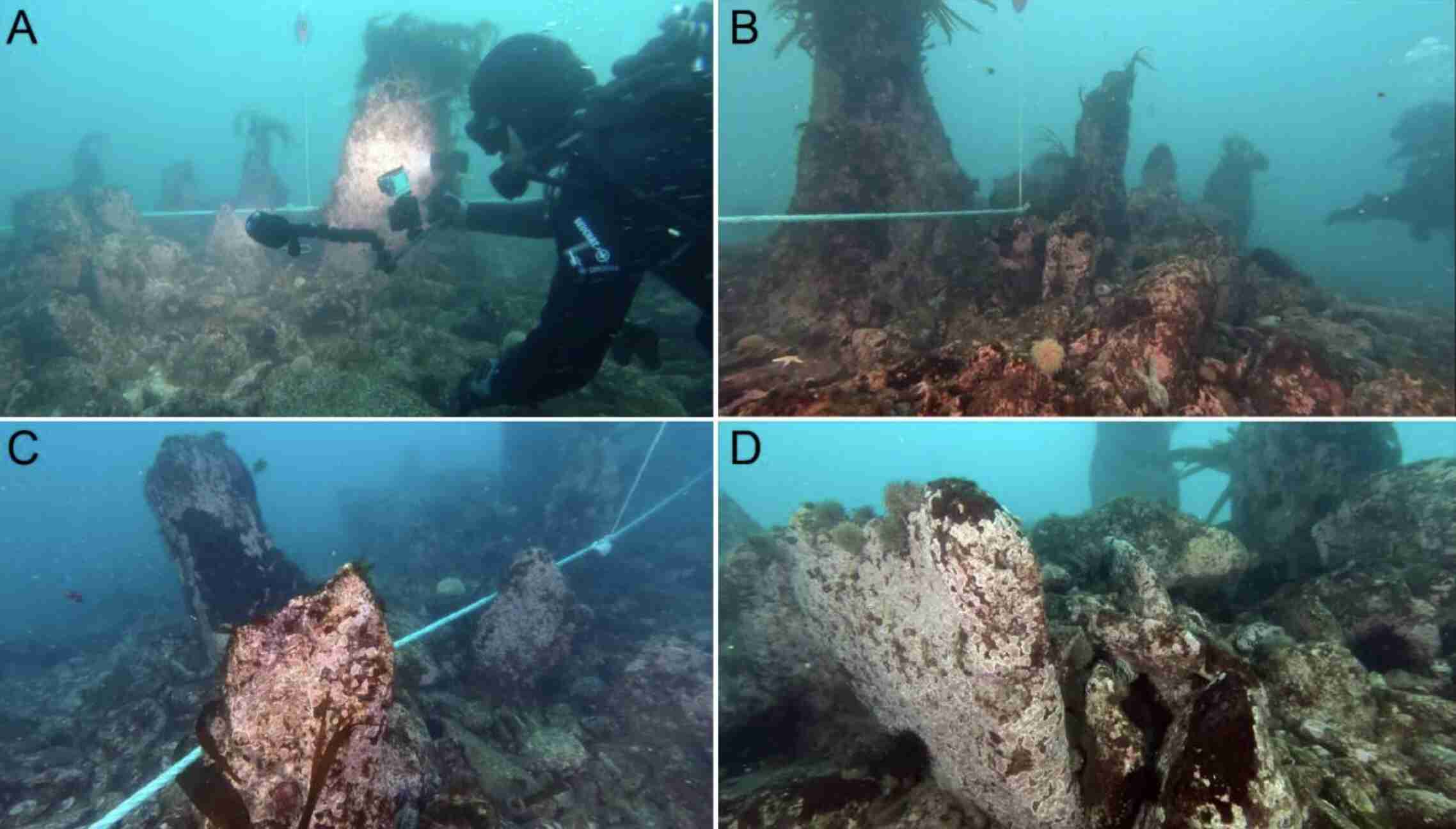
Marine archaeologists uncovered a massive 7,000-year-old undersea wall off the coast of Brittany in France. Stretching 120 meters (394 feet) long and weighing an estimated 3,300 tonnes, the stone formation is believed to be the largest underwater construction ever found in the country.
Researchers say the wall dates back to around 5,000 BC and may have been built by a late Mesolithic or early Neolithic society. Located near the Île de Sein, the structure now sits nine meters (30 feet) underwater, but when first constructed, it likely stood along the shoreline between high and low tides. Over time, as sea levels rose, much of the island’s landmass disappeared, leaving the wall submerged.
Ancient engineering points to a settled society
The formation measures roughly 20 meters (66 feet) wide and two meters (6.5 feet) high. Divers found granite monoliths arranged in two parallel lines, spaced evenly across the structure. Experts believe these standing stones were anchored directly into the bedrock, with the wall later built around them using slabs and smaller rocks.
Archaeologists suggest the wall served either as a fish trap or as a barrier against encroaching seas. If used for fishing, the upright stones may have held nets made from branches to capture fish as the tide retreated.
Archaeologists have uncovered a 7,000-year-old undersea wall in France off the coast of Brittany. The massive Stone Age structure may be linked to ancient fishing and lost city legends.#Archaeology #France #History #UnderwaterDiscovery #Brittany pic.twitter.com/cy9jXp9ofk
— Tom Marvolo Riddle (@tom_riddle2025) December 12, 2025
The scale and complexity of the structure point to a well-organized, settled community capable of planning and executing large-scale projects.
Yvan Pailler, one of the lead archaeologists on the project, said the construction likely reflects a society that had moved beyond nomadic life, becoming semi-sedentary as resources allowed. He added that it might also have been the work of early Neolithic populations arriving in the region around the same time.
Linking the undersea wall in France to Brittany’s past
Pailler also noted that the granite monoliths bear similarities to Brittany’s famous menhirs, though these underwater stones are older. He believes knowledge of quarrying, shaping and moving such stones may have been shared between the earlier hunter-gatherer groups and the incoming agricultural communities.
The discovery was first made by geologist Yves Fouquet, who spotted the formation while analyzing modern radar-based depth charts. He noticed a straight line blocking an undersea valley near the island, which appeared to be man-made.
Initial surveys began in summer 2022, but a full examination had to wait until winter, when seasonal seaweed cleared. In a paper published in the International Journal of Nautical Archaeology, researchers suggest that submerged sites like this may have inspired local legends of sunken cities, including the myth of Ys, believed to lie just east of the discovery site.
The study concludes that the sudden submersion of a developed community may have left a lasting impression, passed down through generations in the form of regional folklore.
See all the latest news from Greece and the world at Greekreporter.com. Contact our newsroom to report an update or send your story, photos and videos. Follow GR on Google News and subscribe here to our daily email!

