



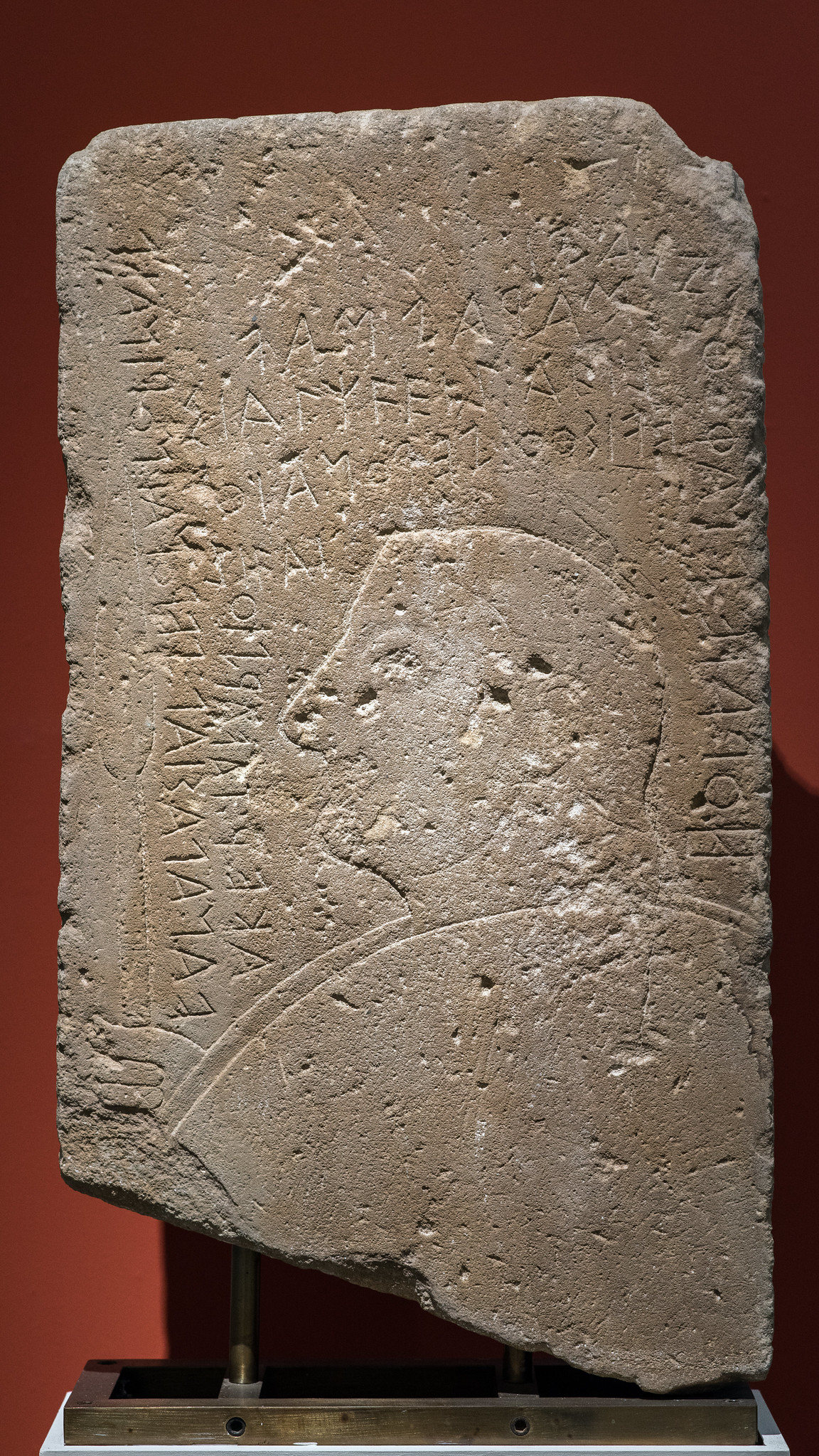
The story of the Lemnian Stele (also known as the Kaminia Stele) begins in 1885 in the village of Kaminia on the Greek island of Lemnos.
An unsuspecting farmer, while clearing stones from his field near the ruins of the local chapel of Aghios Alexandros, unearthed an ancient stone slab. This artifact would go on to become one of the greatest archaeological and linguistic puzzles to this day.
Present at the discovery was the teenager Argyrios Moschidis, who would later become a renowned philologist and historian. Recognizing the find’s importance, Moschidis entrusted the stele to Ioannis Pantelidis, a wealthy collector of antiquities residing in Myrina.
The French claim and the hiding of the Lemnian Stele
The stele’s existence was first formally published in 1886 by the French Archaeological School of Athens. Based on this early documentation, the French laid claim to the artifact.
Using their embassy in Constantinople, the French obtained an official decree from the Ottoman authorities (who controlled Lemnos at the time) granting them ownership of the stele.
A French warship soon arrived at the Kastro of Lemnos with orders to retrieve the stele. Ioannis Pantelidis, determined to keep the treasure out of foreign hands, bribed the Turkish commander and hastily buried the stele in the massive 20-acre garden of his estate in Myrina, the capital of Lemnos.
Pantelidis claimed the stele had been stolen. Despite thorough investigations and interrogations by French and Ottoman authorities, the stele was not found, and the French warship eventually departed empty-handed.
The stele remained hidden until Pantelidis’s death in 1898.
The smuggling attempt and patriotic donation
Following his father’s death, his highly educated son, Odysseas Pantelidis, a passionate amateur archaeologist, returned from India. After systematic excavation of his father’s 20-acre garden, he successfully rediscovered the buried stele.
Around 1900, Odysseas arranged for the stele to be smuggled out. After again bribing local Ottoman officials, he and a confidant loaded the stele onto a specially chartered sailing vessel bound for Alexandria, while Odysseas traveled separately by steamboat.
Upon meeting the vessel in Alexandria, Odysseas was shocked when the captain claimed the stele had been thrown overboard due to damage sustained at sea. Unconvinced, Pantelidis reported the incident to the Greek Consulate. A thorough search of the vessel, aided by consular authorities, revealed the stele hidden aboard.
Though a wealthy American (possibly Rockefeller) offered 10,000 gold pounds for the famous artifact, the patriotic Odysseas refused all offers, intending to donate it to the National Archaeological Museum of Greece.
Fearing Ottoman retribution—which could prevent his return to Lemnos—Pantelidis hesitated to make a public donation. It was his old friend Argyrios Moschidis, who had since moved to Alexandria, who provided the solution in 1905: Dr. Vasilios Apostolidis, a trusted local physician and amateur archaeologist, would act as the official donor.
Today, the Lemnian Stele is displayed at the National Archaeological Museum in Athens, officially recorded as a “Gift of Dr. V. Apostolidis.” The dramatic efforts and sacrifices made by the Pantelidis family to secure the stele for Greece remain largely unrecognized.
Archaeological significance
The Lemnian Stele, dated to the 6th century BC, is not just a story of adventure; it is critical to understanding the ancient history of the Aegean.
The stele features an inscription of 198 characters written in an alphabet derived from the Greek, but the language itself is not Greek.
This language is known as Lemnian. It exhibits remarkable similarities to the Etruscan language of ancient Italy.
The discovery provided powerful evidence supporting the theory that the pre-Greek inhabitants of Lemnos (known as Pelasgians or Tyrsenians) might be linguistically related to the Etruscans, suggesting a link between the pre-Indo-European cultures of the Aegean and Italy.
Related: The Ancient Lemnian Language and Its Connection to Etruscan
See all the latest news from Greece and the world at Greekreporter.com. Contact our newsroom to report an update or send your story, photos and videos. Follow GR on Google News and subscribe here to our daily email!

