



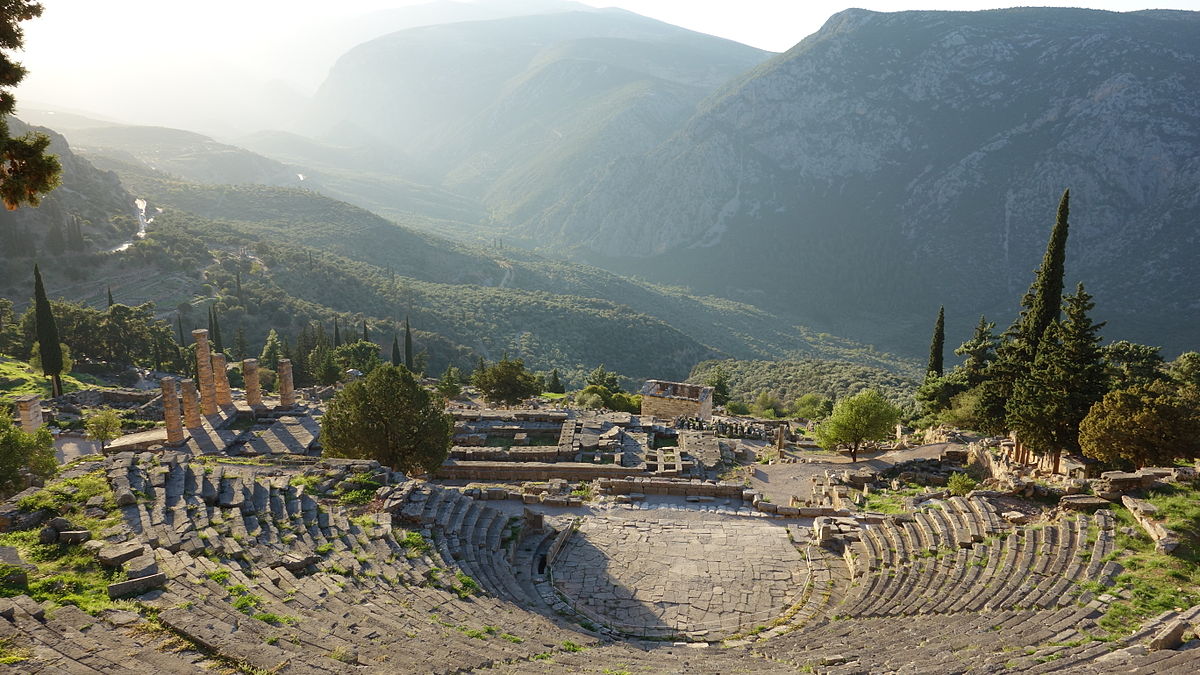
Archaeological findings indicate the presence of a Sun worship cult at Delphi, based on discoveries north of the Temple of Apollo. A study, conducted by Elena Partida, PhD, an archaeologist with Greece’s Ministry of Culture, provides compelling evidence that Helios, the Sun god, was worshiped at the ancient site.
The Temple of Apollo at Delphi was destroyed by fire in 548 BC and later restored by an Athenian aristocratic family, the Alcmaeonids. In addition to the temple structure, the fire consumed numerous gold-and-ivory statues of exceptional artistic mastery that adorned one of the most important sacred grounds in ancient Greece. Along with the larger-than-life bull sculpture, several other offerings to the god were destroyed. The burnt remnants were buried with honors in a repository beneath the processional (sacred) path, in keeping with their status as divine property.
As the ceilings of ancient temples were built using timberwork, they were highly combustible. A notable aspect of ancient Greek temple and domestic architecture was the lack of windows, meaning these spaces depended on artificial light instead of natural illumination. The primary purpose of having no windows in temples and homes was to conserve heat during the winter, which also explains why lamps are frequently found at archaeological sites of various time periods.
Literary sources note that the eternal flame of Hestia burned within the temple. It was said to be lit by Apollo himself and to have never been extinguished. Colonies established following the god’s prophecies received light from this sacred flame. From a scientific perspective, the continuous release of gases from the prophetic crevice—especially methane from the adyton fissure—could plausibly have sustained an eternal flame.
However, the smoke and gases, along with the burning of laurel leaves used to induce the Pythia’s trance for delivering the oracle, would require an outlet. Partida suggests that an oculus in the ceiling allowed sunlight to enter, thus serving such a function.
Ritual fire in Sun worship at Delphi
In terms of sacrificial and ritual fire, a variety of altars was set up at Delphi. There was a Chian altar, still under scholarly debate; a trapezoid altar of Athena Pronoia for animal sacrifices; and a cylindrical marble altar with reliefs depicting maidens decorating garlands, used for sacrifices such as the burning of fragrant plants, also from the sanctuary of Pronoia.
The use of fire was common at Delphi. The numerous bronze statues—including the famous Charioteer, as well as those not preserved or yet unearthed—demonstrate the use of fire in antiquity for forging or casting metal figures, endowing them with a lifelike quality. Pieces of masonry and a mold indicate that bronze foundries had once operated at Delphi.
Although nocturnal ceremonies have not been documented at Delphi, torches were traditionally associated with the cult of Dionysus and his entourage, the Thyiades or Maenads, depicted on the western pediment of the Classical Temple of Apollo. Torches would also illuminate the Corycian Cave on Mount Parnassos, allegedly used for secret religious activities or divination.
Indications of Sun worship at Delphi
On the island of Rhodes, Helios was worshiped as the supreme god. A Rhodian offering to Delphi took the form of a tall pillar surmounted by a quadriga, depicting the chariot of the deified Sun, Helios the All-Seeing, known from vase paintings, coins, bronze figurines, and mosaics up to the Roman imperial period. Apollo Phoebus, meaning “Bright Apollo,” was also venerated as God of the Sun and Light.
The pillar with the Rhodian chariot of the Sun was positioned facing the pediment sculpture of the temple facade, depicting Apollo and his entourage. Partida compares the pillar to that at the main sanctuary on Rhodes, shared by Apollo Pythios and Helios. The pedestal of the solar chariot was set in a cistern coated with waterproof stucco, suggesting that the sun rises from and sets in the ocean. The layout resembles the scheme at Delphi, likewise oriented towards the temple facade.
The Rhodian pillar is not the only finding from Delphi related to the Sun and its worship, particularly that of Helios. A small fragment of a marble relief slab housed in the Delphi Archaeological Museum reveals new aspects of religious symbolism. The fragment was discovered in 1923, embedded in a wall from a later period. Its dimensions rule out its use as a metope, and the plaque appears to be votive. The heads of two figures are preserved, with the one on the right identified as Helios.
While the size of the slab fragment indicates it is a votive offering, the archaeologist suggests it was actually part of the top of a coffer. Representations of the Sun on coffer lids from the Temple of Athena at Priene, the Temple of Apollo at Didyma, and the “Captives’ Façade,” an elaborate two-story public building in Corinth, support this interpretation.
Figurative coffers first appeared in the 4th century BC and were considered an innovation. From its small size, the researcher infers it was not a state offering but a personal dedication.
Depictions of the Sun god in parts of ancient Greece and Delphi
Sculptural representations of the Sun are rare, and most are found in architectural settings, offering evidence of its worship at notable sites such as Delphi. Another example is the Hellenistic head in the Rhodes Museum, restored to look as if it were mounted on a gable. Likewise, the socket on the pediment of the Temple of Isis on Delos probably held a head of Helios, and a relief bust of the radiant Sun from Delos has been interpreted as part of a disc or medallion decorating an exterior wall.
The metope from the Temple of Athena in Troy depicts the Sun guiding his galloping horses, with his distinctive halo or aura—a double row of rays—also rendered in relief. Comparable rays were inserted into the holes of the clay head of Helios from Rhodes.
Inscriptions from Delos indicate that the few dedications to the Sun were made by foreigners and brought from the Orient. A Roman imperial dedicatory epigram, engraved on the lintel of a temple devoted to Helios-Sarapis, Isis, and the polis, was discovered on Mykonos and is thought to belong to a local monument.
It is believed that the cult of Helios was introduced into Greek religion and art during the Hellenistic period, as Alexander the Great was thought to embody the Sun. The bust of Alexander as a Sun god in the Capitoline Museums in Rome, Italy reflects the Hellenistic tradition established by his Diadochi, who regarded the king as the terrestrial epiphany of a divinity.
Interest in the celestial bodies
It was in this period that a marked interest arose in astronomy and in understanding the Earth’s relationship to the celestial bodies. Aristarchos of Samos proposed his heliocentric theory in the early 3rd century BC, placing the Sun at the center of the universe. Archaeologists have dubbed a large 2nd-century BC marble statue from Magnesia “Helios and Apollo” because of the metal crown of rays that once encircled its head, though some debate whether it might instead represent a Macedonian ruler.
Roman emperors embraced and reinforced the tradition of associating themselves with the Sun god. Emperor Aurelian commissioned a Temple of the Sun in Rome. Nero named his palace the Domus Aurea (Golden House), imagining it as the residence of a cosmic divinity—a Sun palace—dominated by the colossal statue of Nero-Helios. He promoted his image as a god, at times identifying himself with the Sun and occasionally with other deities.
The Persian equivalent of Helios was Mithras, a mystery cult that spread widely in Roman times, as evidenced by findings in Western Greece, where Roman rule had been established. In Achaea, the Mithras cult was practiced in an underground cave in Aigion, as documented by a relief now on display in the Patras Archaeological Museum. Less well known is a sculpted depiction of this deity subduing, slaying, or sacrificing a bull, preserved in the Archaeological Museum of Thyrreion in Acarnania.
The Mylasa coins from Asia Minor, modeled after Rhodian designs, show an eagle on Helios’s head on the front side. Early depictions of Helios as an eagle carrying people were seen as representing either their transformation into gods or the journey of souls after death, linking Helios to the underworld in this eagle form.
The Syrians portrayed the solar eagle seizing a reptile in its beak or claws. This motif appears as a cast decoration on a 5th-century BC bronze hydria in Kiev and on the cheekpiece of a bronze helmet from Delphi. While it may have been influenced by northern art from around the Black Sea, it also appears on coins from Elis and Arcadia.
Helios worship on the Peloponnese
On the Peloponnese, Pausanias recounts several offerings. In some cases, the Sun is characterized as Liberator (Greek: Ελευθέριος) or Savior (Greek: Σωτήρας). In the Temple of Great Gods (Greek: Μεγάλοι Θεοί) in the Agora of Megalopolis in Arcadia, Pausanias (8.31.7) saw a herm—a stone pillar topped with a carved head—representing Helios the Savior. An altar to Helios the Liberator in the Agora of Troezen reminds citizens that the god rescued them from subjugation to Xerxes and the Persians (Paus. 2.31.6).
This shows that people worshiped Helios even before his cult became formally organized in the Hellenistic period. Not far from Troezen, on the peninsula of Hermione, a temple dedicated to the Sun was reported by Pausanias (2.34.10). So far, archaeologists have uncovered only a fragment of a circular altar dedicated to Helios, built nearly a century after the historian had visited Hermione.
During his journey through Laconia, Pausanias (3.26.1) mentions bronze statues of Pasiphae/Selene and Helios standing outdoors in an oracular sanctuary near Oitylos. At the Captives’ Façade in Corinth, archaeologists have recovered the two coffers containing the busts of Helios and Luna/Selene, which show similarities to figurative panels excavated at Aphrodisias in Caria.
While in Corinth, Pausanias (2.3.2) walked through an arch marking the northern entrance to the forum. He described an arched gateway topped with statues: two gilded chariot groups showing Helios and his son Phaethon as drivers, clearly built by the Romans.
In Olympia, Helios appears on the pedestal of the gold-and-ivory statue of Zeus (Paus. 5.11.8). The date of the stone statues of radiating Helios and horned Selene, which once stood outdoors in the Agora of Elis (Paus. 6.24.6), is still unknown.
Plutarch: “All Greeks identify Apollo with Helios”
Plutarch wrote that nearly all Greeks identify Apollo with Helios. In a speech to the Rhodians, Dio Chrysostom (c. 40-110 AD) said that “some claim that Apollo, Helios and Dionysos are one, and so you (Rhodians) believe.” The Sun’s eastern origins influenced Greek religion, and Rhodes—well connected through trade and culture—became one of the few places where Helios had a major cult, even though he was worshiped elsewhere too.
Features typical of a Rhodian workshop have been identified on the metope from Troy, and most masterpieces depicting Helios can be traced to Rhodes. Partida therefore suggests that part of this Rhodian cult may have been brought to Delphi through a specific votive relief, which depicted Apollo in the guise of Helios—or Helios in the guise of Apollo. This relief was likely another dedication from Rhodes, alongside the famous solar chariot atop the pillar, from which Helios greeted Apollo seated on a tripod in the gable of his temple.
From a religious perspective, Rhodes was the only place where Helios was worshiped as the supreme deity. Key events in the island’s history help explain a dedication in a Panhellenic sanctuary, such as the domination of the Peraia on the coast of Asia Minor facing Rhodes. Notably, the unification of Cameiros, Ialyssos, and Lindos in 408 BC under the protection of Helios, already the island’s patron god, aligns closely with the date of the relief—around 400 BC, according to the archaeologist.
The connection between the Helios and Dionysus cults at Delphi can be explained historically. During a period of turmoil in the second half of the 1st century BC, the Rhodians replaced Helios with Dionysus on their coinage. However, on many of these coins, Dionysus is depicted with rays, as if merged with Helios.
Helios represents cosmic order, while Dionysus embodies wild joy and chaos. Yet these two forces are complementary aspects of human experience. At Delphi, the depiction of Dionysus on the western pediment of the Classical Temple of Apollo, dating to as early as the 4th century BC, shows that the two gods were seen as interchangeable and equal in local theology, sharing authority over Delphi.
The spread of Sun imagery suggests that this relief is likely one of the earliest sculptures depicting Apollo-Helios and among the earliest evidence of his cult and worship in mainland Greece, particularly at Delphi.
See all the latest news from Greece and the world at Greekreporter.com. Contact our newsroom to report an update or send your story, photos and videos. Follow GR on Google News and subscribe here to our daily email!

