



The face of the Griffin Warrior, a powerful Mycenaean leader, has been brought to life through a new facial reconstruction. Created by forensic experts from the University of Cincinnati, the digital model is featured as part of the exhibition, The Kingdom of Pylos: Warrior-Princes of Ancient Greece, at the J. Paul Getty Museum in Los Angeles.
The exhibition, The Kingdom of Pylos: Warrior-Princes of Ancient Greece, features over 230 works of art and artifacts from Messenia, part of the Mycenaean civilization that thrived 3,500 years ago.
DNA proves Griffin Warrior was Greek
The Griffin Warrior was buried around 1450 BC in an unlooted tomb near the ancient city of Pylos, Greece. He was named for a mythological creature—part eagle, part lion—engraved on an ivory plaque found in his grave.
He likely held a high-ranking position, possibly as one of the first kings of Mycenaean Pylos, who united a society previously run by competing aristocratic families.
Recent DNA analysis indicates he was from the region where he was buried, debunking earlier speculation that he was a foreign invader.
The objects buried with him suggest he played multiple roles in society. He was an elite warrior, as evidenced by his armor, weapons, and boar-tusk helmet. However, he also had ceremonial and religious items, implying he was a spiritual or political leader as well.
The reconstruction of the Griffin Warrior has him looking on in a frontal mugshot pinned to the gallery wall. He’s a dashing, square-jawed, clean-shaven matinee idol with a luxurious head of long, curly black hair.
As The Los Angeles Times reports, the handsome face is a digital photograph fabricated through sophisticated forensic techniques currently used by law enforcement to determine things like the appearance of murder victims.
Armed with skeletal DNA, Tobias Houlton, a specialist in craniofacial reconstruction, produced a model derived from multiple views of the warrior’s skull, which was crushed in an ancient tomb collapse. Houlton inserted eyes, then overlaid the model with layers of tissue, muscles and skin.
The Pylos combat agate at the Getty exhibition
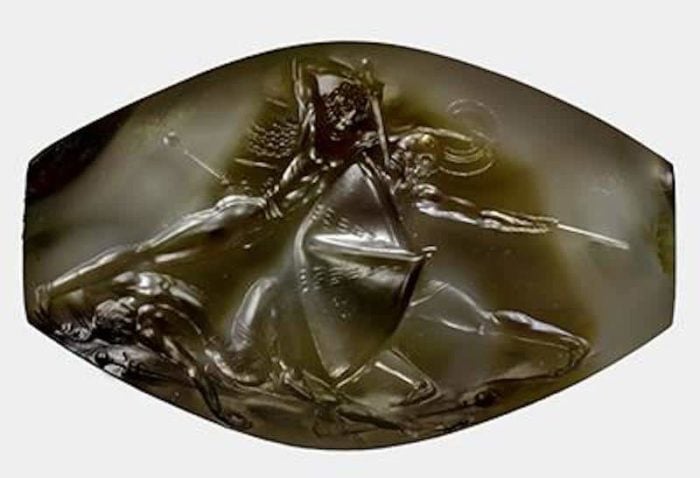
The paper notes that adjacent to the entombed Griffin Warrior’s wrist is a carved and gold-tipped agate, almond-shaped and just 1.3 inches in length, here making its public debut outside Europe. Its minuscule, deeply engraved surface carving is barely legible to the naked eye, but Getty curators produced a searchable video that is jaw-dropping in the fierce drama that is exposed. The touch-screen is installed next to the agate.
The tiny but exquisite intaglio shows two lean but muscled warriors going at it in shallow three-dimensional space. One plunges a big sword downward near the collarbone of the other, who fruitlessly twists his body behind a massive shield, while a third fighter lays already vanquished, sprawling dramatically at their feet. The marvelous composition is perfectly fitted to the stone’s shape.
The seal stone is called the Pylos Combat Agate.
The exhibition at Getty Villa Museum runs until January 12, 2026, and marks the first major North American exhibition dedicated to the Mycenaeans.
See all the latest news from Greece and the world at Greekreporter.com. Contact our newsroom to report an update or send your story, photos and videos. Follow GR on Google News and subscribe here to our daily email!

