



Paleontologists working in Canada have uncovered what they say is the first evidence of dinosaur herding behavior involving multiple species.
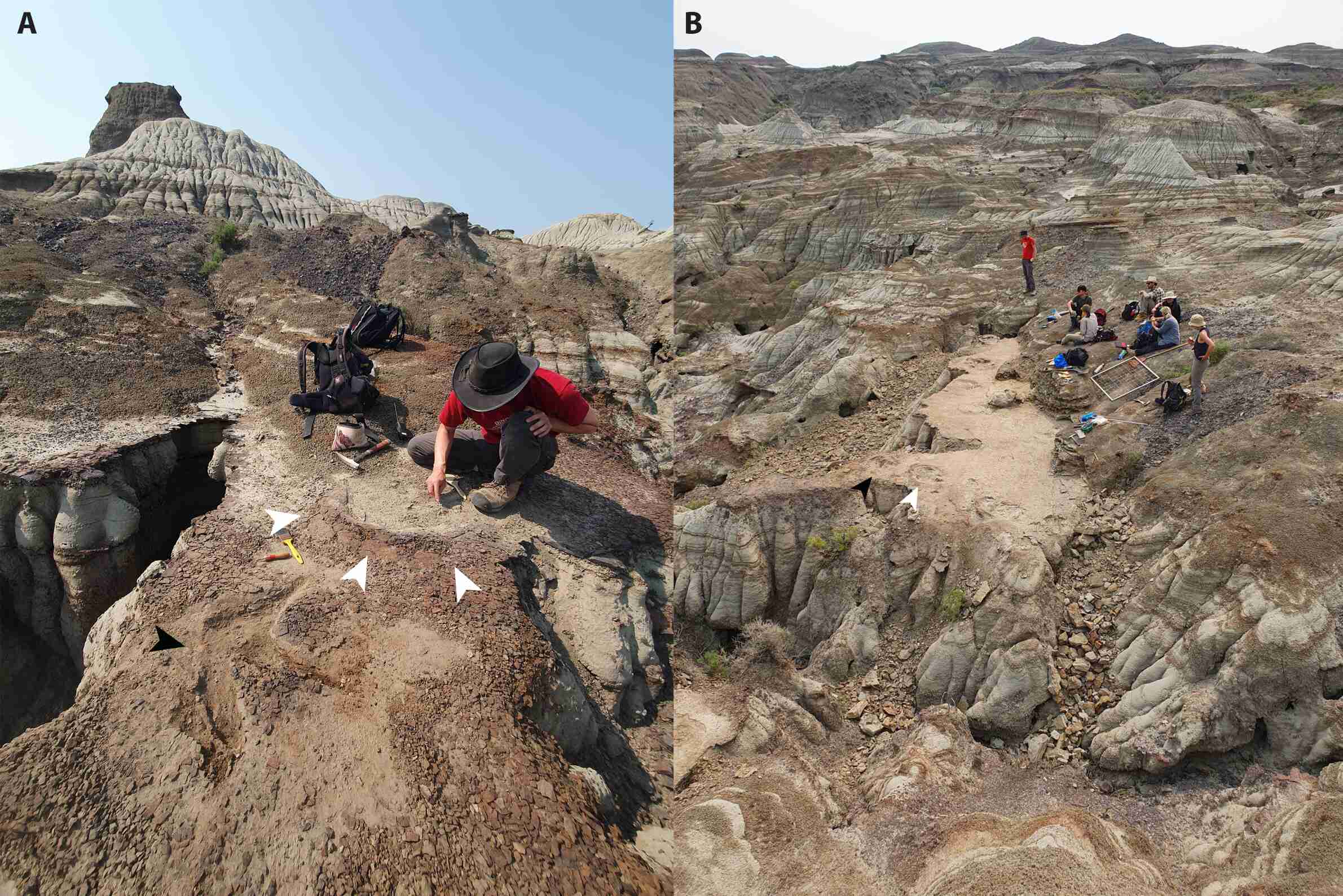
The 76-million-year-old fossilized footprints, found in Alberta’s Dinosaur Provincial Park, reveal a group of horned dinosaurs moving together in a coordinated pattern—possibly alongside an armored dinosaur—while the tracks of two large tyrannosaurs suggest the presence of predators nearby.
The discovery, made at a site now known as the Skyline Tracksite, marks a significant shift in how scientists understand dinosaur behavior. It is the first time tracks have provided such clear signs of mixed-species movement in a single herd, a dynamic seen today among animals like zebras and wildebeests that travel together for protection.
Researchers say the discovery reveals how some dinosaur species may have relied on group behavior for survival, especially in predator-rich environments.
The tracks, which include thirteen footprints from ceratopsian (horned) dinosaurs, appear to have been made by at least five individuals walking side by side. Among them, scientists believe, was likely an ankylosaurid—an armored dinosaur species—positioned within the group.
Discovery of dinosaur herding reveals rare mixed-species footprints
Two large tyrannosaur tracks crossing the herd’s path were also uncovered. Their alignment and perpendicular direction suggest they may have been observing or stalking the group. A nearby print from a smaller carnivorous dinosaur adds further intrigue to the complex scene.

Dr. Phil Bell of the University of New England, who led the research, described the moment of discovery as unexpected.
After two decades of studying dinosaur bones in the same region, he had never paid close attention to footprints until a patch of rock resembling squelchy mud caught his eye. That moment led to the uncovering of one of the most revealing sets of trackways in the park’s history.
According to Dr. Bell, the tyrannosaur tracks strongly imply that the predators were observing the herd, although there is no definitive proof that they interacted. He added that the possibility alone adds a chilling dimension to the discovery.
Experts highlight significance of discovery
Dr. Brian Pickles from the University of Reading said the opportunity to walk in the exact steps of dinosaurs that roamed the land 76 million years ago was thrilling.
He noted that identifying these new track patterns has already helped researchers locate additional sites within the park, potentially offering more insights into dinosaur interactions and social behavior.
Moreover, Dr. Caleb Brown of the Royal Tyrrell Museum emphasized how the find demonstrates that even in one of the world’s most thoroughly studied fossil sites, there is still much to uncover.
Dinosaur Provincial Park has yielded hundreds of skeletons and countless bones and teeth over the years, but trackways have remained rare. The new find underscores the park’s potential to reveal more about how dinosaurs lived, moved, and survived together.
See all the latest news from Greece and the world at Greekreporter.com. Contact our newsroom to report an update or send your story, photos and videos. Follow GR on Google News and subscribe here to our daily email!

