



Pope Francis, head of the Roman Catholic Church since 2013, has died aged 88, the Vatican announced Monday.
Bells tolled in church towers across Rome after the announcement, which was read out by Cardinal Kevin Ferrell, the Vatican camerlengo, from the chapel of the Domus Santa Marta, where the Pope lived.
“At 7:35 this morning, the Bishop of Rome, Francis, returned to the home of the Father. His entire life was dedicated to the service of the Lord and of his Church,” Ferrell said.
Francis recently left Rome’s Gemelli hospital, where he was admitted on February 14 after having difficulty breathing. He had recovered to the extent where he was able to appear in front of crowds at St. Peter’s square for Easter Sunday, and met US Vice President JD Vance Sunday morning.
Before being discharged from the hospital, he had battled double-pneumonia. His death plunges the 1.4 billion Catholics across the world into mourning.
The death now sets off a weekslong process of allowing the faithful to pay their final respects, first for Vatican officials in the Santa Marta chapel and then in St. Peter’s for the general public, followed by a funeral and a conclave to elect a new pope.
The pontiff’s health had been described by the Vatican as “critical” on February 22 after suffering a “prolonged asthma-like respiratory crisis” earlier in the day. He had also received blood transfusions that were deemed necessary due to a low platelet count, the Vatican said.
The pope was hospitalized in a special ward at the Gemelli Hospital in Rome. He had since been forced to cancel a number of public appearances.
The 88-year-old pontiff’s health had become increasingly fragile in recent years. In late February, Pope Francis, who had part of a lung removed as a young man, had already sensed he was close to death. According to two people who were familiar with his condition, he had been suffering from intense pain and had privately expressed certainty he wouldn’t make it this time.
As his health deteriorated, Francis also moved to complete key initiatives and appoint sympathetic figures to key posts, following a progressive-tinted papacy marked by bitter ideological divisions.
When he became pope in 2013, Francis ushered in a new era of leadership in the Roman Catholic Church. He aimed to make the Church more inclusive, opening up key roles to women and LGBT+ people. While that provoked furious reaction from many conservatives, liberals complained that the reforms had been insufficient.
Meanwhile, the pope’s efforts to put an end to rampant child abuse by clerics have produced mixed results.
At the time of his election he drew vast support from both Church conservatives and reformers. His supporters liked his “common touch” and his zealous determination to reform the Vatican bureaucracy, root out corruption in the Vatican bank and deal with the horrific legacy of child sex abuse within the Church.
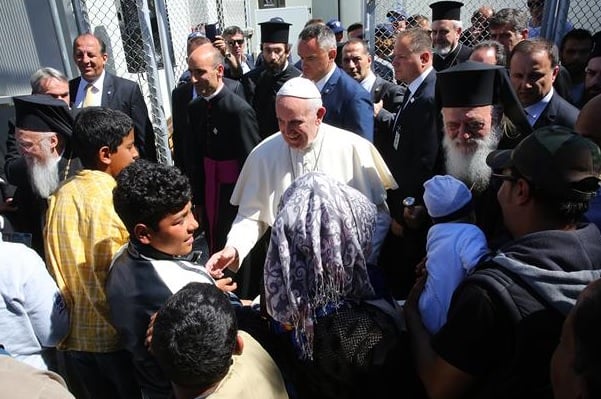
Pope Francis and his relation with Greece and the Orthodox Church
In 2021, Francis visited Greece and Cyprus seeking to improve historically difficult relations between the Roman Catholic and Greek Orthodox Churches.
Francis visited the island of Lesvos in 2016, where he visited the island’s refugee camp, accompanied by the President of the Hellenic Republic, Katerina Sakellaropoulou. But his trip to Athens, which included a mass and meetings with Greece’s top cleric, Archbishop Ieronymos, was the first to the Greek capital by a pope since John Paul II came in May 2001.
The Orthodox Church has been separated from the Catholic Church since the schism of 1054 between Rome and Constantinople, today’s Istanbul, which was then the capital of the Byzantine Empire.
In 2014 Ecumenical Patriarch Bartholomew and Francis crossed a fifty-year milestone, continuing the legacy of their predecessors Pope Paul VI and Ecumenical Patriarch Athenagoras. In 1964, those leaders broke a silence of centuries and paved the way toward greater dialogue.
In 2022, Pope Francis decided to send back to Greece three fragments of the Parthenon Marbles that the Vatican Museums had held for centuries.
The Vatican termed the gesture a “donation” from the pope to His Beatitude Ieronymos II, the Orthodox Christian archbishop of Athens and all Greece, “as a concrete sign of his sincere desire to follow in the ecumenical path of truth.”
In a statement shortly afterward the Acropolis Museum in Athens said that the artifacts will be displayed on its premises.
But the Vatican statement suggested the Holy See wanted to make clear that it was not a bilateral decision to return the marbles from the Vatican state to Greece, but rather a religiously inspired donation.
The life of Pope Francis and his ascent to the papacy
Jorge Mario Bergoglio, as he was known, was born on December 17, 1936 in Buenos Aires, Argentina.
According to his official Vatican biography, he was ordained as a Jesuit in 1969, and went on to study in Argentina and Germany.
Pope Francis, as he became, was the first Jesuit, the first Latin American and the first born and raised outside Europe to lead the Roman Catholic Church since the 8th-century papacy of the Syrian pope Gregory III .
He became a bishop in 1992 and Archbishop of Buenos Aires in 1998. At the 2005 conclave, he was seen as a contender for the papacy.
As Cardinal Bergoglio, his sermons always had an impact in Argentina and he often stressed social inclusion, indirectly criticizing governments that did not pay attention to those on the margins of society.
His election as the 266th pope surprised analysts who had been expecting a younger man than the 76-year-old. Four years into his papacy, polls suggested the Pope enjoyed high popularity ratings among Catholics and other faiths. Around the time of his death, he had over 18 million followers on X.
See all the latest news from Greece and the world at Greekreporter.com. Contact our newsroom to report an update or send your story, photos and videos. Follow GR on Google News and subscribe here to our daily email!

