



How peaceful were the Minoans, really? Why did they leave behind no iconography of war, no murals of battles, no towering fortifications—despite their contact with contemporary Eastern cultures that celebrated military might in art and architecture? Were the people of Minoan Crete truly “children of flowers,” living among lilies, hosting bull-leaping festivals, and basking in the meadows and olive groves in a blissful, untroubled society?
“Unfortunately, this idyllic picture cannot be true,” argued archaeologist Dr. Metaxia Tsipopoulou, a leading expert on Bronze and Early Iron Age Crete, who has directed key excavations at the Early and Middle Minoan cemetery of Petras in Sitia, continuously used from 2800 to 1700 BC.
So, why the absence of war scenes in Minoan art? Dr. Tsipopoulou recently offered two possible explanations: either the Minoans experienced no wars during their 2,000-year civilization—or, more plausibly, they consciously chose not to represent conflict in their visual culture. “Common sense favors the view that Minoans simply decided not to depict war,” she emphasized.
The motivations behind this choice, however, remain unclear, just as mysterious as the complete absence of rulers in Minoan iconography.
“We have no depictions of kings or named leaders in Minoan Crete,” she noted, “except for mythic figures like King Minos or Rhadamanthys, whose historical basis is tenuous at best. Even Idomeneus, mentioned in Homer, was a Mycenaean king of Crete.”
She also addressed one of the most iconic Minoan images—the Prince with the Lilies fresco from Knossos—explaining that recent research by Wolf-Dietrich Niemeier has shown it to be a modern reconstruction combining the body of a boxer and the head of a sphinx.

Walls existed in Minoan Crete
And yet, walls did exist in Minoan Crete. Excavations led by Dr. Tsipopoulou in the 1980s in eastern Crete—specifically at Agia Fotia and Petras—revealed fortifications. At Agia Fotia, a unique rectangular building dated to 2100–2000 BC was found surrounded by a wall.
“Were these to guard against seaborne threats? Or were they built to protect activities from neighboring communities?” she asked. At Petras, two nearly cyclopean walls, complete with rectangular towers, enclose the palace hilltop—features interpreted not as battlefield defenses but as monumental declarations of newly consolidated power.
She suggested that the establishment of the first palaces around 1900 BC was likely preceded by periods of unrest and elite competition. The walls were not built for war, but “as propaganda,” she explained—symbols of unity and deterrents against future upheaval.
Weapons used by the Minoans
As for weapons, Early Minoan examples (3000–2100 BC) include small silver and bronze daggers—likely status symbols or multipurpose tools, not battlefield weapons. Figurines such as the male figure from the Petsofas peak sanctuary show men bearing such blades at their belts—perhaps less for combat than for displaying their access to imported luxuries like copper and ivory.
After the destruction of the first palaces around 1900 BC—possibly caused by an earthquake—new, more centralized palace complexes were constructed, with Knossos rising to dominance. This era marked the start of Minoan expansion across the Aegean. But was this expansion peaceful?
The Minoan presence on islands like Thera, Milos, Rhodes, Kea, and even in Asia Minor (at places like Miletus and Iasos) likely stemmed from trade. Archaeological evidence includes Linear A tablets, seals, pottery and other artifacts, suggesting deep cultural entanglement, not mere commerce. This influence was long referred to as the “Minoan Peace,” an Aegean parallel to the later “Pax Romana.”
Was there a Minoan military presence in these areas? Were wars fought before the peace? “We simply don’t know,” said Dr. Tsipopoulou. However, the Neopalatial period (post-1700 BC) brings intriguing changes—most notably in weaponry and imagery.
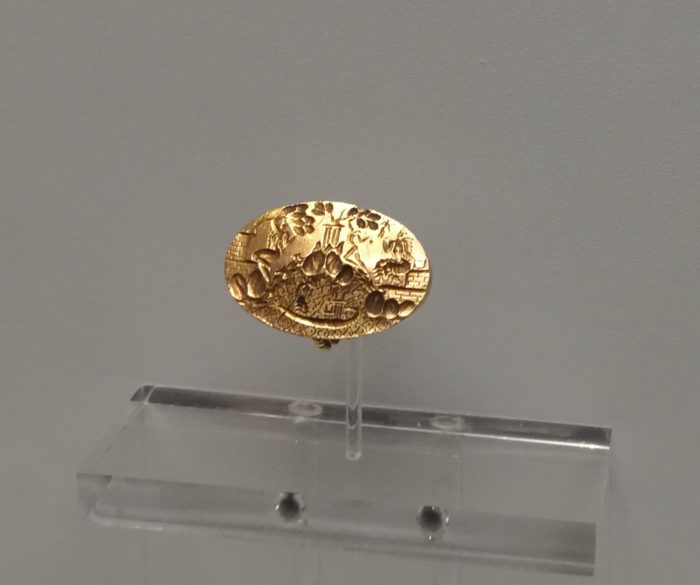
Large, clearly functional swords appear for the first time, and we begin to see miniature depictions of duels on seal stones. These motifs suggest the emergence of a warrior elite, keen to express their status symbolically. Curiously, these scenes never appear in frescoes, unlike in later Mycenaean art.
Minoan frescoes remain steadfastly peaceful
Still, Minoan frescoes remain steadfastly peaceful, even as power shifted. After 1450 BC, Crete came under Mycenaean rule. With the newcomers came drastic social and political changes. Mycenaeans were unabashedly martial, burying their elites with long swords and boar-tusk helmets. Later waves of Mycenaeans, arriving after the collapse of their mainland palaces in the 12th century BC, brought with them more warriors, whose burials in vaulted tombs featured heavy offensive and defensive armament.
Ultimately, while Minoan Crete may not have glorified war in art, the archaeological record tells a more nuanced story—one of elite competition, symbolic weaponry, guarded power centers, and strategic expansion. The flower-laden image of Minoan serenity, it seems, may conceal centuries of tension, negotiation, and the quiet exercise of authority.
Related: Research Shows Minoans’ Martial Side
See all the latest news from Greece and the world at Greekreporter.com. Contact our newsroom to report an update or send your story, photos and videos. Follow GR on Google News and subscribe here to our daily email!

