


Asclepiades of Bithynia (124–40 BC) was the first physician to formulate an ancestral doctrine analogous to the germ theory of disease. Influenced by Epicurean philosophy, he accepted the atomic theory.
The Bithynian physician founded Methodical Medicine, rejecting the theory of a benevolent Nature and introducing naturalistic, compassionate, and painless treatment into medical practice. Asclepiades was the first physician to distinguish between acute and chronic diseases, the first surgeon to perform an elective, non-emergency tracheotomy, and the first Greek to establish medicine in Rome.
Early life and education of the great physician
Asclepiades Prusaeus was an ancient Greek physician and physiologist from Bithynia, most likely from Prusa or Prusias. He initially studied in his homeland and later traveled to Athens, where he followed the Epicurean teaching on the “atomic composition of the world,” becoming a devoted follower. Furthermore, he then visited Paros, where he learned from the famous pharmacologist Cleophandus. He was the son of the physician Andreas.
He studied medicine at the renowned Medical School of the Museum of Alexandria. He also studied philosophy at the Epicurean School of the Garden of Athens. He refused an attractive offer from King Mithridates Eupator of Pontus to become his official physician. At around the age of 30, he moved to Rome, where he first taught philosophy before practicing medicine. Asclepiades possessed both philosophical and medicinal skills, as his contemporaries, the Greek Platonic philosopher Antiochus of Ascalon and the Roman philosopher Cicero, attest with admiration.
Philosophical influence and medical theories
In contrast to Democritus, who questioned the reliability of sensory perception, Epicurus accepted the properties of complex bodies and understood that they arise from the way atoms are connected. He bridged the Democritean physical reality of atoms and the void with the Aristotelian biological reality of the sensible world. Atoms are eternal, preserving the total amount of matter. However, new functions and possibilities arise from the addition and removal of atoms in aggregates, according to Epicurus.
Influenced by Epicurean philosophy, Asclepiades rejected Hippocrates’ doctrines of the four elements and four humors, as well as the idea of a benevolent Nature. He accepted the atomic theory and the idea that chance rather than divine providence determines the universe. Additionally, he argued that “Nature does not care at all for the preservation of living organisms.” He warned that in most cases if proper care is not provided to a patient, their condition will worsen.
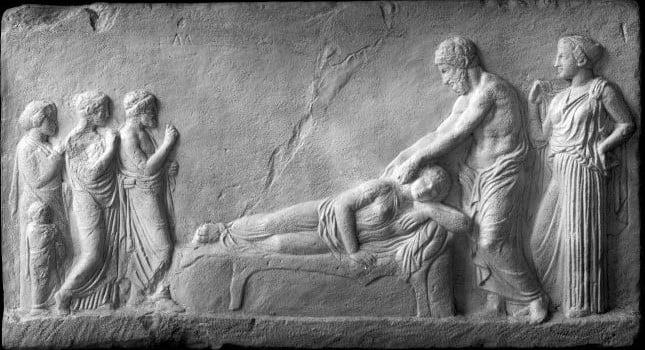
Asclepiades taught that the human body is composed of (a) parts made of atoms and (b) empty space. According to Asclepiades, diseases arise from changes in the shape, position, or free flow of a patient’s atoms. To restore health, he primarily advocated mild therapeutic methods. These included a healthy diet, exposure to sunlight, hydrotherapy, manual massage, and physical exercise. In some cases, he used herbal remedies, notably highlighting chamomile, or even surgical procedures when deemed necessary.
Contributions of Asclepiades to medicine and surgery
He was the first physician to introduce the critical distinction between acute and chronic diseases. Freed from the mistaken belief in a benevolent Nature and influenced by a core doctrine of Epicurus regarding pain (“those that are transient are more intense, while those that are chronic are milder”), Asclepiades recognized that some diseases are short-lived while others are incurable. He concluded that a physician must act quickly to seize the opportunity to cure acute diseases, while in the case of chronic diseases, the best approach is to offer patients the highest possible quality of life. This means Asclepiades was the first physician to systematically address chronic diseases.
The humane and naturalistic approach of the Bithynian physician, along with his medical expertise, earned him great fame in Rome. He was called “Philophysicist” for his adherence to a naturalistic philosophy and “Pharmacist” due to his extensive use and description of medicinal herbs, as noted with admiration by the ancient Greek pharmacologist Dioscorides Pedanius. Though he wrote many texts, none have survived; his views are known through later authors.
Ancient Greek physicians Galen and Aretaeus said Asclepiades was the first physician to perform a non-emergency therapeutic tracheotomy. The Roman natural philosopher Pliny the Elder recounts an incident in which, during a funeral procession, Asclepiades realized that the person presumed dead was actually alive and “resurrected” him, astonishing those present. Asclepiades was also likely the author of a remarkable theory recorded by his Roman contemporary Marcus Terentius Varro, suggesting that stagnant water contains “invisible little animals” (germs) capable of causing disease. This insight may have stemmed from applying the Epicurean principle of inferring invisible realities by analogy with observable phenomena, explaining why people who drank stagnant water, even when mixed with fresh water, frequently became ill.

The physician’s influence on later thinkers
Another contemporary, the Epicurean poet Lucretius, adopted Asclepiades’ framework. He described atoms as moving through the empty space of bodily pores. Lucretius incorporated much of Asclepiades’ medical language and practice into his poem “On the Nature of Things,” which also features Epicurean psychotherapy. The work culminates in the description of the Plague of Athens, presented as a natural epidemic devoid of divine intervention. Given that Lucretius’ poem is a verse adaptation of Epicurus’ “On Nature,” it is possible that Epicurus himself had described the plague using Thucydides’ historical account.
According to Pliny the Elder, Asclepiades died in Rome at an advanced age. His influence endured for over 500 years through the Methodist School of Medicine, founded by his students. The school’s name derives from the word “method,” reflecting a systematic approach to scientific investigation. Methodist Medicine emphasized the atomic theory and was free from metaphysical concepts.

Rediscovery and Modern Legacy
Modern scientists rediscovered some of Epicurus’s and Asclepiades’s fundamental ideas. In the 17th century, the French Catholic priest and natural philosopher Pierre Gassendi revived Epicurean atomism, influencing scientists such as Galileo, Malpighi, Boyle, and Newton. These ideas contributed to the intellectual awakening that led to the Enlightenment and modern science.
John Dalton provided experimental confirmation of atomic theory in the 19th century. Simultaneously, Louis Pasteur demonstrated the germ theory of disease. Asclepiades’ notion that disease arises from disturbances in bodily particles loosely foreshadowed later microbiological discoveries. By the 20th century, medicine had entered its molecular phase. The discovery of DNA provides a biochemical model for life’s organization and advances molecular biology.
Despite his groundbreaking contributions, Asclepiades of Bithynia remains relatively unknown as a forerunner of the germ theory of disease.
See all the latest news from Greece and the world at Greekreporter.com. Contact our newsroom to report an update or send your story, photos and videos. Follow GR on Google News and subscribe here to our daily email!

