



Visitors now have a unique opportunity to see ancient artifacts up close from the Griffin Warrior Tomb, discovered in the Peloponnese in 2015, during an exhibition inaugurated in the port city of Kalamata, Greece late Friday, February 14.
The exhibition, titled “Princes of Pylos,” will be open to the public at the city’s archaeological museum from February 15 through April 26, 2025.
It showcases 200 of about 1,400 extraordinary contents of the single grave that was discovered near the ancient city of Pylos, in the Peloponnese. More recent discoveries are also included, such as artifacts from Tholos tombs VI and VII in Englianos, the Tholos tomb in Psari, and the finely decorated crown from Myrsinochori.
“Princes of Pylos” was inaugurated by the Greek Minister of Culture, Lina Mendoni, who, during a press conference on February 12, underscored the invaluable insights the exhibition offers into the Mycenaean era.
The exhibition will open at the Getty Villa in Malibu, California in the United States in June, before moving to Greece’s National Archaeological Museum in Athens in the first half of 2026. Finally, it will return to the Archaeological Museum of Chora in Messenia, in southern Greece later that year. The Museum of Chora has one of the most complete collections of Mycenaean art across the country.

In 2015, a husband-and-wife team made a staggering discovery in an abandoned Greek olive grove: an ancient tomb filled with the kind of treasure that archaeologists only dream of.
🎥Secrets: Griffin Warrior pic.twitter.com/2JVsZXVQtC— Smithsonian Channel (@SmithsonianChan) July 20, 2022
The discovery of the Griffin Warrior Tomb
The discovery of the Griffin Warrior Tomb is one of the most fascinating archaeological findings, as it appears to link the Minoan and the Mycenaean civilizations.
On May 28, 2015, the research team sponsored by the University of Cincinnati and led by husband-and-wife archaeologists, Jack L. Davis and Sharon Stocker, were conducting excavations in Pylos in southwestern Greece. There, they discovered a Bronze Age tomb with a skeleton surrounded by rich artifacts, suggesting it belonged to an important man.
The grave belongs to the Mycenaean Civilization, approximately 1750 BC to 1050 BC. Additionally, many of the objects found appear to be related to the Minoan Civilization, circa 3500 BC to 1100 BC.
The Griffin Warrior Tomb was discovered near the ancient Palace of Nestor in the Bronze Age city of Pylos in southwest Greece. The excavation began in a spot where three stones appeared to form a corner. A two-meter by one-meter shaft was discovered.
There was a stone-lined chamber containing a wooden coffin inside the shaft. Several offerings were found inside the chamber and on top of the coffin.
The tomb’s ancient artifacts that stunned archaeologists
They found jewelry, seal stones, carved ivories, combs, gold and silver goblets, and bronze weapons, hence the warrior suggestion.
The artifacts included a gold box-weave chain with “sacral ivy,” a meter-long sword with a gold-coated hilt, a gold-hilted dagger, and multiple gold and silver cups. These cups featured carnelian, amethyst, amber, and gold beads, four gold rings, and many small, carved seals with etched depictions of combat, goddesses, reeds, altars, lions, and men jumping over bulls.

A plaque of ivory with a depiction of a griffin in a rocky landscape, a bronze mirror with an ivory handle, thin bands of bronze from the warrior’s armor, and boar tusks, possibly from the warrior’s helmet, were among the objects found.
Analyses of the skeleton indicate that the man was in his thirties and around five feet tall with long hair. Furthermore, the findings suggest he was a rich, prominent member of society.
“It seems he was a handsome man, he had participated in battles but most likely he had died from an illness,” Dr. Stocker has said, while Dr. Davis, her husband has confirmed that he had not found any wounds on his skeleton so they can attest that he did not die in a battle.
The computerized facial reconstruction of the warrior’s skull reveals a broad, determined face with close-set eyes and a prominent jaw.
The analysis suggests that the Griffin Warrior lived during the end of the shaft grave period before the construction of the palatial centers in Mycenaean Greece, including the Palace of Nestor.
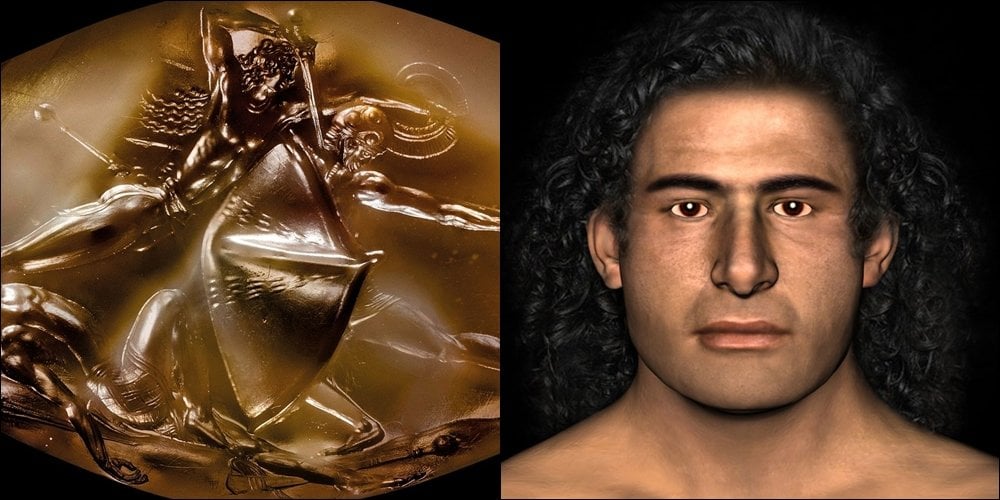
DNA studies proved Griffin Warrior was Greek
In a remarkable revelation, recent studies by the University of Cincinnati show that the Griffin Warrior was of Greek descent. The results, published in the journal Science, were part of a three-part study overseen by Harvard University, disputing previous claims that he was of foreign origin.
“When we look at the rise of the Mycenaean civilization, ancient DNA supports the notion that it was a local phenomenon, not something imported from the outside,” said co-author Jack Davis. The UC Classics professor and department head, along with his wife Sharon Stocker, unearthed the Griffin Warrior’s tomb.
Their findings were significant for historians, fellow archeologists, and geneticists alike. They helped clarify the migration patterns of people living five to seven thousand years ago whose ancestry had intermingled when they joined Greece’s indigenous population.
“This research addresses a bigger question,” Davis added. “Where do Greeks come from? We had no way of addressing that question without looking at genetic relationships.” It was the use of new scientific techniques that proved the Griffin Warrior’s Greek origins. This meant that the migration patterns they had been studying had had very little impact on Greek society at that time.
See all the latest news from Greece and the world at Greekreporter.com. Contact our newsroom to report an update or send your story, photos and videos. Follow GR on Google News and subscribe here to our daily email!

