



Greece is at the epicenter of climate change and in 2024 the country not only witnessed its hottest recorded year ever, it also saw daily temperatures above average spanning throughout the year, a new study reveals.
According to Climatebook, a Greek scientific news portal on weather and climate, scientists analyzed meteorological data and found that the average temperature in Greece for 2024 was above the daily average recorded between 1991-2020 during 77 percent of the days. That means that 282 of the 366 days of the year saw increases.
Greece started to officially keep temperature records in 1890. In the past few decades, scientists have been recording a steady increase in temperatures across the country due to climate change.
Climatebook’s scientific team also found that the winter season of 2023-2024 was the warmest ever recorded in Greece, while 2024 had been warmer by 0.7 degrees Celsius compared to 2023.
“Higher temperatures and more intense heatwaves in Greece during recent years confirm a trend of increasing [temperatures], which had been spotted in the middle of the previous decade and which we can almost certainly assume it will continue in the future,” Konstantinos Kartalis, a professor at Athens University and member of the European Scientific Advisory Board on Climate Change, told the Athens-Macedonian News Agency.
Professor Kartalis explains that as the temperature of the sea level has been systematically increasing across the Mediterranean in the past 40 years, there’s more water vapor produced that remains in the atmosphere because of the rise in the air’s temperature as well. “As a result, though it may sound as an oxymoron since at the same time drought also increases, the possibility of big thunderstorms rises, and as a consequence so does [the possibility of] floods,” he adds.
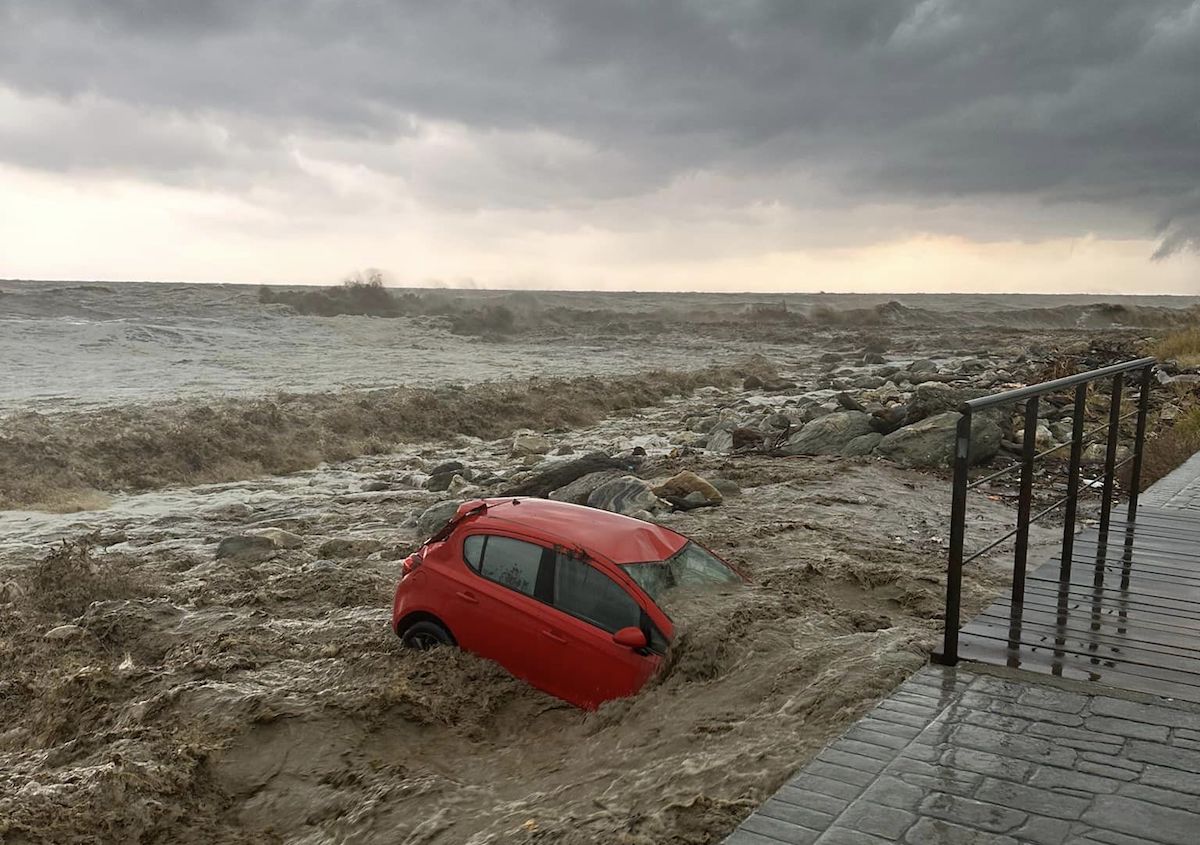
Several regions across Greece are susceptible to extreme weather due to climate change
Some regions are more susceptible to the new weather conditions according to Professor Kartalis. Areas liable to flood include parts of Attica, Central Macedonia, large parts of Central Thessaly, smaller areas in the Peloponnese, and large cities like Athens and Thessaloniki.
Heatwaves are mostly recorded in Crete, the Cyclades and Eastern Mainland Greece, which includes Attica and Athens.
Professor Kartalis warns that the frequent occurrence of combined extreme weather phenomena in the Mediterranean and Greece marks an “alarm for civil protection, since the climate conditions that are being created require a series of new approaches regarding the sustainability of the environment and of the infrastructure.”

Greek seas also hit warmest temperatures in 2024
The seas of Greece hit their warmest temperatures in 40 years this summer. Water temperatures exceeded 28 degrees Celsius (82 degrees Fahrenheit), according to a study conducted by three Greek universities.
Researchers at the Universities of Thessaloniki, the Aegean, and Thrace studied satellite data on the temperature of Greek seas from 1982 until today and concluded that the entire Aegean, Ionian, and Cretan Seas have registered the highest temperatures of the last four decades in the summer of 2024.
The temperature rise was particularly evident in deeper waters, as far down as 50 meters in some areas, and that has been of a particular concern to scientists. “This means there is a cumulative phenomenon at work,” Vasilis Kolovoyiannis, one of the researchers at the University of the Aegean’s Department of Oceanography and Marine Biosciences told the Athens News Agency.
He also said that researchers observed “changes in the usual mechanics of cooling in the Aegean, such as the inflow of cold waters from the Black Sea, which was low, and the coastal rise of colder masses.”
See all the latest news from Greece and the world at Greekreporter.com. Contact our newsroom to report an update or send your story, photos and videos. Follow GR on Google News and subscribe here to our daily email!

