



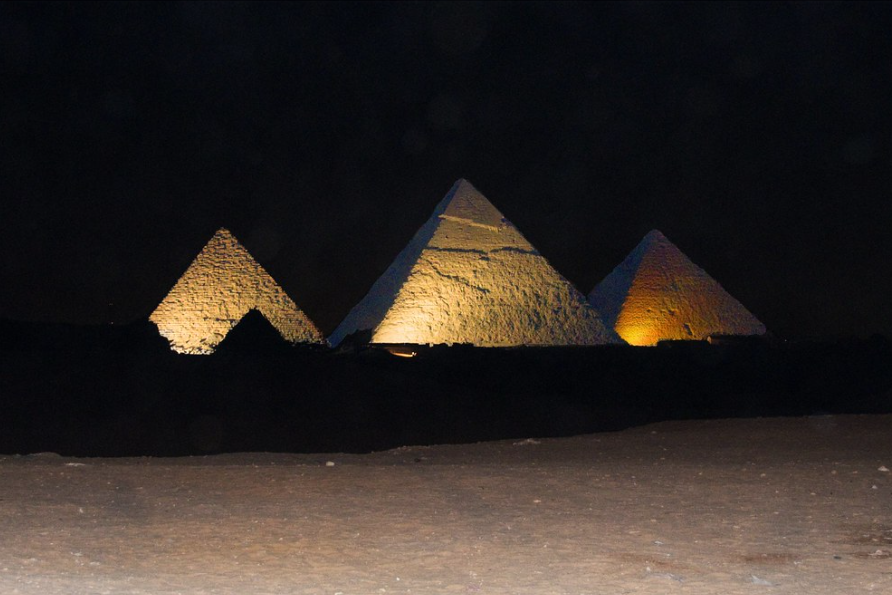
The pyramids of Egypt are some of the most monumental structures on earth. It is no wonder that so many people want to uncover as much as possible about them. Traditionally, experts have claimed that they are tombs of Pharaohs. Does the evidence really support this claim, or are they something more mysterious?
Did aliens build the pyramids of Egypt?
A theory which has become popular in recent decades is the idea that aliens built the pyramids. The fundamental basis for this theory is the fact that they are so huge and impressive that it seems impossible for humans to be responsible.
This idea has been popularized by TV shows such as Ancient Aliens. Of course, if aliens built the pyramids, it seems unlikely they would have done all this simply to provide a tomb for a human king. Therefore, this theory usually goes hand in hand with the suggestion that the pyramids were not tombs.
Rather than serving as a tomb, many theorists speculate that the Great Pyramid of Giza was some type of power plant. Some also believe it could have even been an energy transmitter of some kind, far surpassing human technology.
One of the many problems with this theory is that any close-up photo of the pyramids reveals that the placement of the stones is far inferior to what our 21st century human technology can manage. Are we really to believe that aliens could travel to earth but were unable to cut and place stones as precisely as we can today?
A message from/to the Gods

The idea that the pyramids were a message from (or to) the gods is an intriguing concept rooted in various ancient beliefs. Many ancient civilizations, including the Egyptians, believed that monumental structures like pyramids had a divine connection.
The pyramids, especially those at Giza, could be interpreted as symbolic messages or offerings to the gods, reflecting the pharaoh’s role as an intermediary between the divine and the mortal worlds and the eternal connection between heaven and the earthly realm.
The pyramid shape itself was thought to represent the rays of the sun, symbolizing divine power and the pharaoh’s ascent to the gods. Some theories suggest that the alignment of the pyramids with celestial bodies, like the stars, could be seen as an attempt to communicate with or honor the gods.
The pyramids of Giza, especially the Great Pyramid, are aligned with the stars in the constellation of Orion, which was associated with Osiris, the Egyptian god of the afterlife. The three pyramids are thought to mirror the position of the three stars in Orion’s Belt. This alignment is believed to symbolize the pharaoh’s connection to Osiris, suggesting that the pharaohs’ souls would ascend to the heavens and join the gods, particularly Osiris, after their death.
A message from the one God
An idea which was popular in the late nineteenth and early twentieth centuries was that the Great Pyramid served as a message from the God of the Bible. This was based on Isaiah 19:19, 20, which says:
“In that day there will be an altar to Jehovah in the middle of the land of Egypt and a pillar to Jehovah at its boundary. It will be for a sign and for a witness to Jehovah of armies in the land of Egypt.”
Some Bible scholars interpreted this ‘pillar’ in the land of Egypt as a reference to the Great Pyramid. Since this passage says that it would serve as a ‘sign and a witness’ to God, some felt that the Great Pyramid apparently held information about God’s purpose for mankind.
For example, some religious groups speculated that the length of certain passages inside the Great Pyramid actually denoted the length of time of different aspects of mankind’s history and future, such as the length of time until Christ’s return.
Today, the majority of scholars feel that this statement in the Book of Isaiah is actually describing the fact that many Jews fled to Egypt after the destruction of Jerusalem by the Babylonians and started worshipping their God in that land.
The funny medieval idea that the pyramids were granaries
According to the Bible, Joseph the son of Jacob became responsible for preparing Egypt for an upcoming famine that would last seven years. He ordered the people of Egypt to build large granaries, or storage places, for grain.
One theory about the pyramids in the medieval era is that they were Joseph’s granaries. In fact, this idea became so popular that the pyramids of Egypt were regularly called “Joseph’s granaries.” The idea continued to be popular throughout the medieval era.
It was only in the Renaissance that this theory began to be abandoned. At this time, it became easier to travel to Egypt from more distant regions, allowing the structures to be examined more closely. This closer investigation revealed just how obviously impossible this theory was.
The pyramids are massive structures which are almost completely solid inside. While there are some passages and open spaces within, these are dwarfed by the quantity of solid rocks surrounding them all. The idea that these were used for the storage of grain is untenable.
The ancient idea that the pyramids were tombs

The idea that the pyramids of Egypt were tombs is not a modern concept. It actually goes back thousands of years to at least the time of Herodotus. This Greek historian, writing in the mid-fifth century BCE, traveled to Egypt. There, he learnt a great deal about the civilization and its history.
One of the things that ancient Greek historian Herodotus wrote about was the Great Pyramid of Giza. He stated very clearly that this was a tomb, as we can see from the following quotation:
“The ten years aforesaid went to the making of this road and of the underground chambers on the hill whereon the pyramids stand; these the king meant to be burial-places for himself.”
The idea that the pyramids of Egypt were tombs was not just something that Herodotus believed. We see references to the pyramids as tombs in several other ancient writings, such as in the writings of Diodorus and Strabo.
How do we know the pyramids of Egypt really were tombs?
However, just because Herodotus believed this in c. 450 BCE does not necessarily mean it is true. Fortunately, we have considerable evidence from earlier sources that support this conclusion.
For example, the Ipuwer Papyrus dates to approximately 1200 BCE, though the narrative it contains is apparently much older. In this text, there is a line which refers to the pyramids as being tombs which were looted during a period of trouble.
However, there is evidence which is even more contemporary than this. Within the pyramids themselves, on the walls, there are funerary texts. These provide instructions for the soul of the pharaoh on how to safely journey to the afterlife.
The Great Pyramid of Khufu still contains Khufu’s sarcophagus, although the body itself is missing. As we know from the Ipuwer Papyrus, the pyramids were looted in ancient times, so the absence of an actual body is not significant.
See all the latest news from Greece and the world at Greekreporter.com. Contact our newsroom to report an update or send your story, photos and videos. Follow GR on Google News and subscribe here to our daily email!

