



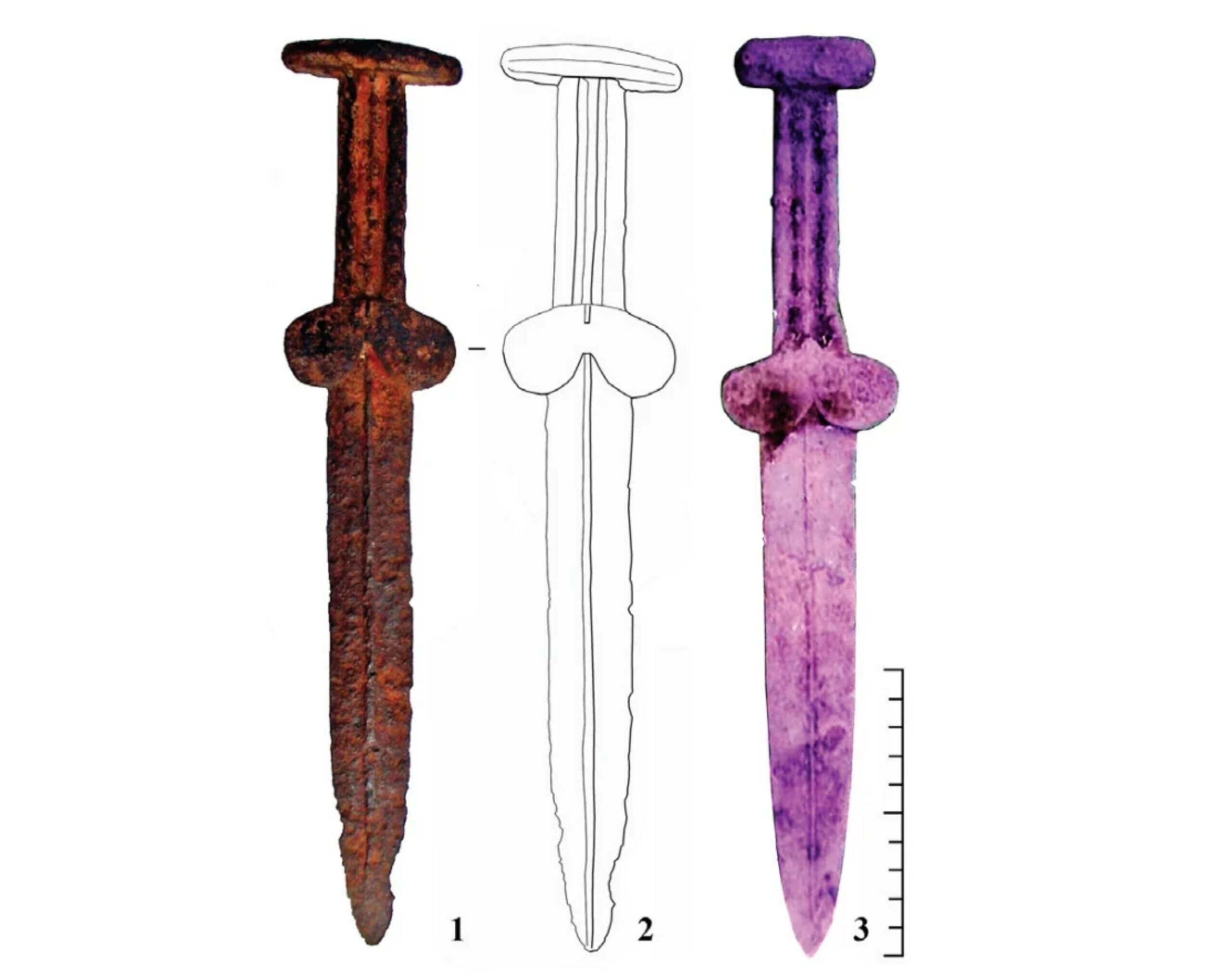
Ancient Scythian swords and daggers found in western Russia may offer clues to a sword cult described by the ancient Greek historian Herodotus. Researchers suggest that Scythian nomads deliberately left weapons and other objects at sacred sites, where they performed religious ceremonies and commemorated fallen warriors.
The study, led by Vadim Zuev and co-authored by Andrey Slovohotov, appeared in the Bulletin of the Federal State University of Education. It examines artifacts discovered near Bessonovka in Russia’s Belgorod region, dating from the seventh to fourth centuries B.C.
The researchers analyzed two iron daggers, a sword, a spearhead, and two bronze cauldrons. Their findings suggest that certain forested areas held religious significance for ancient nomadic communities.
Scythian weapons discovered along ancient routes
In 2009, residents searching for remnants of World War II discovered two bronze cauldrons, a sword, and a dagger beneath a layer of rusted wartime shell casings near Orlovsky forest. Researchers dated the four artifacts to the fifth century B.C. Both weapons feature handles decorated with heads of birds of prey. Damage along their cutting edges indicates that people used them in antiquity.

The bronze cauldrons also display distinctive craftsmanship. One features tightly curled spiral decorations on its handles, while the other bears eight figure-eight ornaments. Between 2010 and 2012, separate discoveries in the nearby Ugrim forest yielded an iron dagger and a spearhead. Researchers dated the dagger to between the second half of the seventh and the end of the sixth century B.C.
The discoveries cluster around the intersection of the Muravsky and Staro-Borisovsky routes. These ancient corridors connected the Eurasian steppes with forested regions farther north. Nearby burial mounds, stone sculptures and fortified settlements highlight the area’s historical importance.
Links to the sword cult described by Herodotus
The researchers connect the weapons to Herodotus’ account of Scythian worship of a war deity he identified with Ares, the Greek god of war. Herodotus described how the Scythians constructed structures from bundles of brushwood and placed sacred swords on them as objects of worship. Other archaeological discoveries have also offered insights into Scythian religious practices recorded by Herodotus.
Zuev and Slovohotov suggest that wooded hilltops may have served as suitable locations for such ceremonies. The bronze cauldrons may also have played a role in ritual meals and commemorative gatherings. However, residents recovered the artifacts outside formal archaeological excavations, limiting researchers’ ability to establish their original context.
The study argues that similar isolated discoveries across Eurasia could help identify previously unrecognized sacred sites and improve understanding of Scythian religious traditions.
See all the latest news from Greece and the world at Greekreporter.com. Contact our newsroom to report an update or send your story, photos and videos. Follow GR on Google News and subscribe here to our daily email!

