



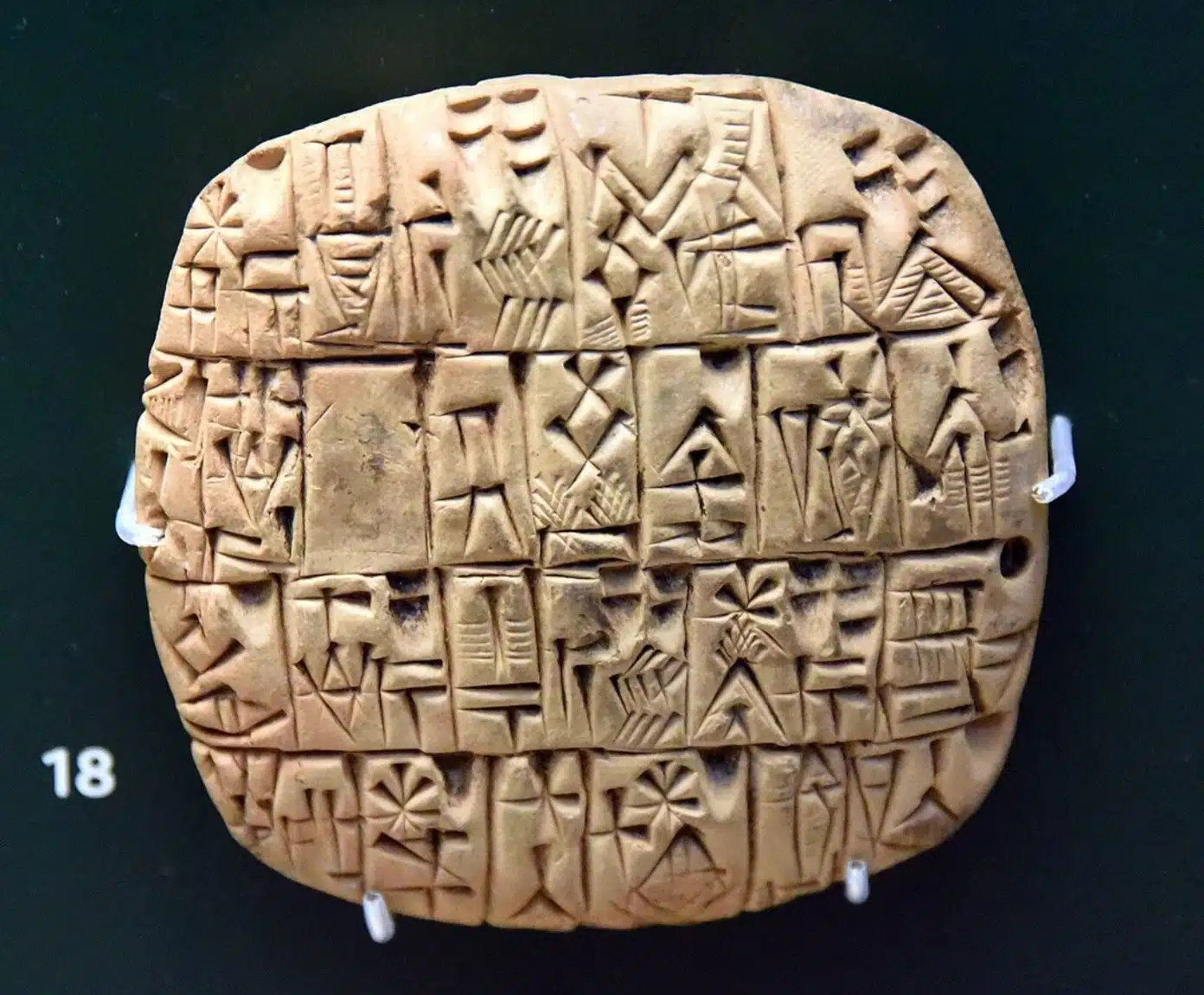
The Sumerian language, spoken thousands of years ago in ancient Mesopotamia, reveals how one of the world’s earliest civilizations communicated and developed its writing system. A detailed linguistic study shows how Sumerian functioned, how its grammar differed across regions, and how contact with neighboring populations influenced its development.
The research, conducted by Abraham Hendrik Jagersma of Leiden University, examines ancient texts dating mainly to the second half of the third millennium B.C. Published under the title “A Descriptive Grammar of Sumerian,” the study provides a detailed account of the language’s structure and history.
Sumerian language has no known relatives
Sumerian originated in southern Mesopotamia, in present-day Iraq. Its speakers lived near the Tigris and Euphrates rivers, where cities such as Ur, Uruk, and Lagash became important centers of trade and government. The Sumerian civilization developed complex systems of administration and recordkeeping that depended heavily on written communication.
Researchers classify Sumerian as a “language isolate” because no other known language has been convincingly linked to it. Jagersma explains that identifying possible relatives is difficult because thousands of years separate Sumerian from modern languages. Many ancient languages also disappeared without leaving written evidence.
Ancient tablets reveal a complex grammar
The earliest written records associated with Sumerian date to around 3200 B.C. However, these early inscriptions do not clearly identify the language used. More reliable evidence of written Sumerian appears around 2800 B.C. The development of early writing systems allowed scribes to document economic activities, including agricultural production, livestock, and trade. Other surviving records reveal the structure of Sumerian sentences and words.
The Sumerian language has no known relatives, yet its written history stretches back nearly 5,000 years.
A detailed linguistic study reveals its complex grammar, regional differences and how Akkadian shaped its evolution. pic.twitter.com/mrJPyFJefa
— Tom Marvolo Riddle (@tom_riddle2025) November 12, 2026
Jagersma identifies several distinctive grammatical features. Sumerian generally placed verbs at the end of sentences. Its grammar also distinguished between human and nonhuman nouns rather than using masculine and feminine categories. The study identifies regional differences in pronunciation and grammar, particularly between northern and southern Sumerian. These findings help researchers understand how the language varied across communities.
Separate research into 4,000-year-old Sumerian tablets has also revealed how ancient households managed workers, livestock, and agricultural resources.
How Akkadian influenced and replaced Sumerian
The study examines extensive contact between Sumerian and Akkadian, a Semitic language spoken in neighboring regions. Both languages influenced each other’s vocabulary, pronunciation, and grammar. Jagersma notes that Akkadian adopted verb-final sentence structures under Sumerian influence, while Sumerian increasingly placed adjectives after nouns. Over time, Akkadian became more widely spoken.
Jagersma argues that Sumerian remained a living language into the early second millennium B.C. By the 19th century B.C., however, it had largely disappeared from everyday speech. Scribes continued using Sumerian for religious, literary, and scholarly purposes long afterward. The research demonstrates how surviving written records help scholars reconstruct the grammar of a language that disappeared from daily conversation thousands of years ago.
See all the latest news from Greece and the world at Greekreporter.com. Contact our newsroom to report an update or send your story, photos and videos. Follow GR on Google News and subscribe here to our daily email!

