



Melina Mercouri, the Greek actress and former culture minister who made the return of the Parthenon Sculptures, also known as Elgin Marbles, a major international campaign, was born on October 18, 1920. More than three decades after her death, her efforts remain central to Greece’s claim for the reunification of the sculptures in Athens.
During the 1980s, Mercouri brought the dispute with the British Museum to international attention through diplomatic initiatives, speeches and public appearances. She argued that the sculptures were integral parts of the Parthenon and should be reunited with the monument.
Although she did not secure their return, her campaign established the issue as a continuing priority of Greek cultural diplomacy.
From Film Star to Culture Minister
Born Amalia-Maria Mercouri in Athens, she came from a politically prominent family. Her grandfather, Spyros Mercouris, served as mayor of Athens, while her father, Stamatis Mercouris, was involved in Greek politics.
She graduated from the National Theatre’s drama school in 1944 and established herself on stage before making her film debut in Michael Cacoyannis’ Stella in 1955.
Her international breakthrough came with Jules Dassin’s Never on Sunday in 1960. The performance earned her the Best Actress award at the Cannes Film Festival and an Academy Award nomination. The film’s song, “The Children of Piraeus,” composed by Manos Hadjidakis, won the Oscar for Best Original Song.
Mercouri subsequently appeared in Phaedra (1962), Topkapi (1964) and other international productions. She married Dassin in 1966.
Following the military coup in Greece in April 1967, Mercouri campaigned against the dictatorship from abroad, participating in demonstrations, concerts and international media appearances. The military regime revoked her Greek citizenship and confiscated her property.
After democracy was restored in 1974, she returned to Greece and entered politics with the Panhellenic Socialist Movement (PASOK).
She became culture minister in 1981, serving until 1989, and returned to the position in 1993. Her tenure included the establishment of the European Capital of Culture initiative, launched in Athens in 1985.
Her principal international campaign, however, concerned the Parthenon Sculptures.
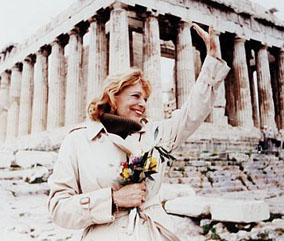
Bringing the Parthenon Sculptures to the World Stage
The sculptures were removed from the Parthenon and other Acropolis buildings in the early 19th century by agents of Lord Elgin and have been held by the British Museum since 1816.
Greece disputes the circumstances of their removal and seeks their return. The British Museum maintains that the sculptures were lawfully acquired.
Mercouri made the issue a central priority after becoming culture minister, arguing that the marbles were architectural elements of a single monument rather than independent museum objects.
In 1982, she presented Greece’s case at UNESCO’s World Conference on Cultural Policies in Mexico City.
“You must understand what the Parthenon Marbles mean to us,” she told delegates, describing their significance to Greek history, democracy and national identity.
Her intervention helped place the dispute on the international cultural agenda and strengthened Greece’s efforts to pursue the matter through UNESCO.
Mercouri also challenged the term “Elgin Marbles,” arguing that the sculptures should be identified with the Parthenon rather than the British diplomat responsible for their removal.
In 1983, she confronted British Museum director Sir David Wilson over the restitution demand. When Wilson noted that other countries also sought the return of objects from the museum, Mercouri emphasized that the Parthenon sculptures had been removed from an existing architectural monument.
Her campaign attracted further attention in 1986, when she addressed a debate at the Oxford Union in Britain.
“There are no Elgin Marbles,” she declared, insisting that they should be recognized as the Parthenon Marbles.
Mercouri acknowledged the British Museum’s stewardship of the sculptures but maintained that their return would constitute an act of historical justice.
Through speeches, interviews and diplomatic contacts, she expanded the campaign beyond bilateral negotiations, drawing international attention to the question of cultural property and the reunification of monuments.
The British government and the British Museum did not accept Greece’s demand during her lifetime. Nevertheless, her efforts made the issue a recurring subject of diplomatic discussions and international cultural debate.
“I hope to see the Marbles back in Athens before I die,” Mercouri said. “But if they come back later, I shall be reborn.”
Mercouri died of cancer in New York on March 6, 1994, at the age of 73.
Successive Greek governments continued the campaign, while the opening of the Acropolis Museum in 2009 provided a dedicated exhibition space for the sculptures near the original monument.
The Parthenon Sculptures remain divided between Athens and London, with Greece continuing to seek their reunification.
Mercouri’s campaign established the dispute as an international cultural and diplomatic issue that has remained active for more than four decades.
See all the latest news from Greece and the world at Greekreporter.com. Contact our newsroom to report an update or send your story, photos and videos. Follow GR on Google News and subscribe here to our daily email!

