



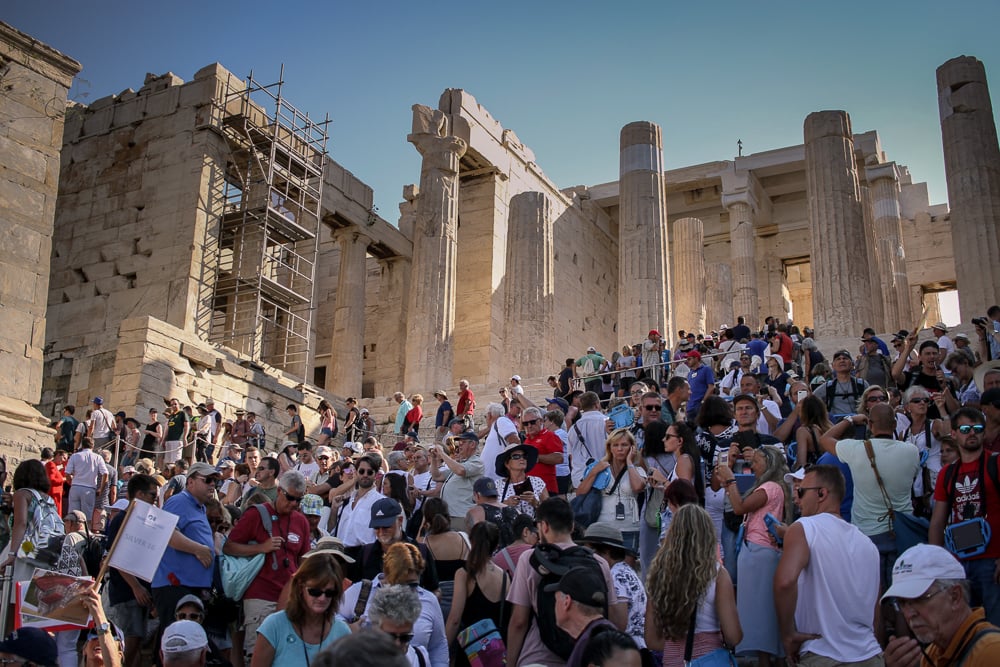
In many parts of Southern Europe, tourism is hailed as a modern “heavy industry,” a powerful engine for economic growth. But as senior analyst Marko Jukic of Bismarck Analysis at Palladium argued recently, this reliance is a dangerous illusion. His stark conclusion: no country in history has become rich from tourism, and none ever will.
The data reveals a deep dependency. In 2019, international tourism revenues made up over half of Montenegro’s and Albania’s exports, and a significant portion of Croatia, Greece, Portugal, and Spain. As Jukic points out, some countries are more reliant on tourism than Dubai is on oil.
And yet, nations that rely almost exclusively on tourism—such as Jamaica, the Maldives, or Bali—remain poor. Even apparent exceptions like Monaco or Andorra are not true success stories of tourism; their wealth comes from special tax and financial conditions, supported by their tiny populations.
The impossible case of Croatia
Jukic uses Croatia as a powerful example. To match Switzerland’s GDP per capita ($100,000), Croatia would need to host an astounding 1.93 billion tourist overnight stays a year. To put that in perspective, foreign tourists recorded about 85 million overnight stays in Croatia in 2024 and 85.6 million in 2025.
Even to reach Germany’s GDP per capita ($56,000), Croatia would have to increase its current tourist traffic fivefold, while tourists spend twice as much. This isn’t just difficult—it’s a mathematical and logistical impossibility.
Why tourism falls short as an economic driver
A Low Ceiling on Productivity: Unlike manufacturing or technology, core tourism services like serving drinks, cleaning rooms, or driving tours offer little room for automation or significant technological upgrades. It is an industry with a productivity level that has remained stagnant for centuries.
A Resource-Consuming Model: Other sectors can scale globally, but tourism requires finite natural resources: beaches, cities, and a local workforce. As tourism grows, it consumes these resources, putting a strain on everything from real estate to social cohesion.
Extreme Vulnerability: Tourism is highly susceptible to international crises, from pandemics and wars to economic recessions. By contrast, industries like technology and manufacturing can innovate and adapt, creating value even in difficult times. This is why countries like Taiwan (semiconductors), Denmark (pharmaceuticals), and Qatar (natural gas) have built their wealth on high-value exports and services.
The tourism economy, Jukic emphasizes, creates a two-tiered society: a small elite that controls real estate and a large workforce of low-skilled laborers. This model neither builds productive capital nor develops the human resources needed to adapt to new technologies. “Being a waiter or a room rental owner is not the future a country deserves,” he writes.
The path forward: From tourism to industry
Jukic concludes that the solution for Southern European nations is not to pour more money into tourism. Instead, they must focus on boosting domestic production, encouraging new entrepreneurs, reducing the tax burden on young people, and incentivizing the return of their educated professionals from abroad.
A return to production and innovation is the only sustainable path to transform the South from a holiday destination into a leading economic player.
Related: Greece Tourism Model Faces Climate, Sustainability Challenges
See all the latest news from Greece and the world at Greekreporter.com. Contact our newsroom to report an update or send your story, photos and videos. Follow GR on Google News and subscribe here to our daily email!

