



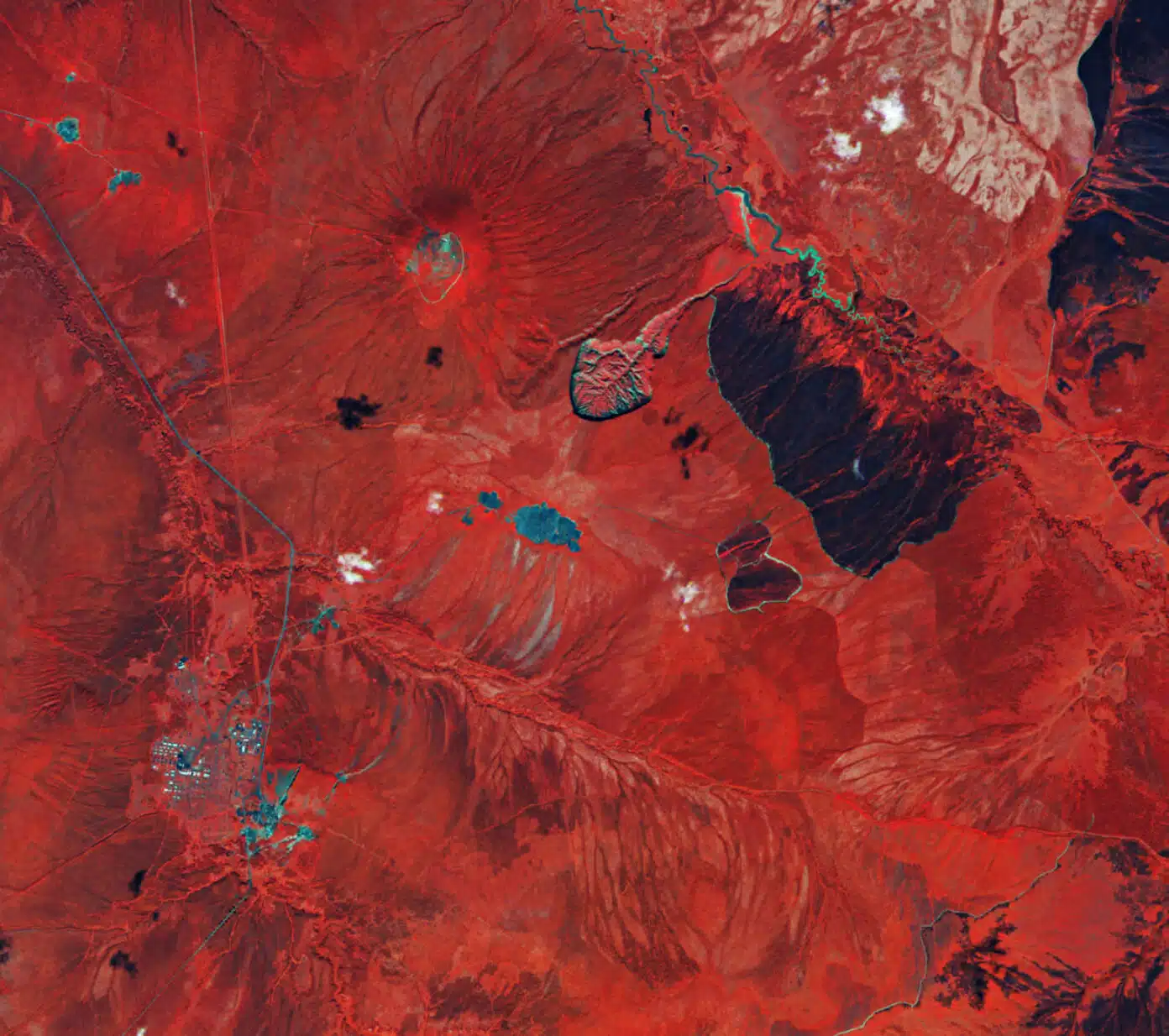
In the cold and unhospitable environment of Siberia, a giant hole is breaking open the land. This hole has the shape of a stingray, and it is viewable from space. The story of this “Gateway to Hell” in Siberia dates back to the Cold War, as shown by declassified imagery from the 1960s, when it was barely visible.
Now, the gateway to hell has steep cliffs that are clearly visible from space. This is because, in a period of almost 30 years, the hole has grown to an unprecedented degree. A major 2024 study using drones, satellite data, field observations and 3D geological modeling estimated that the Batagay megaslump had mobilized about 35 million cubic meters of material since it formed and was losing roughly 1 million cubic meters annually since 2014.
The researchers found that about two-thirds of that lost volume was ground ice and about one-third was thawed sediment. They also estimated the release of roughly 4,000 to 5,000 tons of previously frozen organic carbon each year.
So why is there a Gateway to Hell in Siberia?
In essence, this massive crater in Siberia is a direct consequence of the Arctic heating up faster than the rest of the Earth. The direct consequence of this process is that permafrost is quickly thawing, resulting in “craters” like the one in Siberia.
However, Siberia’s Gateway to Hell is actually not a crater at all. It is the world’s largest “retrogressive thaw slump.”
Now, it doesn’t take a geologist to see that this is not the best name to describe such an interesting phenomenon, but it is accurate, given that it is a pit that forms when permafrost thaw causes the ground to cave in. This then creates a landslide as the earth as its edges slumps into the pit.
This is not an uncommon phenomenon either, given that there are thousands of thaw slumps across the Arctic. What sets Siberia’s Gateway to Hell apart is its size, which has earned it the title of mega slump.
The mega slump in Siberia could be oddly useful to understand where our planet is headed in the future
Permafrost is a strange but fascinating substance. As permafrost thaws, all the dead organisms frozen in it for millennia begin to decompose and release carbon dioxide and methane into the atmosphere.
Essentially, permafrost has blocked these emissions from being released into the atmosphere. This is even more significant considering that permafrost covers 15 percent of the land in the Northern Hemisphere, which contains twice as much carbon as the atmosphere.
If permafrost continues to defrost, then it could emit as much carbon dioxide as a large industrial country by 2100.
This has the potential to further aggravate the climate crisis, but not much is really known about the actual process. However, studying sites such as the Gateway to Hell in Siberia can shed much light on an otherwise unknown phenomenon.
For instance, researchers have calculated that the Gateway to Hell releases somewhere between 4,000 to 5,000 tons of carbon every year.
See all the latest news from Greece and the world at Greekreporter.com. Contact our newsroom to report an update or send your story, photos and videos. Follow GR on Google News and subscribe here to our daily email!

