



If you could pick your next life off a supermarket shelf, what would you choose? Would it be money, good looks, or good fortune? Perhaps it would be power or simply a quiet existence free from all types of drama?
This is a question that has captivated countless minds, from academics to TikTok philosophy accounts and late-night debates among younger generations. Today, these ideas often appear wrapped up in the trendy language of manifestation and multiverses, but the question itself is actually far older. Plato even explored it roughly 2,400 years ago, answering it with one of the most fascinating and unusual stories in ancient philosophy—the Myth of Er.
The Myth of Er in Plato’s Republic
Plato introduces this narrative at the very end of his Republic, but unlike many of his other works, it is not presented as a philosophical argument or a debate. Instead, it’s a story about a soldier named Er from Pamphylia who died in battle. Ten days later, when the bodies were collected for burial, Er’s body had not decayed.
On the twelfth day, as he was laid upon the funeral pyre, he opened his eyes and returned to life. During that time, he had been somewhere beyond the human world, witnessing how the dead were judged, sorted, and sent onward toward their next existence. He returned specifically to share what he had seen with others because, as Plato explains through Er, no one else had been permitted to do so.
Plato was not writing a ghost story or an Ancient Greek version of a Netflix thriller. Instead, he brought a dramatic conclusion to a lengthy exploration of justice, using a powerful narrative device to make an abstract philosophical argument feel as real and immediate as possible. After spending hundreds of pages examining what justice truly means, Plato ends with a vision of what happens to those who fail to understand it. It functions almost like a closing argument before a jury.
At the center of the story is a meadow where souls gather after judgment to choose their next lives. Before them lies an entire range of possibilities: kings, tyrants, athletes, beggars, animals, and ordinary, unremarkable people.
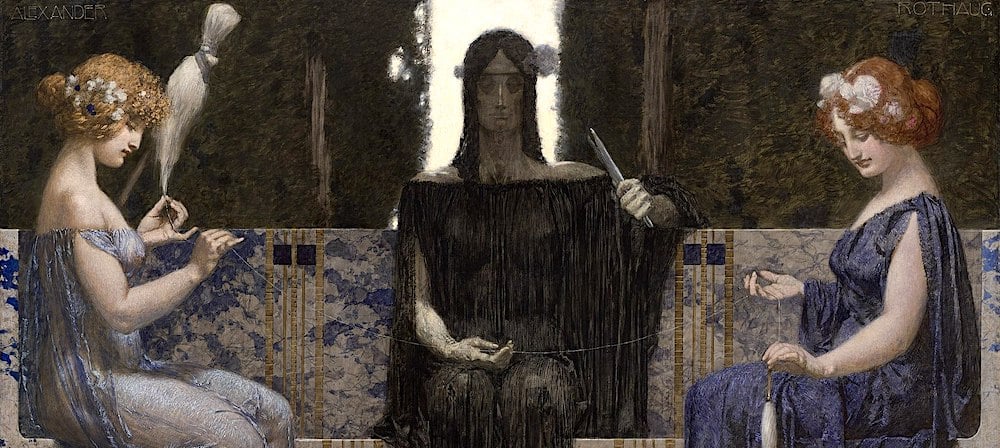
A representative of Lachesis, one of the three Fates (Moirai), addresses the souls before they make their choices, and her words have survived intact:
“Ἀνάγκης θυγατρὸς κόρης Λαχέσεως λόγος. Ψυχαὶ ἐφήμεροι, ἀρχὴ ἄλλης περιόδου θνητοῦ γένους θανατηφόρου. οὐχ ὑμᾶς δαίμων λήξεται, ἀλλ’ ὑμεῖς δαίμονα αἱρήσεσθε. πρῶτος δ’ ὁ λαχὼν πρῶτος αἱρείσθω βίον ᾧ συνέσται ἐξ ἀνάγκης. ἀρετὴ δὲ ἀδέσποτον, ἣν τιμῶν καὶ ἀτιμάζων πλέον καὶ ἔλαττον αὐτῆς ἕκαστος ἕξει. αἰτία ἑλομένου· θεὸς ἀναίτιος.”
In plain English, the passage can be understood as meaning: “Your guardian spirit will not be assigned to you; you will choose it yourself, and responsibility falls on the one who chooses, not on the gods. Blame belongs to the chooser. The divine remains free of blame.”
This was a radical claim to place at the foundation of a religious worldview. There is no predestination, no excuses, no appeal to divine will, and no cosmic scapegoats. You chose this and you alone. The thoughts that shaped your actions were your very own.
What makes this story so compelling today?
This is what makes Plato’s work so enduring. In the Myth of Er, he does not allow the souls to choose wisely. One soul who had lived a long, comfortable, and unreflective life selected the life of a tyrant without considering the consequences, drawn in by its glamor, only to discover afterward that this existence included the horrifying act of eating his own children.
Er explains that souls who had suffered in their previous lives often chose more carefully, ironically because hardship had taught them something valuable. Those who had experienced ease and comfort made the worst choices, precisely because they had never been forced to develop the wisdom that comes from challenges.
Plato was making a psychological observation as well as the moral argument that character shaped by adversity often sees more clearly than that shaped by comfort. The pattern remains recognizable today. Anyone who has witnessed a person coast through good fortune only to struggle when circumstances become difficult has seen a version of this idea play out.
None of this required a god to intervene and ruin anyone’s day or alter anyone’s life. The souls bring these consequences upon themselves, with every option before them and with complete freedom and accountability. It’s the mechanism Plato is most interested in—not fate but choice and the quality of the mind making that choice.
Occasionally, one might wonder why a story like the Myth of Er still gets clipped, narrated, and reposted twenty-four centuries later alongside updated thinking on karma and past lives. Part of its appeal may lie in the imagery of a soldier whose body does not decay, a meadow filled with souls, and a river of forgetfulness that they must drink from prior to being born again, ensuring that no one enters their next life with a “cheat sheet.” It sounds almost like something designed for a modern audience. Yet its lasting power comes from something deeper, and the underlying idea has never gone out of fashion. We still want to believe that character is not simply handed to us and that the person we become is shaped by choices we were genuinely free to make as alternatives to other options.
Plato was not the first thinker to inquire about whether we choose who we become or merely drift into it by accident. Nonetheless, he was exceptionally skilled at making the question impossible to ignore. This remains the enduring appeal of Plato, regardless of whether his ideas are explored through a philosophical dialogue or a forty-five-second TikTok video: remind someone that the choice was theirs, and watch them sit with that realization a little longer than they expected.
See all the latest news from Greece and the world at Greekreporter.com. Contact our newsroom to report an update or send your story, photos and videos. Follow GR on Google News and subscribe here to our daily email!

