



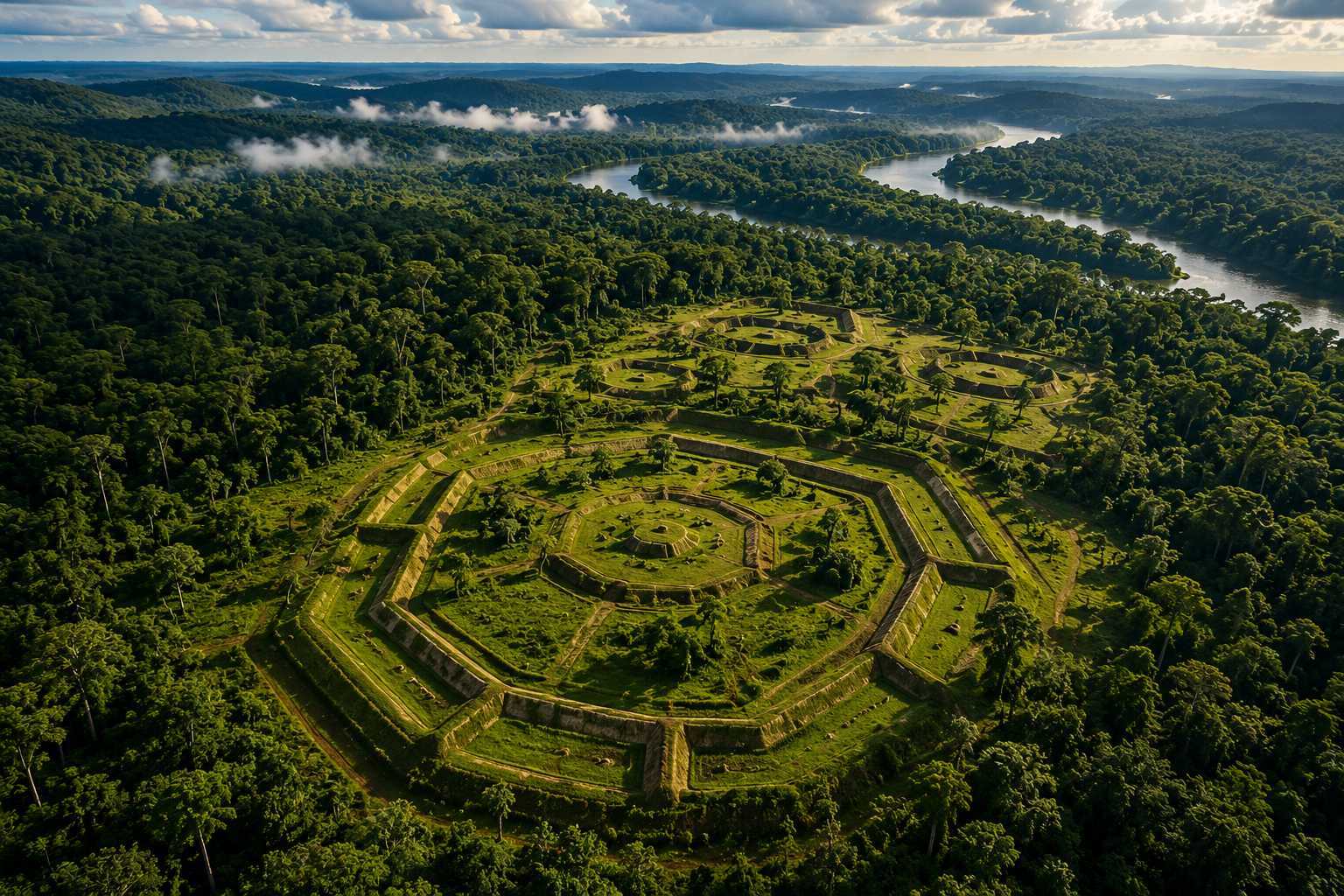
An ancient Amazon civilization that built thousands of monumental earthworks across the rainforest may have supported between 1.25 million and 3 million people at its peak, according to a new study.
The findings challenge long-held ideas that the Amazon was sparsely populated before European contact and suggest parts of the rainforest were home to large, organized societies that reshaped the landscape for centuries.
The study, led by Martti Pärssinen, used airborne LiDAR technology to scan dense forest in southwestern Amazonia. The laser-based system can penetrate tree cover and reveal structures hidden beneath the canopy.
Researchers say the new survey uncovered far more archaeological sites than previously known, pointing to one of the largest pre-Columbian cultural landscapes ever identified in the Amazon. The research focused on the Aquiry civilization, a society that built large geometric earthworks across what is now Brazil, Bolivia and Peru.
Researchers estimate the civilization flourished between AD 100 and 300, although many of its ceremonial centers were built over a much longer period beginning around 600 BC.
LiDAR reveals thousands of hidden earthworks
For decades, archaeologists relied mainly on satellite imagery and deforested areas to locate Amazonian earthworks. Thick forest cover made it difficult to detect sites hidden beneath the canopy.
To overcome that challenge, researchers flew more than 4,430 kilometers (2,753 miles) over the rainforest using LiDAR. The survey covered nearly 4,500 square kilometers (1,737 square miles) and identified 432 earthworks, including 396 sites that had never been recorded before. Only 36 of the structures were already known.
An ancient Amazon civilization may have supported up to 3 million people, according to a new LiDAR study that uncovered thousands of hidden earthworks beneath the rainforest canopy.
The findings challenge long-held beliefs that the pre-Columbian Amazon was sparsely populated. pic.twitter.com/2uqRGlA7oR
— Tom Marvolo Riddle (@tom_riddle2025) July 30, 2026
When combined with previous archaeological data, the discoveries dramatically expanded the known extent of the Aquiry civilization.
Researchers estimate the society occupied roughly 183,000 square kilometers (70,656 square miles), about three times larger than earlier estimates. They also calculated that the region may contain between 24,000 and 30,000 earthworks, compared with previous estimates of only about 1,500 structures across all of Amazonia. The findings suggest that many more archaeological sites remain hidden beneath the rainforest.
Monumental centers shaped social and political life
The earthworks range from small geometric enclosures to massive ceremonial complexes covering dozens of hectares. Most consist of large ditches and raised embankments laid out in circles, squares, or other geometric patterns.
Researchers believe these sites were not permanent towns surrounded by defensive walls. Instead, they likely served as ceremonial, political, and public gathering places where communities came together for religious events, celebrations, and decision-making. Some sites were connected by roads, while others formed clusters containing several enclosures.
Building these monuments required careful planning, skilled labor, and long-term organization. Researchers say the construction of the earthworks over nearly 1,500 years points to sophisticated societies with knowledge of geometry, coordinated labor, and strong social institutions.
Population may have reached 3 million
Using the newly mapped earthworks, radiocarbon dating and archaeological evidence, researchers estimated how many ceremonial centers were active at the same time. They concluded that about 25% to 60% of the Aquiry earthworks were likely in use during the civilization’s peak between AD 100 and 300.
Based on estimates that each active ceremonial center supported around 300 people, researchers calculated that the population probably ranged from 1.25 million to 3 million people. If additional hidden earthworks exist beneath dense forest, that figure could have reached 3.8 million.
Those numbers are far higher than earlier estimates for the region and suggest southwestern Amazonia alone may have contained as many monumental sites as researchers once believed existed across the entire Amazon Basin.
The rainforest supported a thriving civilization
Researchers found evidence that ancient communities cultivated crops including maize, squash, manioc, beans, peanuts, sweet potatoes and chili peppers. They also managed forests rich in Brazil nut trees and several palm species that provided food and other resources.
Rather than living in untouched wilderness, researchers argue these communities actively shaped the rainforest through farming, forest management and controlled burning over many centuries. That long-term human activity may still influence today’s forest structure, biodiversity and soil conditions.
Researchers say the discoveries have implications beyond archaeology. If similar hidden landscapes are found elsewhere in Amazonia, scientists may need to reconsider estimates of the region’s ancient population as well as the role Indigenous societies played in shaping one of Earth’s largest tropical forests.
The study concludes that understanding this human legacy could also improve future research on Amazonian biodiversity, sustainable land management and even global climate models.
See all the latest news from Greece and the world at Greekreporter.com. Contact our newsroom to report an update or send your story, photos and videos. Follow GR on Google News and subscribe here to our daily email!

