



The scientific identification of the long lost sanctuary of Odysseus on his home island, Ithaca, has provided additional evidence that the Trojan War hero was worshipped as a god by a cult for as long as a thousand years from his death.
Latest archaeological research suggests that the worship of the Homeric hero began around the 9th Century BC, when his extraordinary adventures were narrated in oral poems by Homer, and probably gained momentum after the Odyssey was written down in the late 8th Century BC, before it started to decline in the Roman era, the BBC reports.
Historical remains of this cult include ruins of the actual sanctuary dedicated to Odysseus on Ithaca, as well as coins and tiles bearing the hero’s name.
Some of the finds were unearthed by a Dutch archaeologist as far back as 120 years ago, but were only recently reasearched thoroughly and interpreted in combination with latest discoveries by Greek experts.
Newly discovered inscriptions reveal existence of Odysseus cult
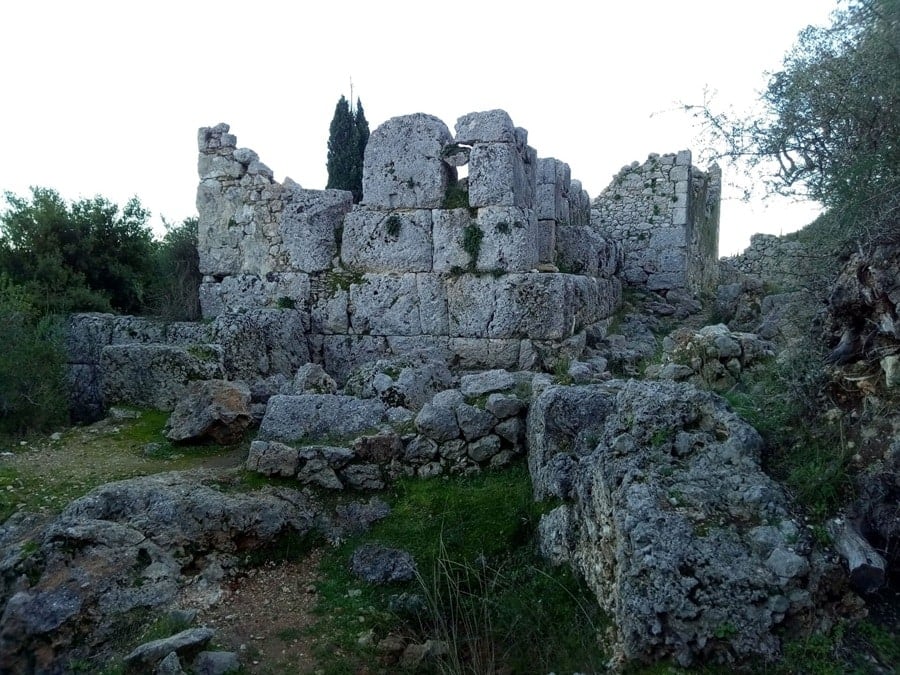
Odysseus’ sanctuary on Ithaca was identified in 2025 as part of the significant archaeological site of Agios Athanasios-Homer’s School, located in the northern part of the island.
Having been referred to as Homer’s School since the early 19th century, when it was first excavated, the site is centered around a large rocky formation on the eastern slopes of Exogi, an area rich with water springs.
Excavated antiquities are spread across two terraces, connected by carved staircases and various lower points. The Upper Andiro features the remains of a Hellenistic tower (3rd century BC), while a large rectangular building dominates most of the Lower Andiro.
In June 2025, the Greek Ministry of Culture announced the discovery of two inscriptions of major importance at the site, both bearing the name of the Homeric hero. The one of them, translated as “of Odysseus,” is similar to tiles with inscriptions found in other sanctuaries dedicated to well-known gods in the ancient Greek world to declare which god the building was dedicated to those gods. The second one reads like a dedication, “to Odysseus”, and was likely a votive left there by a pilgrim of the sanctuary.
Long lost Sanctuary of Odysseus identified after 100 years of search
Matched with other finds from a century-old excavation by Dutch archaeologist Carl Wilhelm Vollgraff – a miniature bronze bust and coins – these inscriptions allowed researchers from the University of Ioannina to identify the site as the location of the long lost ancient Odysseion, the sanctuary of Odysseus.

“About a century after the discovery of the engraved dedicatory inscription ΕΧΗΝ ΟδΥΚΕΙ on a fragment of a clay mask from the Late Hellenistic period from the Cave of Ormos Polis, the two new epigraphic testimonies of the same period (ΟδΥΚΕΟΚ and ΟδΥΚΕΙ) for the later cult of the hero in northwest Ithaca, now come, in combination with the other available data, to document the development of a prominent public complex at the site, with a major role in the religious, social and possibly political life of the Ithacians of the Hellenistic-early Roman periods, but also with a broader pilgrimage character,” the announcement of the Greek Ministry of Culture revealed.
The existence of the Odysseion sanctuary was known to archaeologists from having been documented in a resolution of the Ithaca deme dated from around 207 BC, found in Magnesia in ancient Ionia, modern-day Turkey. The same resolution refered to games taking place near the sanctuary in honour of Odysseus.
The 2025 study by the University of Ioannina brought an end to the quest for the Odysseion; one that lasted almost a hundred years, becoming a metaphorical Odyssey in its own for the international archaeological community.
According to the Greek Ministry of Culture, “the character of the Odysseion and its exact place in relation to the games have been the subject of fruitful scholarly debate since the 1930s”.
See all the latest news from Greece and the world at Greekreporter.com. Contact our newsroom to report an update or send your story, photos and videos. Follow GR on Google News and subscribe here to our daily email!

