



Anaxagoras, a pioneering ancient Greek philosopher, can be seen as a forerunner to the modern understanding of the expanding universe. His revolutionary ideas on cosmic plurality and the infinite nature of existence laid the groundwork for later scientific discoveries, bridging the gap between ancient speculation and modern astrophysics.
Anaxagoras: The forerunner of cosmic expansion and the theory of many worlds
In the grand narrative of cosmology, figures like the American astronomer Edwin Hubble stand as defining pioneers of our understanding of an expanding universe. Yet, over two millennia before Hubble observed galactic recession, the Greek philosopher Anaxagoras (c. 500–428 BCE) had already laid down an intellectual framework that resonates with modern cosmological theories.
Though he lacked the tools of contemporary science, his radical ideas about cosmic motion, the role of intellect (Nous), and the existence of multiple worlds positioned him as a visionary in the history of thought.
The expanding universe: Anaxagoras’ proto-cosmology
Anaxagoras’ worldview begins with a profound saying: “All things were together.” As recorded by the Neoplatonist philosopher Simplicius in his Commentary on Aristotle’s Physics, this phrase suggests a primordial state of the universe where everything existed in an undifferentiated mixture. Only through the intervention of Nous—the universal mind—is this chaotic unity set into motion. This initiated a process of separation and differentiation. This motion was not finite but continuous, suggesting a cosmos that expands and evolves.
In this view, Anaxagoras appears strikingly ahead of his time. His concept of an ever-unfolding cosmos, where elements continuously move and separate, mirrors the fundamental principles behind modern cosmological expansion. Hubble demonstrated that galaxies are moving away from each other, indicating an expanding universe. Likewise, Anaxagoras posited a universe in perpetual motion, driven by an underlying rational principle.
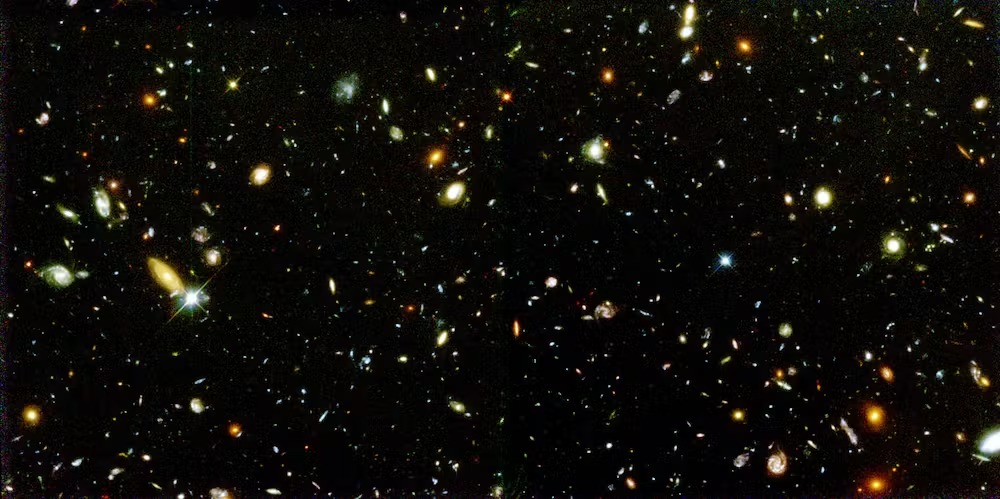
Anaxagoras and the theory of many worlds
Anaxagoras also advanced a concept that aligns with later theories of exoplanets and multiple habitable worlds. The ancient Greek biographer Diogenes Laertius, in his work Lives and Opinions of Eminent Philosophers, records some of his statements. “with men also cities are conjoined” he said in other realms. Anaxogras further claimed that these places contain suns and moons like our own. This was a revolutionary assertion: if celestial bodies exist elsewhere, why wouldn’t life exist there too?
This view laid the foundation for later philosophical speculations about the plurality of worlds, influencing thinkers such as the Greek philosophers Democritus and Epicurus. Today, with the discovery of thousands of exoplanets in habitable zones, Anaxagoras’ insights appear less speculative and more prophetic. His refusal to limit existence to a single world reflected a profound intuition about the nature of the cosmos.

The separation of intellect and sense: A philosophical precursor to scientific thought
Beyond his contributions to science, Anaxagoras introduced a dual order of reality—one intellectual, one sensible. He argued that Nous was the force that put order to an otherwise chaotic universe. Nous governed the separation of elements and the emergence of structured reality. In his dialogue Phaedo, Plato mentions Anaxagoras’ emphasis on Nous as a cause of order in the universe. He distinguished between what we perceive by the senses and what we understand by the intellect. This conceptual framework prefigured the rationalist approaches of later philosophers like Plato and Descartes.
This distinction was crucial in the development of scientific methodology. By prioritizing reason and observation over mere sensory experience, Anaxagoras paved the way for a worldview where nature is understood through systematic inquiry rather than mythological interpretation.
Legacy and influence: A mind ahead of his time
Anaxagoras’ ideas were controversial in his own time. The Athenians even exiled him for suggesting that the sun was a fiery rock rather than a divine entity, as the Greek biographer Plutarch recorded in “On Exile.” Yet, his vision of a dynamic, rationally ordered universe anticipated the principles that would later define modern physics and astronomy. His belief in cosmic motion, separation, and the existence of multiple worlds aligns remarkably well with modern scientific discoveries, making him not only a pioneering philosopher but also an unrecognized forerunner of cosmology.
Had he lived in an age with telescopes and advanced mathematics, one might wonder if he, rather than Hubble, would have been the first to talk about the universe’s expansion. In this sense, Anaxagoras is an intellectual bridge between ancient speculation and modern cosmic discovery. He was a true intellectual, and his ideas continue to echo through space and time.
See all the latest news from Greece and the world at Greekreporter.com. Contact our newsroom to report an update or send your story, photos and videos. Follow GR on Google News and subscribe here to our daily email!

