



Zeus, ruler of Olympus and father of gods and men, was never one-dimensional, and one of his most intriguing forms was Meilichios, the “kindly” or “gracious” Zeus. While this name evokes benevolence, it also carries the shadow of death, purification, and the chthonic realm.
Chthonic Zeus and the serpent
The word meilichios comes from the Greek meilichos, meaning soothing, gentle, or appeased. At first glance, it suggests a Zeus who offers kindness and reconciliation. Yet in the religious imagination of the Greeks, names often concealed paradoxes. The same Zeus who bore the thunderbolt could also wear the mask of the underworld. Thus, “Meilichios” referred not only to gentle Zeus but also to the Zeus who required appeasement—the god to whom offerings were made to turn away anger or avert misfortune.
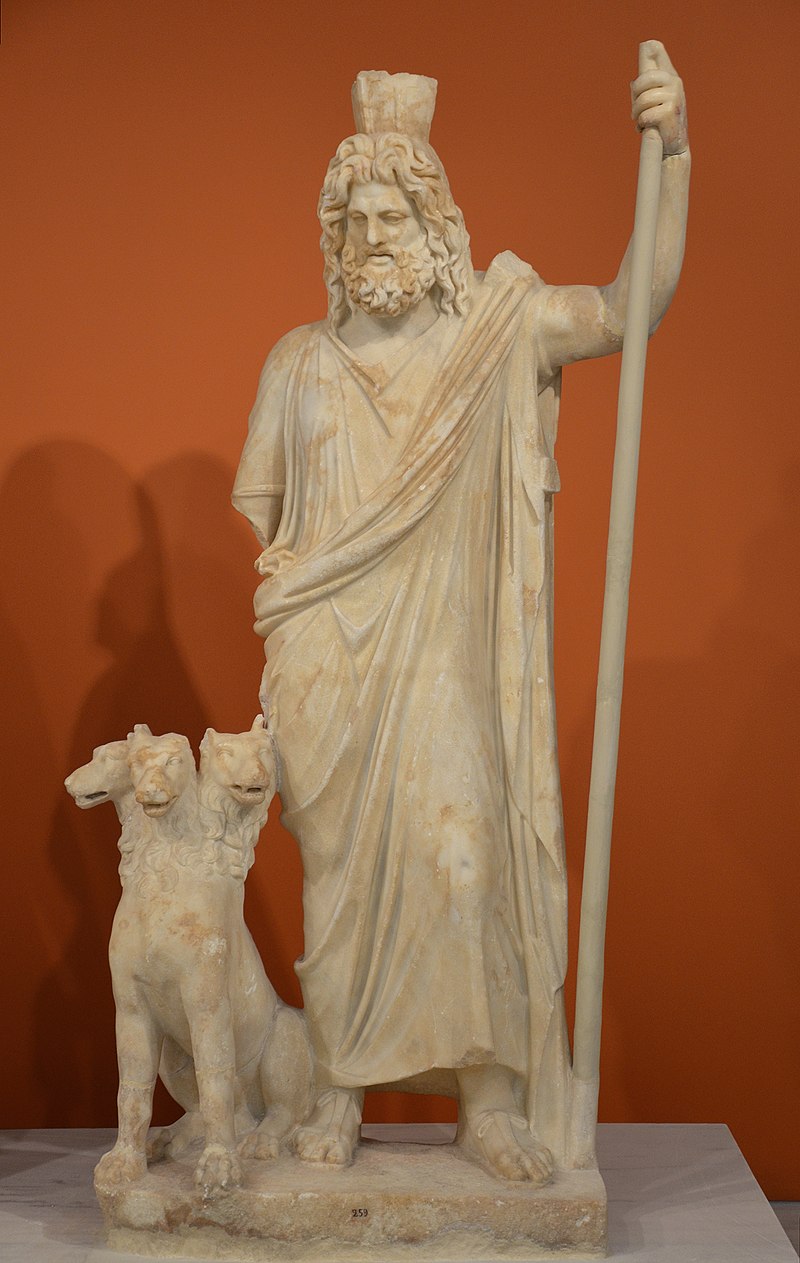
This duality explains why Zeus Meilichios was worshiped in rituals closer to the cults of Hades and the chthonic gods than to the bright festivals of Olympus.
Unlike the familiar statues of Zeus holding a scepter or thunderbolt, representations of Zeus Meilichios often appeared in serpent form. In Greek religion, the serpent symbolized the underworld, ancestral spirits, and fertility bound to the earth. At shrines, worshipers did not erect the towering figures known from Olympia or Dodona; instead, they raised stone pillars or simple images, sometimes adorned with serpentine motifs.
In Athens, evidence survives of sacrifices to Zeus Meilichios in this form. The cult emphasized purification after bloodshed and reconciliation with the divine order. In this way, Zeus Meilichios became not the sky-father of Olympus but a power rooted in earth and death.
Athens and the cult of Meilichios
The worship of Zeus Meilichios played a central role in rites of purification, especially after acts of blood guilt. In Greek thought, murder—even accidental—stained the soul and polluted the community. Cleansing required ritual action and divine acceptance. To Zeus Meilichios, worshipers brought offerings at night, often holocaust sacrifices in which the victim was completely burned. Unlike the festive sharing of meat in Olympian rituals, chthonic sacrifices gave everything to the god, consumed in smoke and ash.
The ritual marked both submission and supplication. By destroying the offering entirely, the community acknowledged the distance between mortals and chthonic power. They sought not companionship with the god but release from his wrath.
In Athens, the cult of Zeus Meilichios had deep roots. Pausanias, the second-century AD traveler, mentions altars dedicated to him in the city, and Archaeological evidence confirms his worship in suburban shrines and private households. Unlike the grand temples on the Acropolis, these cult sites were modest, almost hidden, reflecting the god’s dark, intimate character.
The Athenians associated Zeus Meilichios with the expiation of ancestral guilt. In times of plague or social crisis, communities turned to him to restore balance. His cult demonstrates that Athenians never saw Zeus only as a celestial figure but also as a power entwined with the fates of the dead.

Meilichios and political order
Authors such as Simon Hornblower argue that Zeus Meilichios was virtually indistinguishable from Hades in practice. Both received black animals as offerings, both presided over purification after death or blood guilt, and both were honored with holocaust sacrifices. Yet the Greeks hesitated to invoke Hades directly, as names carried power. Calling the underworld god “Zeus” framed him within the order of justice and cosmic rule, rather than sheer terror.
Thus, Meilichios reveals how Greek religion softened the boundaries between sky and underworld. Zeus himself embodied the full range of divine authority: he was both thunderer and chthonic judge.
Despite the somber character of his worship, Zeus Meilichios could also bring blessings. In many households, he functioned as a guardian of prosperity. Families poured libations to him at their hearths, praying for fertility of the land and health of the lineage. The serpent form tied him not only to death but also to the cycles of life renewed in the earth.
In this sense, the epithet Meilichios truly meant “kindly.” He was the Zeus who, once appeased, granted abundance. He was the power who turned aside destruction and gave sweetness where bitterness threatened.
The cult of Zeus Meilichios also intersected with politics. City-states invoked him during times of civic turmoil. In Greek imagination, blood guilt could extend beyond individuals to infect entire communities. Only through appeasement could order be restored. When factions fought or tyrants fell, sacrifices to Zeus Meilichios marked the end of strife and the beginning of reconciliation.
In this way, Zeus Meilichios served as a divine guarantor of justice not only for individuals but also for the polis. He reminded citizens that peace required humility before powers greater than themselves.

The worship of Chthonic Zeus
The modern understanding of Zeus Meilichios owes much to Jane Ellen Harrison, the pioneering classical scholar of the Cambridge Ritualists. In her Prolegomena to the Study of Greek Religion (1903), Harrison argued that the cult of Zeus Meilichios preserved some of the oldest layers of Greek religious practice. For her, the serpent imagery, nocturnal rites, and holocaust sacrifices all pointed to a primitive, chthonic Zeus later overshadowed by the Olympian thunderer.
Harrison insisted that Greek religion could not be reduced to the lofty ideals of Homer or Plato. Beneath the literary surface lay ancient ritual layers, deeply tied to fear, death, and communal guilt. Zeus Meilichios embodied this hidden foundation. By studying him, Harrison revealed how the Greeks confronted not only divine justice but also the darker mysteries of existence.
Philosophers, especially in later antiquity, reflected on Zeus Meilichios as a symbol. To some, he represented the soul’s need for purification before ascending to higher realities. To others, he revealed the twofold nature of divinity: transcendent yet immanent, celestial yet chthonic. The Orphic tradition, with its emphasis on purification and release from the cycle of rebirth, found in Zeus Meilichios an image of the divine force that liberates through suffering.
Legacy of a forgotten Zeus
Today, the figure of Zeus Meilichios remains little known outside circles of classical scholarship. Yet his cult reveals essential truths about Greek religion. The Greeks did not separate the bright from the dark, the heavenly from the chthonic, as rigid opposites. Instead, they saw them as facets of the same power. Zeus could rule from Olympus and yet also dwell in the underworld, demanding both reverence and fear.
The worship of Zeus Meilichios illustrates how the Greeks confronted guilt, death, and the demand for justice. They turned to him in their darkest hours, seeking release from pollution and hope for renewal. In his serpent form and nocturnal rituals, he embodied the mystery of life bound to death, destruction transformed into blessing.
Zeus Meilichios stands as one of the most compelling aspects of Greek religion. Far from the thunderer alone, he appeared also as a chthonic force, demanding purification and offering reconciliation. His cult reminds us that Greek piety encompassed both joy and dread, festival and sacrifice, life and death.
See all the latest news from Greece and the world at Greekreporter.com. Contact our newsroom to report an update or send your story, photos and videos. Follow GR on Google News and subscribe here to our daily email!

