



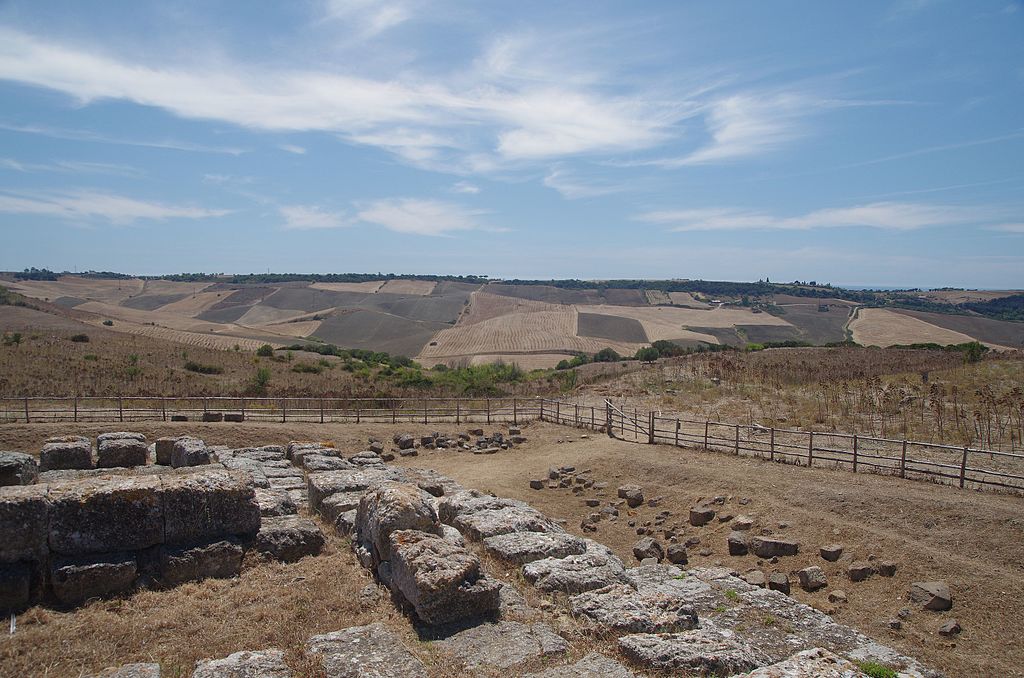
_F0164005_Tarquinia,_area_archeologica_etrusca_della_Ara_della_Regina,_vedute_e_fondamenta_del_tempio.jpg)
Excavations at Italy’s Civita di Tarquinia are revealing that the ancient Etruscan city, long celebrated for its tombs, was also a thriving Roman settlement.
The campaign, launched in September, is directed by Jaume I University in Spain in collaboration with the University of Macerata and the University of Verona. The Italian Ministry of Culture authorized the work, which is co-directed by Josep Benedito of Jaume I University and Giulia Baratta of the University of Macerata.
A Roman city of scale and sophistication
Archaeologists are uncovering the framework of a Roman city that once extended across nearly 160 hectares. Excavation in the forum area near the Ara della Regina, previously studied by P. Romanelli, has brought to light paved streets comparable to those in Pompeii. These streets formed the backbone of a city that also included squares, markets, and public buildings.
The team has also identified private residences, or domus, once owned by prominent families. These homes preserve mosaics and painted walls, evidence of wealth and cultural life. Columns, capitals, and other architectural fragments point to monumental structures of significant value.
Findings confirm earlier studies
The discoveries cover a wide chronological span, from the Republican era to Late Antiquity, with traces into the early Middle Ages. This continuity challenges the long-held view of Tarquinia as a city that declined after its Etruscan period.
The new evidence corroborates earlier geomagnetic surveys conducted by the University of Verona, which had mapped the outline of a large and complex urban settlement beneath the soil. Those surveys suggested a sophisticated urban plan with a careful distribution of public and private spaces. The latest excavation confirms that vision, positioning Tarquinia as a Roman city of considerable importance in the Mediterranean world.
Recasting Tarquinia’s legacy
Tarquinia has long been defined by its Etruscan heritage, most famously its painted tombs, part of a UNESCO World Heritage Site. Until now, its Roman phase was largely overlooked. Archaeologists say the current findings restore balance, showing Tarquinia as a dynamic city that thrived under both Etruscan and Roman rule.
The Tomb of the Shields, ( dated 340 BC and discovered in 1870), is a large hypogeum one of the largest #Etruscan #tombs in #Tarquinia. The plan of the tomb imitates that of a house with a central atrium with three rooms #TombTuesday #Italy #Archaeology #History #art pic.twitter.com/ulmXBQrywd
— Jon Hawke 🏛️🏺 (@HawkeJon) August 1, 2023
The project will continue in the coming years, with plans to investigate areas of the Roman city that remain unexcavated. Researchers aim to reconstruct Tarquinia’s development during the Republican, Imperial, and Late Antique periods, offering a fuller account of its urban history.
By uncovering this hidden chapter, the excavation seeks to restore Roman Tarquinia to international recognition and enrich the broader understanding of one of ancient Italy’s most influential cities.
See all the latest news from Greece and the world at Greekreporter.com. Contact our newsroom to report an update or send your story, photos and videos. Follow GR on Google News and subscribe here to our daily email!

