



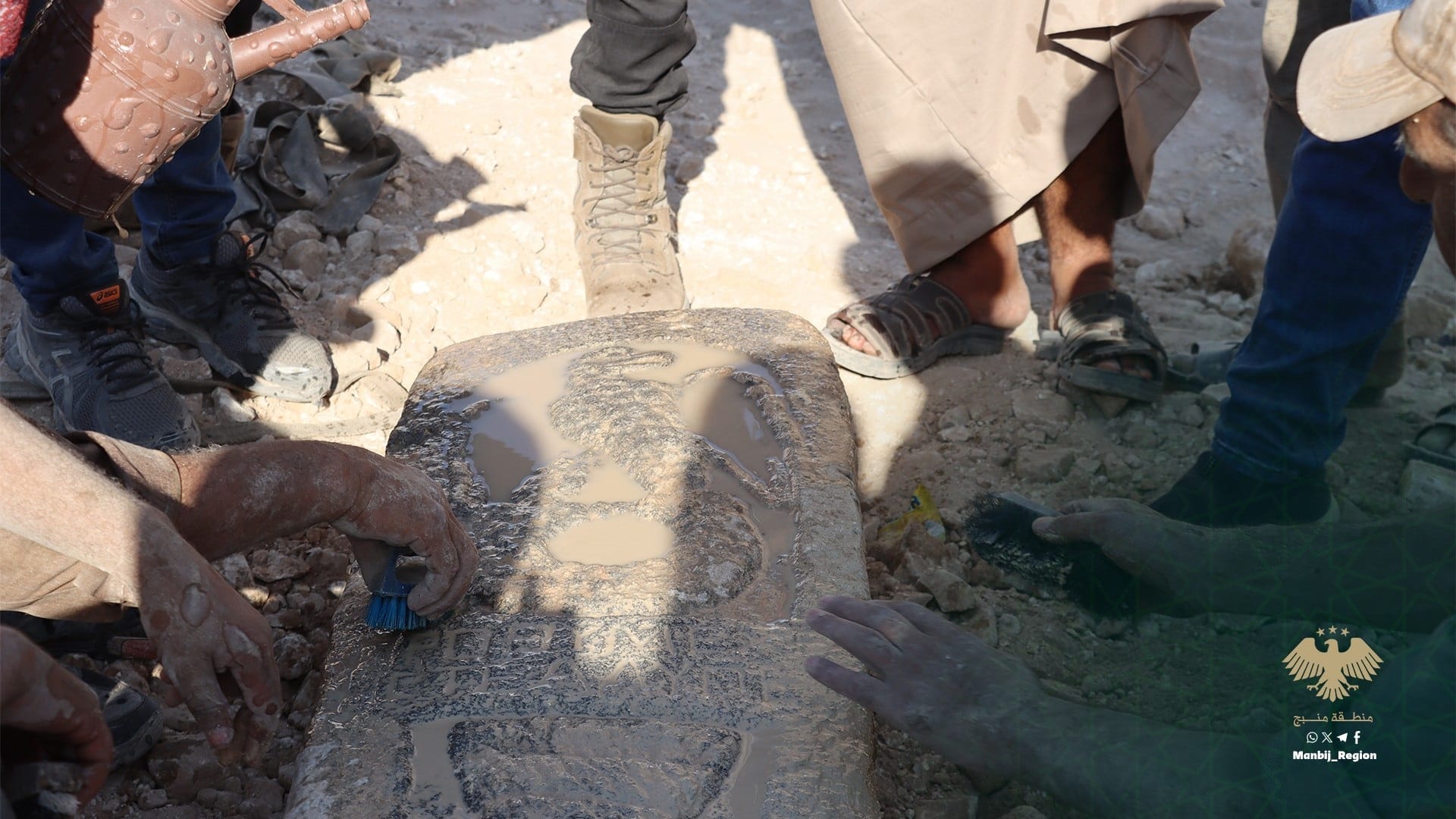
A 2,000-year-old Roman stele featuring Greek inscriptions was discovered in the historic city of Manbij in Syria. The artifact, carved out of black basalt stone, also featured the image of an eagle clutching a wreath.
The discovery was made following a report by a local resident who noticed the unusual stone near the city’s cardamom market and notified the Directorate of Museums and Artifacts. Experts recovered the artifact and removed it from the site for study and safeguarding.
Manbij, Syria, where Roman stele with Greek inscriptions was found, was ancient Syrian fertility goddess worship center
The history of the city of Manbij goes back almost three millennia and has always been a troubled one to the present day. Its strategic position has rendered it a point of contention among cultures, armies, and kingdoms throughout the centuries.
Initially a prominent Aramaic and Assyrian city, Manbij came under Alexander the Great’s Macedonian Empire and prospered under the rule of the Seleucids. It was known as Hierapolis, meaning “Sacred City” in Greek.
Throughout antiquity and even prior to the Macedonian conquest, Manbij was known as the center of the cult of the Syrian fertility goddess Atargatis. A shrine allegedly served by three hundred priests of the goddess and a pond with sacred fish attracted thousands of faithful during the Roman Era, as well.
Hierapolis’ cult peak and decline
The 2nd century AD Greek treatise De Dea Syria, attributed to the Syrian essayist Lucian of Samosata, describes the religious practices of the cult of Atargatis in Hierapolis, written in the Ionic Greek dialect. Among others, it chronicles a mode of divination by movements of a xoanon of the Greek god Apollo.
In the 3rd century, Hierapolis remained one of the greatest cities of Syria but declined thereafter. Caliph Harun al-Rashid restored the city at the end of the 8th century, and it later became the headquarters of Hulegu and his Mongols.
Today, no ruins of Atargatis’ temple or of her sacred pond survive, and most monuments date to the later periods of the city’s history.
An Archaeological Office was inaugurated recently in Manbij, with the aim of recovering and restoring any remains of the rich ancient past of the city which has kept changing hands and suffering violence during the Syrian Civil War and related unrest in the area.
See all the latest news from Greece and the world at Greekreporter.com. Contact our newsroom to report an update or send your story, photos and videos. Follow GR on Google News and subscribe here to our daily email!

