


The Archipelagos Institute of Marine Conservation, a non-governmental organization active in Greece, has continued to add new plants this season to the underwater meadows of Posidonia oceanica, a carbon-absorbing seagrass species.
The effort began in 2018 and has continued at an intensive pace annually from early spring through the end of the year, aiming to reverse the ever-increasing destruction of Posidonia seagrass meadows in Greek seas.
Endemic to the Mediterranean waters, Posidonia oceanica, also known as Neptune grass or Mediterranean tapeweed, has a very high carbon absorption capacity, as it is able to soak up fifteen times more carbon dioxide every year than a similar-sized area of the Amazon rainforest, which makes it an important part of the ecosystem. Furthermore, it prevents the coastline from erosion and is a reliable bio-indicator of low pollution levels.
Underwater seagrass planting techniques a difficult job
The Archipelagos Institute of Marine Conservation has been developing and implementing experimental underwater seagrass planting techniques in collaboration with scientists from leading European universities for the past seven years.
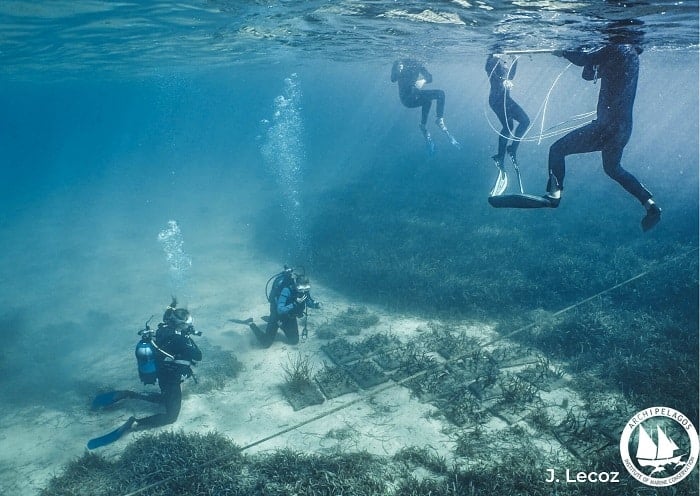
As explained in a Facebook post alongside photos of the restoration campaign, the process requires taking fragments of Posidonia oceanica uprooted from boat anchors and replanting them within the short timeframe that they remain alive.
Damage from anchors is among the species’ most prevalent threat factors, besides the obvious rising sea temperatures, which slow down its growth.
The planting process is particularly demanding. In the first years of plant growth, systematic care is required by specialized scientific divers, almost on a weekly basis, below sea surface and throughout the year, the Archipelagos Institute of Marine Conservation explains. “Enormous perseverance and patience” is required for the successful development of the carbon-absorbing underwater gardens of the species.

Slow growth of Posidonia seagrass renders restoration challenging
Named after Poseidon, the Greek god of the seas, the species was first described by Swedish biologist and physician Carl Linnaeus in his Systema Naturae in 1758-1759, although it was then named Zostera.
The viability of Posidonia ocenica underwater gardens depends on the sea currents, the quality of the sediment, the weather conditions that prevail mainly during the first years of development, as well as the abundance of specific herbivorous species of fauna in the area, according to the Archipelagos Institute of Marine Conservastion.
The meadows have extremely slow growth rates of only between 1-6 centimeters per year horizontally and 1-4 centimeters vertically, which makes their restoration a long-term challenge but holds great importance because the seagrass helps filter the water and sequester carbon, whilst it also provides an important food source for marine life.
See all the latest news from Greece and the world at Greekreporter.com. Contact our newsroom to report an update or send your story, photos and videos. Follow GR on Google News and subscribe here to our daily email!

