



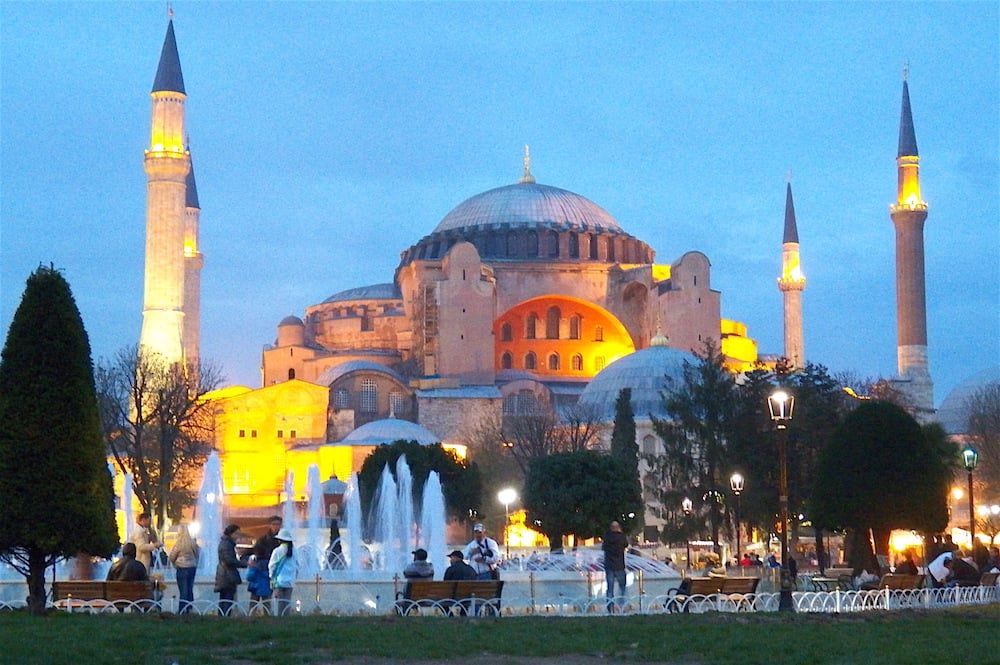
Six cadets of the Hellenic Air Force Academy were arrested by Turkish authorities near the Hagia Sophia monument in Istanbul, after displaying the Greek flag.
The incident took place on Saturday, December 21 and involved six students (three Greek nationals and three Cypriot nationals) who had traveled to Istanbul for the Christmas holidays, reportedly without permission from their unit as required for all Greek military personnel when traveling abroad (especially to Turkiye).
When the students arrived at the Hagia Sophia monument and displayed the Greek flags, they were spotted by members of Turkiye’s National Intelligence Organization (MIT) and arrested for violating Turkish laws regarding the display of foreign symbols. Turkiye has strict laws regarding the display of foreign flags and they are described in the country’s Turkish Flag statute.
According to reports, five students were arrested on the spot while another managed to leave the area before also getting arrested. The Greek Consulate was immediately informed by Turkish authorities and after a diplomatic intervention, the cadets were released and returned to Greece, where they await disciplinary action.
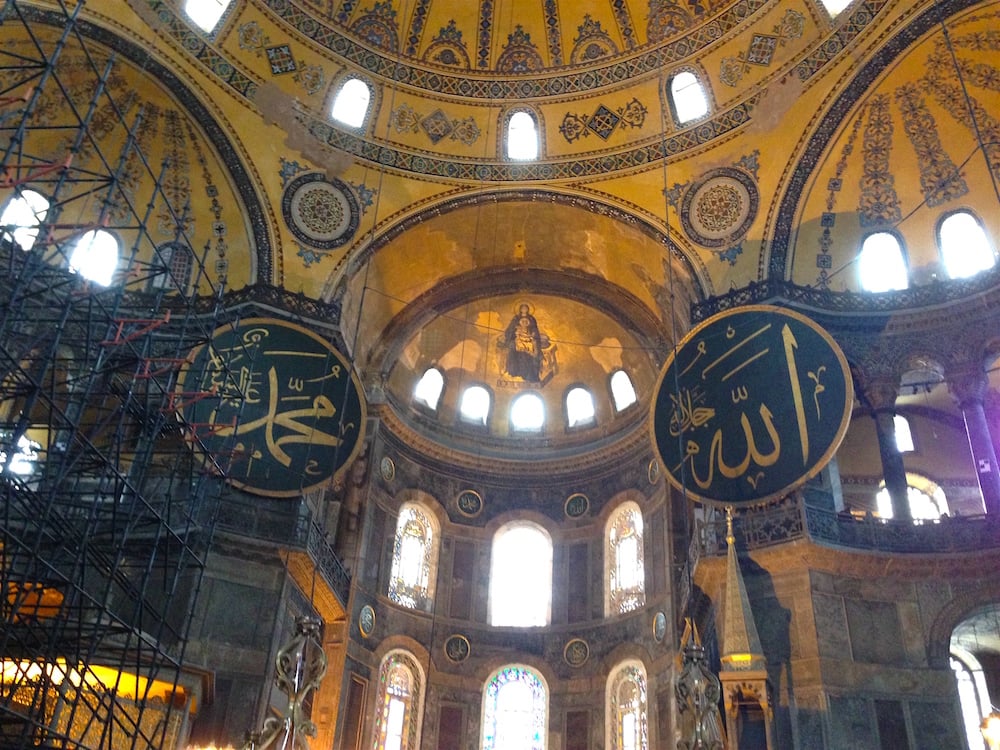
Hagia Sofia, the center of Greek Orthodox faith
Hagia Sophia in Istanbul remains the symbolic center of the Greek Orthodox faith even almost six centuries after its fall to the Ottomans and its conversion to a mosque. Every year it is visited by hundreds of thousands of Greeks.
From 537 to 1453, the “Great Church,” as the Byzantines called it, was the eastern heart of Christianity.
The massive temple held a total of twenty-three thousand worshipers, and 525 priests, deacons, and chanters served its liturgies.
The cathedral has its own unique, eerie spiritual sense which is felt by all who enter it and cannot be explained by any rules of architecture or engineering.
This architectural masterpiece took only six years to build, a remarkably short time for a work of such magnitude. The inauguration liturgy was conducted by Patriarch Minas on December 27, 537. The emperor was astonished when he entered the temple. He rose to the pulpit, lifted his hands to the sky, and exclaimed, “Thank You, God, for You have done this work with me. I beat you, Solomon.”
On May 29, 1453, after more than nine centuries of serving as the center of Christendom, the glory of Hagia Sophia ended along with the Byzantine Empire. Despite the brave efforts of the last Byzantine emperor, Constantine XI Palaiologos, who fought gallantly in defending Constantinople, the city fell into the hands of the Ottomans led by Sultan Mehmed II.
Despite the fact that Hagia Sophia was in disrepair, the Christian cathedral still made a strong impression on the new Ottoman rulers, and they decided to convert it into a mosque. Four minarets were added to the outside corners of the building.
Many changes occurred on the interior of the building, as well. All surviving mosaics and holy icons were covered with plaster or yellow paint with the exception of the Theotokos (the Virgin Mary, pictured with Jesus).
Hagia Sophia converted to a mosque yet again
Despite the ravages of time, Hagia Sophia remains universally acknowledged as one of the most beautiful buildings in the world. It was pronounced a UNESCO World Heritage Site in 1985.
In early July 2020, the Turkish Council of State annulled the Cabinet’s 1934 decision to establish the museum, revoking the monument’s status, and a subsequent decree by Turkish President Recep Tayyip Erdogan ordered the reclassification of Hagia Sophia to a mosque.
The 1934 decree was ruled to be unlawful under both Ottoman and Turkish law as Hagia Sophia’s waqf, endowed by Sultan Mehmed, had designated the site a mosque; proponents of the decision argued the Hagia Sophia was the personal property of the sultan.
This redesignation is controversial, invoking condemnation from the Turkish opposition, UNESCO, the World Council of Churches, and many international leaders.
See all the latest news from Greece and the world at Greekreporter.com. Contact our newsroom to report an update or send your story, photos and videos. Follow GR on Google News and subscribe here to our daily email!

