



Researchers have revealed the secrets of the long-forgotten ancient Assyrian capital of Dur-Sharrukin, located in modern-day Khorsabad, Iraq.
Dur-Sharrukin was believed to have been abandoned before it was ever completed. However, the most recent discovery dispels that belief, revealing that the ancient Assyrian capital had undergone much more development than previously thought. Dur-Sharrukin, which means “Fortress of Sargon,” was a major project for a new capital city begun by King Sargon II, who ruled the Assyrian empire from 721 BC until his demise in 705 BC.
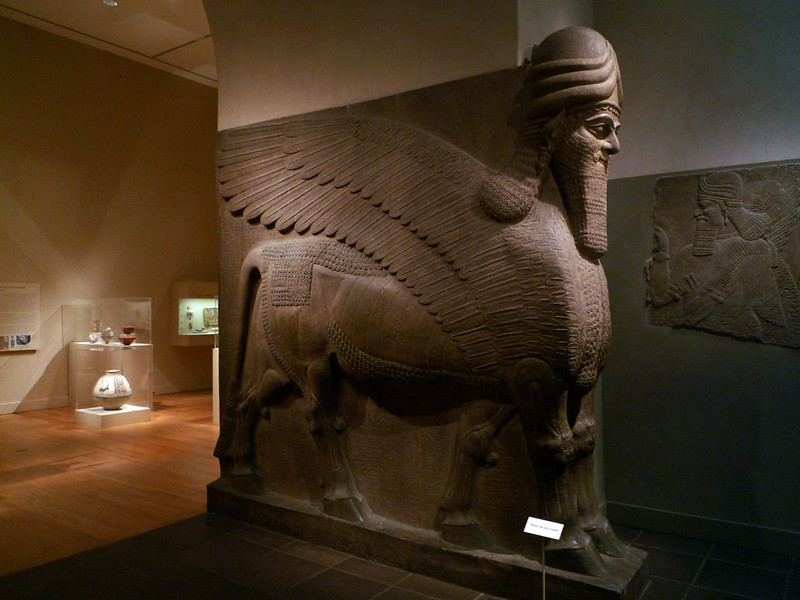
The ancient Assyrian capital of Dur-Sharrukin
King Sargon II had intended the city of Dur-Sharrukin to be the new capital of his empire. It was to be a grand symbol of the Assyrian empire, but the project was abandoned when King Sargon II was unexpectedly killed in battle. His son and successor, King Sennacherib, abandoned his father’s project and moved the capital city to Nineveh.
Once the capital was moved to Nineveh, Dur-Sharrukin faded away into history and remained forgotten. About 2,500 years later, in the 1800s, French archaeologists found the ancient Assyrian capital and got to work exploring it. Despite their best efforts, they came up empty-handed.
They found plenty of artifacts in King Sargon II’s palace but nothing outside of this. The French archaeologists determined that the ancient Assyrians had managed to build only the palace prior to King Sargon II’s untimely death and the move to Nineveh. In 2015, the Islamic State destroyed part of Khorsabad and the ancient capital, occupying it until 2017. When occupation ended, archaeologists made a plan to investigate Dur-Sharrukin.
In 2022, Jörg Fassbinder of Ludwig Maximilian University of Munich, Germany and a team of colleagues—from Near Eastern Archaeology, Panthéon Sorbonne University and the University of Strasbourg—mapped out about seven percent of the area using a magnetometer, a device that can identify characteristic magnetic properties in soil and rocks. Fassbinder says it is “like having an X-ray of features beneath the ground.”
So as to not draw attention to themselves, the experts held the devices by hand and walked them over the surface of the area they sought to investigate. What the Fassbinder-led team discovered turned everything that historians and scientists thought they knew about the city on its head.
Hidden beneath the surface, the team found an entire city. Multiple buildings, including a massive villa twice the size of the White House, were found just in the small area they combed with the magnetometers.
“Every day we discovered something new,” Fassbinder said. “When the data were visualized as grayscale images, ghostly outlines emerged of structures as deep as six to ten feet (two to three meters) below ground. The data revealed the location of the city’s water gate, possible palace gardens, and five enormous buildings, including a 127-room villa twice the size of the US White House. These and other discoveries are evidence that, at least for some time, Khorsabad was a living city.”
Fassbinder also pointed out that the discoveries were made without excavations, saving time and money for archaeologists who were unsure there was anything at all under the surface.
See all the latest news from Greece and the world at Greekreporter.com. Contact our newsroom to report an update or send your story, photos and videos. Follow GR on Google News and subscribe here to our daily email!

