



Recent excavations in a little known ancient Greek town west of Aigio in the Peloponnese have uncovered an ancient building and a wealth of gold antiquities that archaeologists believe were part of the town of Rypes, referenced by the ancient Greek geographer Pausanias.
Rypes was founded by Pelasgians, an ancient people mentioned in Greek historical and mythological traditions. They are considered one of the earliest inhabitants of the Aegean region and parts of the Greek mainland, appearing in ancient texts and legends as pre-Greek settlers who occupied the land before the arrival of the Hellenic tribes.
The seaside town was later inhabited by Ionians before it was destroyed and abandoned at around 30 BC by the Romans.
According to the Greek Ministry of Culture, archeologists discovered the floor of a public building underneath the rubble which was built before 300 BC, according to first estimates.
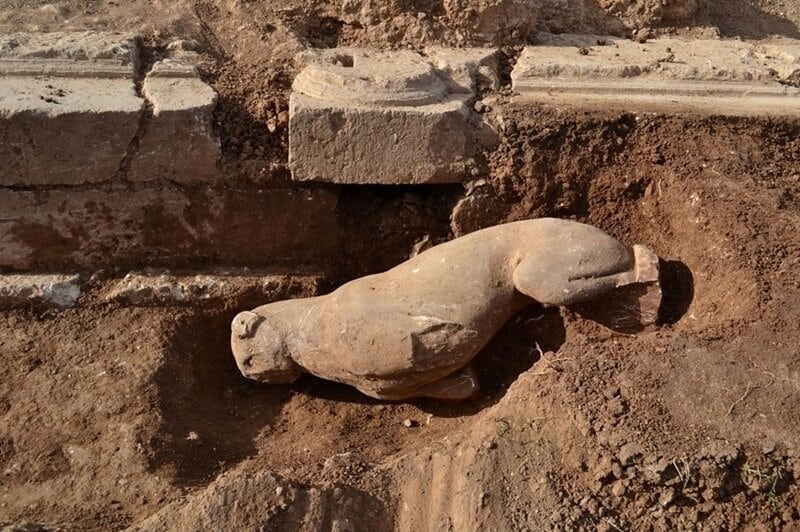
Corinthian columns and lion statues uncovered in ancient Greek town
A 16.80-meter-long base supporting a row of columns was also fully revealed together with pieces of Corinthian semi-columns that are being restored on the facade.
The diameter and the total height of the columns suggest they are of the Peloponnesian type, like those found in the temple of Apollo at Bassae. The excavation data so far reconstruct a monumental appearance of three meters in height.
Under the rubble that covered its facade, archaeologists discovered three marble lion statues in a crouching posture and a marble funerary stele of a youthful male figure. All the sculptures are carved in Pentelic marble. The lions were set in separate stone bases.
Inside the building and in a later phase of its use, intact burials in cist tombs and a sarcophagus were found and investigated, which yielded valuable offerings of particular artistic value.

Gold earrings and coins
Among others, a pair of gold earrings with lion heads on their tops, a solid earring of a naked winged love with a scepter in his right hand and a wreath in his left hand, a gold necklace with its ends ending in solid lion busts, a gold ring, a gold Persian coin, a charone obol, with a turtle on the obverse, two iron buttons surrounded by cloth and an iron stele.

The offerings in the tombs inside the building are witnesses to the prosperity and high social status of their occupants, the Greek Ministry of Culture says.
Excavations at the site will continue and archaeologists believe there is much more to be discovered about this obscure ancient town.
The town was close to Aigio, a city-state of ancient Achaea, and one of the twelve Achaean cities. The city stood between two promontories in the corner of a bay, which formed the best harbor in Achaea next to that of Patras.
See all the latest news from Greece and the world at Greekreporter.com. Contact our newsroom to report an update or send your story, photos and videos. Follow GR on Google News and subscribe here to our daily email!

